Key takeaways
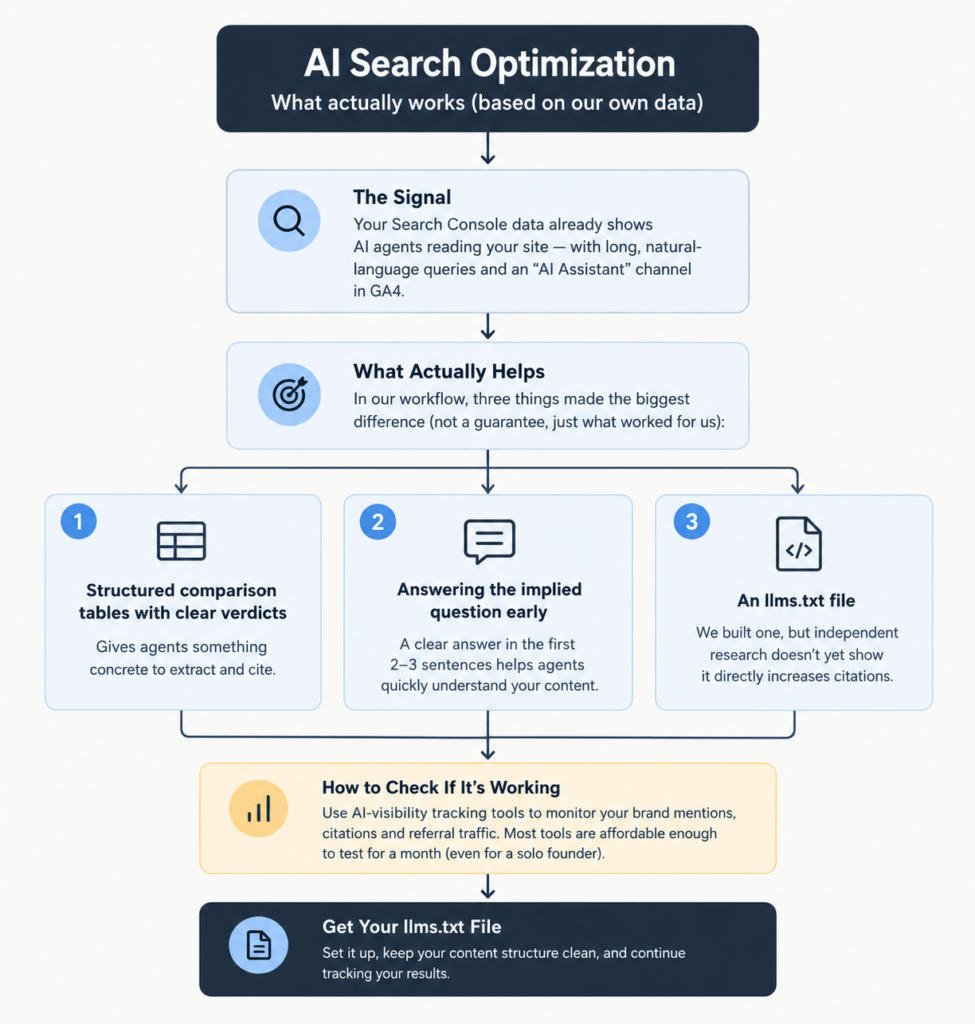
- Our Search Console data already shows long, natural-language query patterns consistent with AI agents before we made any changes for AI search.
- The changes we found most useful in our own workflow were structured comparison tables and answering questions in the first sentences of a section. Neither is a guaranteed citation lever; both just gave the agent something clean to extract.
- Independent large-scale testing (1,885 pages, Ahrefs) found that adding schema markup made no meaningful difference to AI citations on pages already being cited. A separate 137,000-domain study found that 97% of published llms.txt files receive zero traffic of any kind.
- AI search optimization and classic SEO are not competing systems. They run on the same content, checked differently.
- Most AI-visibility tracking tools are affordable enough for a solo founder to test for one month before committing.
Introduction
Before even starting to optimize anything, our Search Console data was already telling us something. An increasing number of queries landing on our pages weren’t keyword fragments. They were full questions, in the phrasing you might use to ask a colleague rather than a search engine. That’s a telltale sign that an AI system may be reading through your page to answer a human’s question.
What helped was not a dozen optimization techniques, but two patterns: putting comparisons in tables with clear verdicts, and answering the implied question in the first two or three sentences of each section. The other thing we did was build an llms.txt file. I’ll save explaining why that isn’t a cherry-picked reason to expect more citations, since the independent research on this particular optimization technique hasn’t yet shown a clear causal link. If your own operation is still running on ad hoc fixes rather than a repeatable structure, that’s usually a sign of deeper workflow infrastructure gaps, not an AI problem specifically.
What “AI search optimization” actually means
AI search optimization is about structuring content so AI agents and answer engines can extract, verify, and cite it, the way ChatGPT, Perplexity, or Google’s AI Overviews give a direct answer instead of sending someone to ten blue links. Classic SEO optimizes for ranking in a list a human scrolls through. AI search optimization optimizes for being the paragraph an agent lifts out and presents as the answer.
The proof: what we found in our own search data
Here is the case concerning our own data, not a particular client’s case study.
We started noticing that Search Console was reporting query strings that clearly weren’t typed in by a human. They were full questions containing comparison phrasing, multiple clauses, and other details. Basically, the kinds of things an agent might say to a user before directing them to a source for an answer. At the same time, we started seeing a different kind of referral traffic in GA4, coming from AI assistants and separate from both direct and organic search.
In practice, this means a page might be cited inside an answer that an AI assistant presents to a user, with or without credit, resulting in a single highly qualified visit rather than a browsing session. The visitor already has an answer from the AI, but they’ve come to our page to verify it for themselves.
We can’t say for sure whether this affects all search assistants the same way, so we encourage everyone to test their own data. What we saw in our own Search Console and GA4 data, and what changed for us after making specific tweaks to our content structure, is described in this article.
The things we found most useful in our own workflow
Structured comparison tables with clear verdicts. Agents can extract structured comparisons more easily than buried prose. A table with a clear “best for” label gives them something concrete to lift instead of forcing them to infer a verdict.
Answering the implied question immediately. Every section on this page, and every section we’ve rewritten since, answers the heading’s question in the first two or three sentences. This isn’t just a courtesy to skimming readers. It’s what practicing our own writing standard looks like when the reader is a machine instead of a person.
A working llms.txt file, with an honest caveat. We built one, and it’s a five-minute task worth doing. But we’re not going to claim it’s why anything got cited, because the best independent data available says otherwise. If you’re still curious, see how we built our own llms.txt file, just read the next section first so you know what it will and won’t do for you.
What didn’t matter as much as the hype suggests
Two tactics came back weaker than the hype around them, and one is a tactic we ourselves use.
FAQ schema and structured markup generally. Ahrefs tracked 1,885 pages that added JSON-LD schema between August 2025 and March 2026, matched against 4,000 control pages that didn’t, and measured citation changes across Google AI Overviews, Google AI Mode, and ChatGPT. Adding schema produced no meaningful citation lift on Google AI Mode or ChatGPT, and a small, statistically real but practically minor decline on Google AI Overviews that the researchers couldn’t clearly attribute to the schema itself. A separate real-time retrieval test cited in the same research found that none of five major AI systems, including ChatGPT and Claude, actually used JSON-LD schema when fetching a page live. They read the visible HTML and ignored the markup entirely. The takeaway: schema still has real uses for rich results and knowledge graphs, but adding FAQ schema purely to chase AI citations isn’t supported by the data.
What the data says about llms.txt
llms.txt as an AI-citation lever. This is the one that surprised us enough to change how we talk about our own CTA. Ahrefs analyzed server logs across 137,000 domains and found that 28% publish an llms.txt file, but 97% of those files receive zero requests of any kind, from anyone. Of the small remaining slice that does get read, only 19.5% of requests come from named AI tools, and the biggest single reader isn’t a search or citation bot at all, it’s Claude Code, an AI coding assistant, not something reading your site to cite it in an answer.
None of that means llms.txt is useless. It’s cheap, it may matter more as agentic browsing tools mature, and if your customers use coding agents to research vendors, there’s a plausible reason to have one. What it isn’t, based on the evidence we found, is a proven way to get cited more by ChatGPT or Perplexity today. We’re leaving our own file up, but we won’t claim it caused citations.
Pause and think: Before adding another AI search tactic, ask whether you’ve actually checked it against your own numbers. That gap between assumption and verification is a form of operational debt that compounds quietly over time.
How to actually check if it’s working
To measure whether this is working, you need to track when AI platforms mention or cite your site. We’ve used Otterly.ai directly; the other tool details below come from their pricing pages.
| Tool | Best for | Starting price (verified on vendor’s site) |
|---|---|---|
| Otterly.ai | Solo founders and small teams wanting the cheapest real entry point | $29/month (Lite plan, 15 prompts across 4 AI engines) |
| Peec AI | Small marketing teams wanting visibility plus sentiment metrics | Starter plan begins at 50 tracked prompts across 3 models; check peec.ai/pricing for the current monthly figure, since it wasn’t fully visible on our last check |
| Semrush AI Visibility Toolkit | Teams already paying for Semrush who want it as an add-on | $99/month per domain (Base plan, 25 tracked prompts, requires an existing Semrush account) |
| Ahrefs Brand Radar | Teams already on Ahrefs who want citation tracking bundled in | Starts from $199/month as a standalone add-on; also included in limited form on Ahrefs’ Lite plan ($129/month) and up |
| Profound | Enterprise teams; not built for solo or small-team budgets | No published self-serve price. Profound currently offers only a free 7-day trial and a custom-quoted Enterprise plan |
Pricing changes often, and Profound in particular appears to have dropped its self-serve tiers since earlier in 2026. Confirm current numbers directly on each provider’s site before you commit to anything.

Otterly.ai
OtterlyAI is an AI search monitoring and optimization platform that tracks how brands appear across ChatGPT, Google AI Overviews, Google AI Mode, Perplexity, Gemini, Claude and Microsoft Copilot. It measures mentions, citations, competitors, sentiment and AI search visibility so teams can identify where their brand is missing and optimize accordingly.

Peec AI
Peec AI is an AI search analytics platform that tracks how brands appear across ChatGPT, Google AI Overviews, Google AI Mode, Perplexity, Gemini and Microsoft Copilot. It measures visibility, position, sentiment, citations, competitors and AI referrals to help marketing teams build GEO strategies around real prompt-level data.
SEMrush
A comprehensive online visibility management platform that integrates traditional SEO with AI search tracking to help brands dominate both Google and LLM-driven discovery.
Ahrefs
Ahrefs is an all-in-one SEO platform that helps businesses improve search visibility through keyword research, backlink analysis, site audits, rank tracking, and competitor research. It is built for marketers, agencies, content teams, and businesses that want to grow organic traffic with reliable data.

Profound
Profound is an AI marketing platform for monitoring brand visibility across answer engines and optimizing content for AI search. It combines AI visibility tracking, citations, competitive analysis, AI agents, content workflows and AI-sourced traffic attribution.
The wrong way vs. the right way
WRONG                        RIGHT
--------------------------- ---------------------------
✗ Generic explainer →      ✓ Clear verdict upfront
✗ Default FAQ schema →     ✓ FAQ for rich results only
✗ llms.txt as proof →      ✓ llms.txt as housekeeping
✗ Separate AI project →    ✓ One pass, same as SEO
What AI search optimization actually looks like operationally
On Tuesday morning, a two-person content team reviews the previous week’s export from Search Console. They don’t check for keywords first. They sort by query strings of more than ten words, the kind of search phrase that reads like a sentence. Three queries of this type are relevant to the business, and the first paragraphs on the pages ranking for them are clearly answers to questions, not calls to action.
On the two pages with the best rankings, they find that neither opening paragraph beneath the relevant heading actually answers the question. They rewrite both introductions in under twenty minutes, without needing to research anything further. They simply resequence information already on the page.
They spend the next few minutes checking llms.txt as a default housekeeping exercise, not as an expected citation lever. The entire review takes under an hour and becomes part of the weekly content routine.
Treat AI search optimization as a structural habit, not a one-time project. The same discipline applies to how teams capture organizational knowledge instead of letting important processes disappear with the people who documented them.
A checklist you can run this week
- Pull your last 90 days of Search Console queries and filter for anything over ten words long
- Check whether the top three pages ranking for those long-tail queries answer their headline question in the first two to three sentences
- Add or fix one comparison table on your highest-traffic page, with a clear verdict per row
- If you have FAQ schema, audit it for entries that don’t match visible page content; don’t add more expecting a citation boost
- Build an llms.txt file if you want one, but log it as housekeeping, not a growth lever, and check your own bot logs before crediting it with anything
- Set a recurring monthly reminder to repeat this pass, not a one-time fix. This is the same discipline behind a proper AI workflow audit: checking what’s actually working instead of assuming last quarter’s setup still holds
Self-audit
Before you publish anything new, ask: if an AI agent read only the first three sentences of each section on this page, would it come away with the correct answer? If the honest answer is no, the structure needs work before the content does.
Faq
They’re overlapping terms for the same underlying shift. Generative engine optimization (GEO) and answer engine optimization (AEO) are largely used interchangeably with AI search optimization by different vendors. There’s no meaningful technical distinction yet, just different marketing labels for structuring content so AI systems can extract and cite it.
No. They run in parallel. Classic SEO gets your page found and ranked. AI search optimization determines whether an agent trusts your page enough to lift from it once it’s found.
Based on the largest independent test available, a 137,000-domain study, probably not on its own. Most published files are never read at all, and most of the traffic that does reach them comes from coding agents, auditing tools, and researchers rather than the AI search bots people are hoping to influence. It’s still a cheap file to have for other reasons; just don’t expect it to move your citation numbers by itself. If you want the mechanics of building one anyway, our llms.txt generator walks through it.
Your next move
Open your Search Console query report right now and find anything over 10 words long. That’s all. Ten minutes of your time, no new content required, and you’ll have an early signal of whether this is worth investing in over the next three months.
Businesses are starting to care more about two metrics: where a page ranks in Google and whether an AI system trusts a page enough to quote it. Which one is your team looking at?