Key takeaways
- AI operational debt accumulates from undocumented workflows, tool sprawl, and knowledge concentrated in one person
- Workflow drift causes automations to silently produce wrong outputs without any visible error
- Automation sprawl multiplies maintenance cost faster than it multiplies output
- Dependency risk means one API change or one person leaving can collapse multiple connected systems
- Most AI debt is a documentation and governance failure, not a technology failure
Introduction
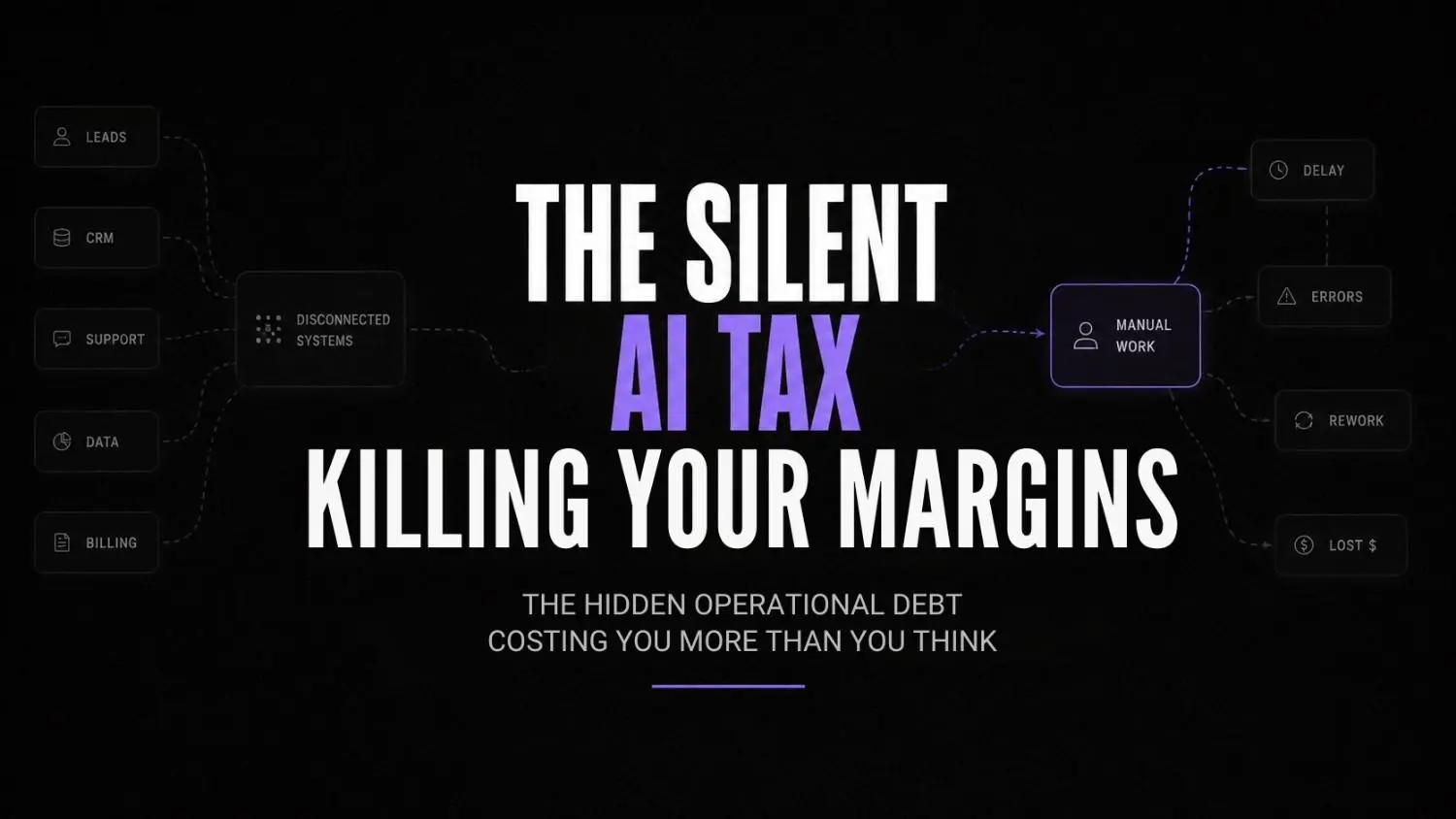
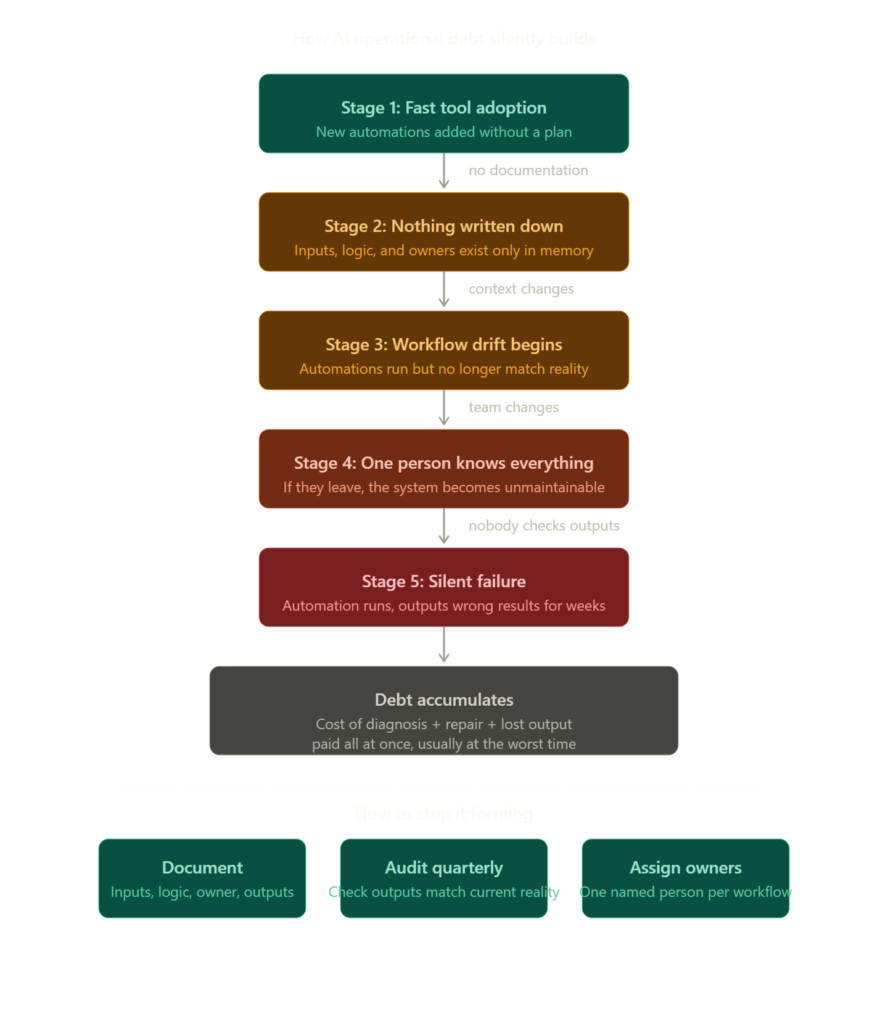
Most operations teams that adopted AI tools in the last two years are now sitting on debt they haven’t priced yet. Not financial debt. Operational debt. The slow accumulation of undocumented workflows, half-maintained automations, and processes that only two or three people understand but nobody has written down.
The first cracks usually show up in AI workflow handoffs, where work starts falling between people and automations. Over time, shadow operations fill the gaps, creating unofficial ways of getting work done that nobody owns.
According to McKinsey’s 2024 State of AI report, only 25 percent of organisations that have deployed AI workflows have formal processes for maintaining them. That gap is where AI operational debt forms.
AI operational debt means the total accumulated cost of running AI systems that were set up without clear ownership, maintenance plans, or documentation. Think of it like a rental property that nobody maintains. It functions for a while. Then small problems compound into expensive ones.
Many operational problems begin long before maintenance, often during the initial workflow infrastructure design phase. And unlike software debt, which usually surfaces in a code review, operational debt tends to surface at the worst possible moment: when a client escalates, when a key person leaves, or when a workflow silently starts producing wrong outputs for weeks before anyone notices.
The hidden cost of AI operational debt
Most teams only count what they can see. Subscription fees. Build time. Onboarding hours. But operational debt charges you differently.
It charges you in diagnostic time when something breaks and nobody knows why. In re-work when a workflow has been producing wrong outputs for weeks. In lost trust when a client-facing process quietly fails and a human catches it before your system does.
There is also the compounding effect. A workflow that drifts for six months is not a six-month problem. It is six months of wrong data, wrong routing, and wrong decisions built on top of each other. Fixing the automation takes a day. Fixing everything the automation corrupted takes much longer.
Most teams could catch these problems earlier with a simple AI workflow audit. Ignore them for long enough, and they often turn into failed AI adoption, even when the technology itself was never the real issue.
And the cost nobody talks about: the opportunity cost of the person reverse-engineering a system they did not build, instead of building something new.
Why AI debt forms faster than software debt
Software debt is something most technical teams understand. You cut corners to ship faster, and eventually you pay it back through refactoring. There’s a concept for it, a budget for it, and a team responsible for it.
AI operational debt has none of that yet.
With software, a broken function usually throws an error you can see. With an AI workflow, a broken step usually returns something. Just the wrong something. And if nobody is checking outputs against expected results, the problem compounds silently for weeks.
An automation (a process that runs on its own without human input each time) that scores incoming leads and routes them to the wrong sales stage doesn’t crash. It quietly misdirects work until someone notices the numbers are off. By then the root cause is buried three layers deep.
Tool sprawl (using more tools than your team can realistically manage or document) is often the first signal that operational debt is forming. Each new tool added without documentation or a clear owner adds to the total debt load. Regular stack audits (a structured review of every tool your business is currently running) help identify redundant automations before they become expensive liabilities.
What I’ve noticed working with businesses is that the teams with the most AI debt are rarely the ones that moved slowly. They’re the ones that moved fast without writing anything down.
Workflow drift: When automations stop doing what you think
Workflow drift means an automation was built for a specific situation, that situation changed, and nobody updated the automation. The process keeps running. It just no longer matches reality.
A common example: a content approval workflow built for a four-person team gets inherited by a twelve-person team. The routing logic (the rules that decide who gets notified and when) was never updated. Senior editors still get pinged for tasks they delegated eighteen months ago. Junior writers wait on approvals that go to a role that no longer exists.
Nobody built this wrong. It drifted.
Workflow drift is one of the biggest reasons maintenance costs continue increasing after launch. Because drift doesn’t announce itself. There’s no error notification. The workflow completes. It just completes incorrectly.
Pause and think: Pick one automation your team runs that was set up more than six months ago. When did you last check that what it produces still matches what your process actually needs today?
For most teams the honest answer is: never.
Automation sprawl: More tools, more things that can break
Automation sprawl means your team has adopted tools faster than it can document or govern them. Each tool solves one problem. But every tool is also a dependency (something your workflow relies on), a maintenance obligation, and a potential point of failure.
According to the Salesforce State of IT report, nearly 70 percent of IT and operations leaders say managing integrations between tools has become significantly more complex over the last two years. The tools aren’t the problem. The unmanaged connections between them are.
Every automation you add creates a recurring maintenance cost. Most teams treat automation as a one-time build. It isn’t. It’s an ongoing obligation that grows with every new tool added to the stack.
Failed adoption creates hidden debt
Not all operational debt comes from broken systems. Some of it comes from abandoned ones.
A team requests a tool, someone builds the workflow around it, and then adoption quietly stalls. The tool sits connected, running partial processes, consuming API calls (requests your system sends to an external service to get or send data), and producing outputs nobody is reading.
Abandoned workflows often leave behind hidden operational debt that nobody accounts for. The build cost was paid. The maintenance cost keeps running. And many scaling failures are actually symptoms of this accumulated operational debt sitting underneath a system that looks functional on the surface.
Knowledge concentration: The one-person dependency problem
Knowledge concentration means one person understands how an AI workflow actually functions, and that understanding exists only in their head.
Someone builds a set of automations across three platforms. They know the logic, the exceptions, and the workarounds. It works well. Then they leave, or get pulled onto something else. Suddenly nobody can maintain, modify, or even explain what’s running.
Self-audit: Check your knowledge concentration right now
- Can someone other than the builder explain what each workflow does?
- Is there written documentation for the inputs, logic, and expected outputs?
- If your most technical person left tomorrow, which workflows would break within 30 days?
- Are login credentials and access permissions stored somewhere the whole team can reach securely?
- Does anyone review automation outputs regularly, or only when something visibly breaks?
More than two “no” answers means you have concentrated knowledge risk sitting inside your operations today.
Dependency risk: When one change breaks everything downstream
Dependency risk is the exposure created when multiple workflows rely on the same tool, API (a connection point that lets two software systems talk to each other), or data source. Change one thing, and the effects cascade.
Most AI workflows are chains. Data comes in from one source, gets processed, gets transformed, then gets pushed somewhere else. Every link in that chain is a dependency. When a platform updates its output format, or a third-party tool changes its pricing tier and you downgrade, the automations depending on them don’t fail loudly. They fail quietly in the middle of the chain.
Consolidation can reduce dependency risk when workflow complexity becomes difficult to manage. Fewer tools with clearer ownership means fewer silent failure points.
Wrong approach vs right approach
| Wrong approach | Right approach |
|---|---|
| Build automations assuming tools stay the same | Document every tool dependency and its current plan tier |
| One person manages the entire workflow stack | Two people understand and can explain each workflow |
| No output monitoring in place | Scheduled output checks against expected results |
| Tools added reactively with no central log | Central tool registry with owner, purpose, and review date |
| Automations treated as one-time builds | Quarterly workflow audits built into operations calendar |
| Knowledge lives in Slack threads and memory | Each workflow has a written brief covering inputs, logic, outputs, and failure state |
How to prevent operational debt from forming
The fix is not a better tool. It is a simple operating habit applied consistently.
Every automation your business runs needs four things documented before it goes live: what triggers it, what it does, what a correct output looks like, and who owns it. That is a fifteen-minute task that eliminates most future debt.
That’s why AI workflow maintenance needs to be part of the routine, not something you think about after things break. It also makes it much easier to avoid organizational knowledge loss when key people leave or responsibilities change.
Beyond documentation, two habits matter more than anything else. First, assign one named person as owner of each workflow, not a team, one person. Second, build a quarterly review into your calendar where every active automation gets checked against current reality.
Debt does not form because teams are careless. It forms because there is always something more urgent than maintenance. Scheduling the review in advance removes that excuse.
What AI operational debt actually looks like on a Tuesday morning
It’s 9am. Your operations lead opens the CRM and notices that the lead scoring automation hasn’t been routing enterprise leads correctly for three weeks.
Portkey (a control layer that sits in front of your AI model calls to manage routing, monitoring, and cost) flagged increased errors two weeks ago. But nobody was watching the dashboard because the person who set it up left last month.

Portkey
Portkey is an AI Gateway and control plane designed for production AI applications. It helps teams manage model routing, observability, prompt management, guardrails, and reliability across multiple AI providers from a single platform. Built for developers and enterprises, Portkey simplifies operating AI systems at scale
The n8n workflow (an open-source tool that connects your apps and data into multi-step automated processes) is still running. Completing every task. Just completing them based on a scoring prompt that was never updated after the target customer profile changed.

n8n
n8n is a workflow automation platform built for technical teams that need more flexibility than traditional no-code tools. It supports self-hosting advanced logic AI integrations and custom workflows while giving developers full control over automation infrastructure.
Stage 1: Finding where the debt lives
You check the Workato logs. Workato is an enterprise workflow management platform that keeps a full audit trail of what ran, when, and what it returned. The logs show the workflow completed 847 times in three weeks. No errors. Just wrong outputs.
Workato
Workato is an enterprise automation and AI orchestration platform that helps organizations connect apps, data, APIs, and business processes. Its AI capabilities enable teams to build, deploy, and govern enterprise-grade AI agents that can securely take actions across business systems.
Stage 2: Tracing the logic
The scoring logic lives inside a LangGraph agent. LangGraph is a framework for building AI agents where each decision step is a visible, editable node. Smart build originally. But nobody documented the decision logic, so now you’re reverse-engineering a live system.
LangGraph
LangGraph is an open-source agent orchestration framework from LangChain designed for building stateful AI agents. It enables developers to create customizable workflows with memory, human-in-the-loop controls, and multi-agent architectures.
Stage 3: Adding a check layer
You bring in CrewAI (a multi-agent framework that lets different AI agents check each other’s work before outputs get pushed anywhere) to add a second-pass review step. A reviewer agent now checks the scorer’s output before anything reaches the CRM.
The whole incident took four hours to diagnose and two days to fix. The debt had been building for eight months.

CrewAI
CrewAI is a platform for creating collaborative AI agents and agentic workflows. It helps teams design, deploy, monitor, and scale AI workflows while maintaining enterprise control and governance.
FAQs
It’s the cost you pay for running AI workflows without proper documentation, ownership, or maintenance. Like a building nobody inspects. It works for a while, then small problems become expensive ones.
Technical debt usually produces visible errors. AI operational debt is silent. The automation keeps running. It just quietly produces wrong outputs or routes tasks incorrectly without alerting anyone.
If you have automations running that nobody has reviewed in six months, you almost certainly have it. If only one person understands how your workflows function, that’s debt. If tools were added without documentation, that’s debt.
No. Solo founders often carry more concentrated debt because there’s nobody else to catch problems. The person who built the workflow is also supposed to be watching it. When they get busy, nothing gets watched.
List every active automation your business is running. Write one line for each: what it does, who owns it, and when it was last reviewed. That list alone will show you exactly where your debt is concentrated.
Conclusion
The businesses that built AI workflows fast in 2023 and 2024 are starting to feel the maintenance cost now. The tools have matured. The workflows have drifted. The people who built them have moved on. And most of those businesses still don’t have a documentation framework, an audit process, or an ownership model for any of it.
What’s coming is an operational reckoning. Not for the businesses that moved slowly, but for the ones that moved fast without building the governance layer underneath. The competitive advantage won’t go to whoever has the most automations running. It’ll go to whoever actually knows what their automations are doing.
The question worth sitting with is this: if your most critical workflow broke silently tomorrow, how long would it take your team to notice?
Your next move
Open a blank document right now and list every AI workflow or automation your business is currently running. For each one write down: who owns it, when it was last reviewed, and whether documentation exists anywhere. That audit takes ten minutes and will show you exactly where your operational debt is sitting before it surfaces on its own.