Key takeaways
- AI tools are not useful without the fundamental understanding of the underlying workflow.
- Digital workers perform processes, and not a particular software’s set of functions.
- The operations which create bottlenecks should be prioritized and designed in a system, not subscribed to separately.
- Automated processes’ introduction should be delayed until essential core functions’ costly early hiring is justified.
You cannot scale a business through brute force. Every operator has an upper limit of personal time and effort they can dedicate to a business before seeing diminishing financial returns. Paying thousands of dollars per month to contractors does not cure this limitation it only shifts the responsibility to a different type of debt. The SMB Group’s 2023 survey found that 64% of small businesses identified a lack of time and resources as the primary constraint on growth.
Delegation of responsibilities to software is a logical step, but building an array of standalone tools produces operational debt. To truly scale beyond one’s means, one needs to rethink the relationship with technology and change from buying software products into employing AI employees. An AI employee is not a B2B product; he is a specialist in a certain area, capable of owning an end-to-end workflow. A solo founder should delegate tasks to AI employees treating them as human ones but with a much more specific set of responsibilities.
In my experience consulting businesses, the real problem isn’t adopting AI tools. It’s adopting them without redesigning the workflow first.The software simply exposes the workflows the business was never able to execute consistently.
| Capability | Traditional B2B SaaS | Autonomous AI Employee |
| Operational Role | Some kind of digital utility that requires a constant stream of human input. | An agent which functions in isolation and knows one particular process. |
| Execution Trigger | Sits around waiting for you to come tell it to do what it needs to do. | Watch all of your data streams and react on it’s own. |
| Business Output | Give you raw data and alerts, along with filled out fields. | Completed tasks, drafted replies, and finished research. |
| Founder’s Job | It’s up to you to control the software and do the work. | It’s up to you to check over the process and accept the outcome. |
Rethinking software as digital team members
When a client tells me they’re overwhelmed, they usually mean that they have to juggle too many browser tabs on a daily basis. Let’s look at this problem in a different light. It’s not about the number of tabs. It’s about the fact that your founder is essentially an API between them.
Forget features. Instead of searching for the best AI tools for solo founders, start by asking which part of your work you’re ready to hand off completely. By clearly stating the responsibilities, you relieve yourself of the need to perform them. Some teams discover this too late, having burned tens of thousands of dollars on failed AI projects.
Pause and think: Are you looking for a tool that will help you work faster, or are you looking for a system that will do some work for you?
Before adding any more tools to your tech stack, take a close look at your current set of bottlenecks and build the necessary infrastructure for an AI workflow.
Mini checklist for self-audit
- Is this a task that only someone with your industry-specific knowledge can perform?
- Does it involve working with consistently structured data sets?
- Can the result of the process be reviewed within two minutes?
- Do you currently perform this set of actions more than three times a week?
Founder as the Bottleneck (Sequential Workflow) Inbound Lead
│
▼
👤 Founder Does Everything
│
┌──────────────┼──────────────┐
▼ ▼ ▼
Lead Research Write Email Review Proposal
│ │ │
└──────────────┼──────────────┘
│
▼
Publish / Send
│
▼
✅ Task Complete
Founder Time: 80+ Minutes
AI-Powered Parallel Workflow
Inbound Lead
│
▼
⚡ Automation Trigger (Relay.app)
│
┌──────────────┼──────────────┐
▼ ▼ ▼
AI Research AI Proposal AI SDR
(Exa) (Dock) (11x)
│ │ │
└──────────────┼──────────────┘
│
▼
Unified Dashboard & Outputs
│
▼
👤 Founder Reviews Only
│
▼
Approve & Launch
Founder Time: ~5 MinutesOnce you map the bottleneck, you can start hiring your digital team.
Automating market intelligence to prevent the empty pipeline trap
Looking for new opportunities involves a colossal amount of research and context acquisition. While traditional AI research tools summarize search results, the best AI research tools go deeper by uncovering market signals and high-intent prospects from across the web.
AI Market Intelligence Analyst (Exa)
Exa is an analyst that understands the context of natural language search queries. Instead of keywords, it is possible to use semantically rich queries to find relevant companies and content.

Exa
Exa is an AI-native search engine and web search API built for developers, AI agents, and businesses. It delivers high-quality real-time web results, structured data, and webpage content optimized for LLMs, making it ideal for research, retrieval, and AI applications.
Author opinion: I like how Exa tackles SEO spam; it dramatically reduces the time spent sifting through irrelevant results. Being able to find a list of companies that match a particular request within five minutes is a significant time-saver compared to traditional manual prospecting.
Cost of deployment: Free tier available; production API access scales at roughly $7 per 1,000 requests.
AI Sales Development Representative (11x)
Alice by 11x is an autonomous SDR that can research prospects, create personalized outreach emails, and track buying signals on various websites.
Alice by 11x
Alice by 11x is an AI-powered outbound sales agent built to automate prospecting, lead research, personalized outreach, and meeting booking. Designed for revenue teams, it works continuously to generate qualified pipeline without the manual effort of a traditional SDR.
Author opinion: In this use case, the value of the tool is found in its speed. It is necessary to invest time in selecting the right prospects because otherwise, Alice will waste time and money chasing poor-quality leads at a frightening pace.
Cost of deployment: Custom enterprise pricing; expect full outbound deployments to start north of $4,000 per month.
However, getting leads is only half the battle; the other half is following up with them correctly. If an organization fails to maintain proper operations, its prospects will be lost due to the sheer volume of communication.
Deploying an AI proposal specialist to stop killing deal momentum
Closing deals requires momentum; if a prospect agrees to schedule a discovery call, it is next to impossible to get them to review a proposal three days later. Connecting your proposals to an AI CRM for consultants keeps your sales pipeline updated automatically, so you don’t have to enter everything by hand.
AI Proposal Specialist (Dock)
Dock is a sales operations tool that can build dynamic playbooks and track when a prospect has visited a particular page with a custom link.

Dock
Dock is a client collaboration platform that helps sales, customer success, and revenue teams create branded digital workspaces for buyers. Teams use Dock to share proposals, onboarding plans, documents, mutual action plans, and track buyer engagement throughout the sales cycle.
Author opinion: I was impressed with the design and the user interface. It removes many barriers that would slow down the process of creating case studies, onboarding, and other aspects of individual deal management. Everything is brought together in one place with a single click of a button.
Cost of deployment: Free for solo operators; scaling startup deployment starts at $350 per month.
Once the deal is closed, the real work can begin. It is now necessary to organize individual operations to ensure that the fulfillment process is appropriate for the client.
Hiring an AI operations coordinator to escape the middle-office grind
The middle of the business is where solo operators get swallowed up. It’s the drudgery of the data moving from one place to another, the reminders, and the meetings that require follow-ups. According to a McKinsey report in 2023, up to 30 percent of all hours worked in the U.S. economy could become automated by 2030.
AI Operations Coordinator (Relay.app)
Relay helps you automate the operations without breaking your strategic processes. It has advanced beyond the usual automation tools by introducing tasks that require human approval to continue.

Relay.app
Relay.app is an AI-native workflow automation platform built for teams that want to automate repetitive processes without losing control. It combines visual workflows, AI actions, and human approval steps, making it especially useful for operations, agencies, and growing startups.
Author opinion: The ability to add tasks that require a human to approve is a game-changer. It means I can get the speed of automation while still retaining control over critical processes such as relaying emails to clients.
Cost of deployment: Free tier available; professional automation plans start at $19 per month.
AI Meeting Strategist (Granola)
Granola attends all your meetings and reminds you of the critical decisions you need to make over the conversation. It summarizes your 45-minute discovery calls into actionable next steps based on your preferred frameworks.

Granola AI
Granola AI is a smart meeting notes tool that combines your manual notes with AI-powered transcription. It enhances what you write instead of replacing it, making it ideal for people who want control with AI assistance. The key benefit is cleaner, structured notes without losing context.
Author opinion: Using granola has been more practical than other such tools because of how non-intrusive the automation is. The amount of time I’ve saved by having next steps automatically extracted from meetings has helped me reclaim at least an hour daily.
Cost of deployment: Free base tier; power-user access runs $10 per month.
Doing the work is important, but being able to retain the knowledge of how the work got done is arguably more critical.
Building an AI knowledge manager to stop answering the same questions
Once a deal is closed, providing consistent service to a client requires access to information. Setting up an automated customer support AI workflow keeps important operational knowledge out of your head and inside your business, reducing one of the biggest single points of failure.
AI Knowledge Manager (Eesel AI)
Eesel connects to your Google Drive, Notion, and Slack, acting as an information manager that can immediately answer questions based on your company’s internal documentation.

eesel
eesel helps businesses build AI teammates that learn from internal documentation and work across existing tools. Instead of traditional chatbots, eesel focuses on AI agents that assist customer support, internal operations, and employee workflows using company knowledge.
Author opinion: The Slack-integration is particularly useful, as instead of searching through folders, one can simply ask Eesel to find the specific SOW or other template-related document.
Cost of deployment: Base paid deployment starts at $19 per month.
AI Customer Success Manager (Pylon)
Pylon monitors customer health and support desk activity from within Slack or Microsoft Teams, tracking response time metrics and identifying at-risk accounts that require extra attention.

Pylon
Pylon is an AI-powered customer support platform built for B2B companies. It centralizes customer conversations from Slack, Microsoft Teams, email, and in-app chat while using AI to automate ticket management, answer repetitive questions, and improve support efficiency. It is designed for startups and growing SaaS teams that want to deliver fast, personalized support.
Author opinion: Pylon is useful in that it provides a much-needed layer of B2B support without having to sift through internal conversations.
Cost of deployment: Custom enterprise pricing based on B2B support volume.
What thinking-first actually looks like operationally
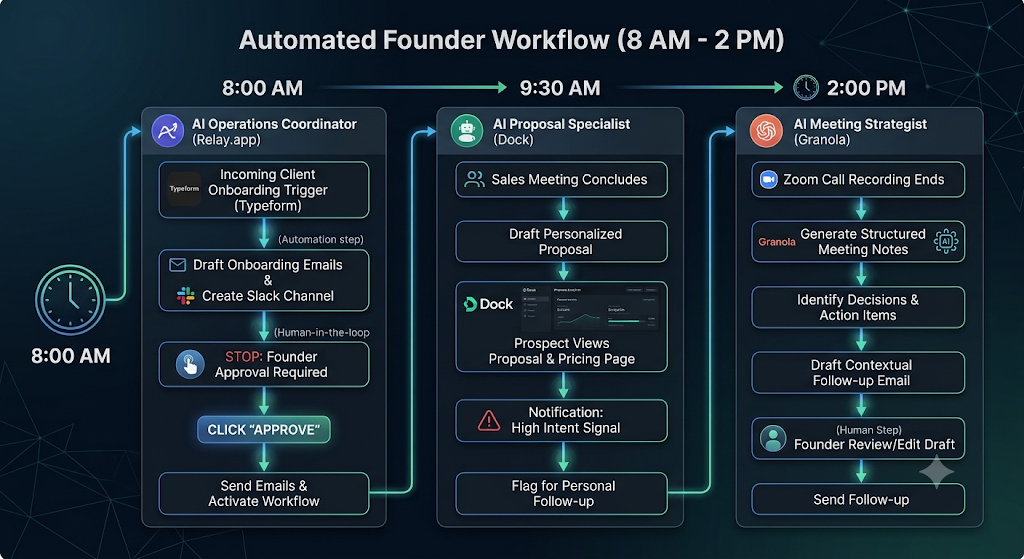
Adopting AI employees for solo founders fundamentally changes your Tuesday. You transition from an executor to a reviewer.
At 8:00 AM, you check Relay.app to approve 3 client onboarding processes automatically submitted overnight. You approve the emails generated by Granola and hit send.
At 9:30 AM, you open Dock to find out that one prospect lingered on our pricing page for 4 minutes. With this information, you can send a more personalized follow-up email.
At 2:00 PM, you conclude a discovery session via Zoom. Granola has prepared the talking points and a follow-up email. It took you 2 minutes to review the latter instead of 20 minutes of drafting.
And just like that, you have executed the workload of three people before midday.
The wrong approach vs. the right approach
Most founders try to think of workflow mapping backwards. Wrong! It is better to make your business fit around the tool, not the other way around.
| The Wrong Approach | The Right Approach |
| Buying tools because they went viral on social media. | Mapping the exact process that is currently an impediment first. |
| Automating a vague, disorganized process. | Fixing the process before automating it |
| Having more than ten separate software subscriptions with no unifying thread. | Giving a digital worker a specific business outcome to achieve. |
| Letting the tool dictate how the work gets done. | Configuring the tool to do your own specific thing. |
FAQs
You have to design the workflows in a way that they always require a human approval. Tools like Relay allow to review the outgoing message before sending it, so that the AI drafts it but you approve it.
No, because the tools mentioned do not require operational logic, but rather require you to be able to draw the architecture of the processes in a flowchart. If you can draw how something works, you can configure it in these tools.
They do not come for free, but instead you have to measure the value of having a human employee versus the cost of the tool. Paying 200$ a month for a tool is significantly cheaper than having to pay someone a significant hourly rate.
You have to look at your calendar and see what is the repeating task you dislike doing the most. Whatever that is, it should be automated first.
They will suspect that you are not doing it yourself, but if you do everything right, their only conclusion can be that you are a really efficient contractor. The point is to not fool them, but to perform on a level that is hard to reach without automation.
Conclusion
We are witnessing a transition from software as a utility to software as a co-worker. In the not too distant future, the most successful solo founders will start to think and act like media companies or hedge funds. They will leverage hyper-specialized AI employees for solo founders to offload day-to-day operations, enabling them to focus on higher-level strategy and relationship-building.
Rushing to produce more is not equivalent to executing better. The value of systems and execution is far greater than the marginal gains from additional tools. Consider: are there not aspects of your own productivity challenges that you are not fully grasping?
Your next move
Grab a sheet of paper and jot down the three tasks that consumed the most time for you yesterday. Focus on the most repetitive one among them and dedicate the next ten minutes to researching one of the previously mentioned tools that could potentially automate this task entirely.