Founders are burning six months of runway building products that solve non-existent problems. Building fast is great but building the right thing matters more. In fact, according to this 2024 CB Insights analysis on startup failure reasons, 42 percent of businesses fail due to lack of market need for their product or service
This is why we’re talking about product validation this AI Workflow Failure Week. You do not have a speed issue, you have a validation issue and using generic prompts in a chat window will not help you.
Using the right AI research tools for founders can make all the difference between a three week long Google rabbit hole and a weekend sprint. Finding out what’s already annoying customers before building yet another solution to a non-existent problem.
The core validation data fast readers need to remember
- Idea validation takes 70 percent less time when using specific questions and search focused models
- General chat TTS interfaces break down when trying to assess market size or understand the competitive landscape
- Software workflow design principles govern the effectiveness of any early-stage product discovery
- Customer complaint mining produces better conversion rates than generic idea generation prompts
The hidden cost of manual validation and broken systems
What I’ve observed while working with dozens of companies is that founders are prone to mistake motion for progress. They waste tens of hours chasing conversations on Reddit and building out disorganized Excel sheets. It creates the illusion of progress but in reality, it’s just operational friction.
I spoke to a founder last Thursday who spent 40 hours reverse-engineering competitor pricing ranges. They were emotionally drained, whereas a simple extract function would have completed the task in twelve minutes while allowing the founder to focus on sales.
We must think of AI not as an oracle but as an operational improvement. We discussed this at length in our post about the Best AI Tools for Solo Founders in 2026 so let me reiterate the key point here: faster production of execution does not equal better execution.
Bypass this crucial step and you’re destined for Failed AI Adoption
Pause and think: what feature you’re building next: is it something users clamoring for or something that seemed simple on your roadmap? Let’s revisit this issue from another angle by looking at the right stack to resolve it.
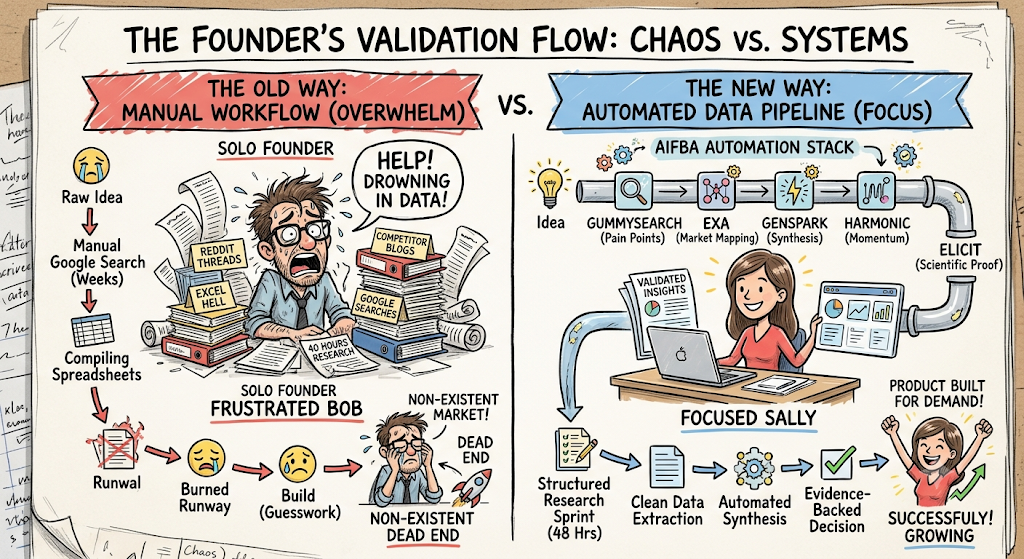
A clear workflow dictates how these tools actually function
The problem with blindly adopting tools is that there is no clear process that tells you how these tools fit together to produce value. You need a system where you answer specific validation questions at set points.
If you already have an unhealthy number of subscriptions you don’t use, you need to start with the AI Stack Audit: How to Cut Your Number of Unused Tools by Half in 30 Minutes and start cleaning up your existing stack before adding more tools. That way you can build out your own AI workflow infrastructure smartly instead of randomly adding tools until everything becomes a tangled mass of bills with no clear system.
Here is exactly what that stack should look like.
Exa handles early market discovery and competitor mapping
You need to know who already dominates the space. Searching Google will get you landing pages that are heavily optimized.
Exa is made for this specific task. Instead of working with keywords, try searching the web via semantic similarity. You could ask Exa to find you companies that offer a particular service and it would present a neat list of relevant organizations.

Exa
Exa is an AI-native search engine and web search API built for developers, AI agents, and businesses. It delivers high-quality real-time web results, structured data, and webpage content optimized for LLMs, making it ideal for research, retrieval, and AI applications.
My thoughts: This tool helps you identify competitors at a speed that no human could match. It cuts out all the noise and gets straight to the point, giving you a list of URLs and relevant entities extracted for your convenience.
GummySearch extracts customer pain points from raw forums
Do not ask an AI what people want to buy. Ask them what they complain about.
GummySearch sorts Reddit forums by the kind of audience they have. You could use it to discover what kind of solutions do people look for when posting in a particular sub. You could also find what problems and inconveniences do they report.
GummySearch
GummySearch is a Reddit audience research platform that helps founders, marketers, product teams, and creators uncover customer pain points, trends, and business opportunities. It simplifies Reddit research by surfacing meaningful conversations without requiring manual searching.
My thoughts: The interface is exceptionally intuitive, making it perfect for product founders. In some cases, it could even substitute primary user research if all you needed was to identify a general pain point.
Genspark synthesizes complex concepts into a single brief
When you need to understand an entirely new space, reading ten articles is a waste of time.
Genspark has a summarization feature that lets you create a custom page out of multiple sources. It works as an AI research assistant, collating information you find interesting. Then, it compiles it into a single document, akin to an analytical report.
Genspark
Genspark is an AI workspace built around autonomous agents that can research, create content, analyze data, build slides, write code, make calls, and handle multi-step workflows. Its Super Agent can coordinate different models and tools so you can describe the outcome instead of manually chaining AI tools.
My thoughts: It is extremely convenient and arguably faster than skimming through several articles. Genspark summarization feature looks professional and could be used to brief executives on a particular topic.
Harmonic tracks startup ecosystem intelligence and momentum
There are various reasons why someone might need to know if someone has just raised ten million dollars to build his idea.
Harmonic tracks funding, headcount, and other data on startups, letting you query the startup ecosystem and understand who is scaling and who is not. I think it can help in determining the most appropriate time to enter the market based on specific goals. Instead of reading various articles about other companies and their progress, one can use this tool to get precise data about competitors’ status.

Harmonic
Harmonic is an AI-driven company intelligence platform that helps investors, venture capital firms, sales teams, recruiters, and enterprises discover startups, monitor private companies, and identify emerging market opportunities. Its proprietary AI continuously maps the startup ecosystem using data from millions of companies and people.
Elicit verifies your assumptions against scientific evidence
In a situation where one is designing a health, productivity, or technical SaaS application, it is important to prove that the proposed solution works.
Elicit’s tool goes through thousands of academic articles to pull out claims and sorts this information into tables. I think it could help people back their ideas better.
Elicit
Elicit is an AI research assistant developed by Ought that helps researchers, students, analysts, and professionals automate literature reviews and evidence synthesis. It searches scientific papers, summarizes findings, extracts key information, and answers research questions using academic sources.
According to research published by the American Psychological Association in 2023, evidence-based approaches help build stakeholder confidence by up to 60 percent, making this tool relevant in convincing shareholders and other stakeholders to invest in a project.
All these tools are great, but one also needs a plan for executing the proposed solution.
What a thinking-first approach actually looks like operationally
Let’s talk about an actual scenario. It’s Tuesday, 9 AM, and you’ve had an idea for a tool that allows agencies to track client deliverables.
Instead of opening Figma and designing a dashboard, you open GummySearch. It takes twenty minutes to pull complaints from agency-related subreddits. At 9:30 AM, with the help of Exa, you identify the top ten most popular niche tools agency owners currently use. You extract their pricing pages to analyze value propositions.
At 10 AM, you throw those competitors’ websites into Genspark to utilize its summarization tool and get their weakest link. At this point, you’ve identified a gap in the market without writing a single line of code. You’ve got a viable solution with a decent amount of pre-thought validation.
Your AI Workflow Maintenance is nearly non-existent at this point because you didn’t build an AI architecture bloated with different tools
That’s how it should be in most cases, and here’s why.
Comparing the wrong approach against the right approach
Most companies don’t have an AI problem. They have a process problem that gets exposed at a much later stage when they start utilizing AI to optimize said processes. When evaluating different AI Research tools for Founders, you have to look at the process first and foremost.
| The wrong approach | The right approach |
| Asking a chatbot for business ideas | Mining particular forums for complaints about the same process |
| Investing three weeks in studying the work of the strongest competitors | Making a semantic search to identify featuresets |
| Developing a prototype to gauge interest | Designing an evidence-based brief to presell |
| Forcing yourself to track every backlink manually in a spreadsheet | Having a place set up to perform research on a specific AI project |
You should double-check your common sense baseline before moving forward.
A mini validation checklist before buying a domain name
- Have I identified at least 20 complaints about this very issue unprompted?
- Can I name 3 competitors and their biggest weakness?
- Do I have quantifiable evidence suggesting this market is growing?
- Did I use AI to test my assumptions, not bolster them?
Probably have some operational questions yourself.
Frequently asked questions about founder validation workflows
I think you will find that general-purpose chatbots are great for writing but terrible for getting accurate information on the market. Specialized tools offer connections to databases and communities.
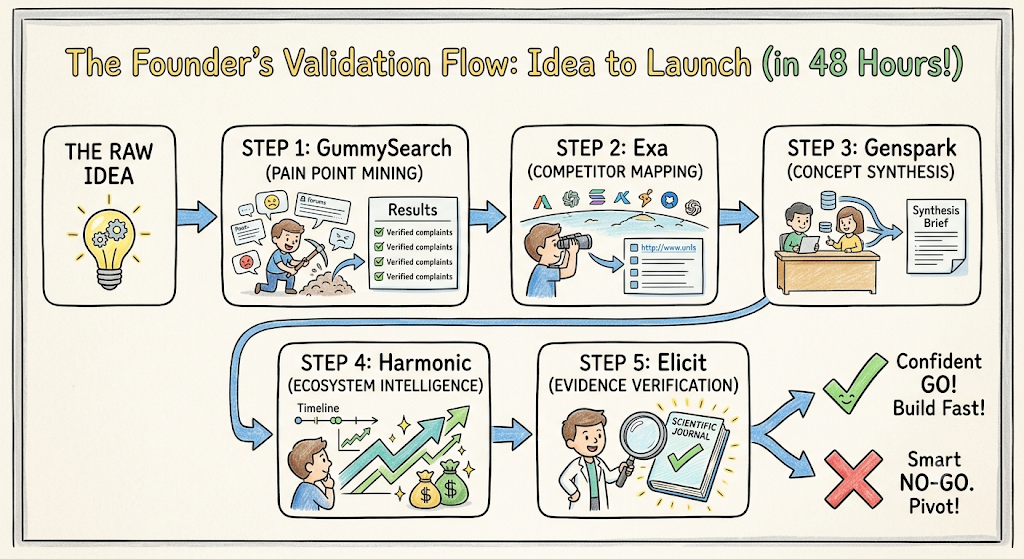
With the right research tools, you should be able to get enough information for a go/no-go decision within 48 hours. If you can’t, you’re just procrastinating.
While these tools can illuminate opportunities and expose weaknesses in your assumptions, none of them will tell you how to sell something. No one can promise revenues; you have to earn those sales dollars.
I wouldn’t trust anything you first read, so you shouldn’t either. The tool might cite sources, but always check the veracity of the information and its context to be sure.
They fall in love with their idea and ignore information that contradicts it. Founders cherry-pick what they want to hear instead of objectively seeking out ways their idea might fail.
The next wave of successful startups will eliminate bad ideas faster
The next wave of successful startups will not be created by founders who can write the best code. They will leave behind those who use AI to kill the worst ideas first.
Consider a future where relentless market research is automated. The right tools will be watching your competitors’ pricing and customers’ complaints without your constant urging. The tools will know when to stop and notify you when an opportunity has appeared.
The right research tool for founders will not compensate for a fundamentally flawed business model. If you’re feeling overwhelmed by too many tools, then maybe you have Too Many AI Tools? Build a Workflow That Actually Simplifies Work
If your competitor can test the viability of an idea in three hours, how much time can you afford to spend doing Google searches?
Your next move
Select an idea you have been developing for the past month to refine. Open an Internet search window and search the idea within social sites to identify who else is considering similar options. Spend ten minutes reading the content of the post and make sure to note three issues affecting individuals that could be the focus of your business plan.