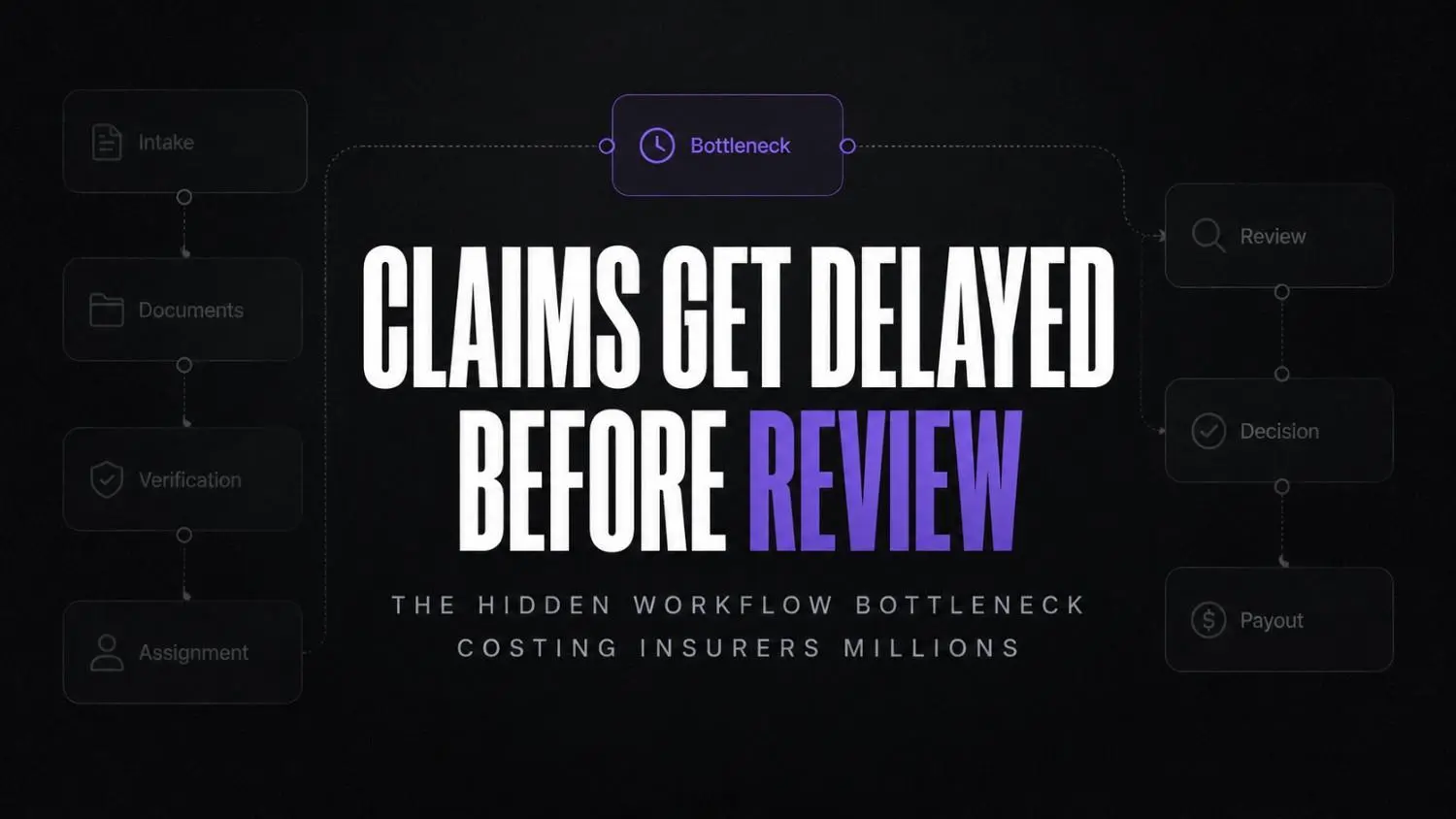
Smooth out insurance claims process bottlenecks by identifying where delays accumulate before human review and setting up effective automated triage.
Key Takeaways
- The real breakdown occurs during initial document collection and policy verification stages.
- The real breakdown occurs during initial document collection and policy verification stages, where up to 35 percent of core administrative capacity is siphoned off in pre-adjudication if manual data extraction from documents is required.
- High-volume queue backs are a thing of the past with low-level complexity claims automatically routed as soon as they hit our system.
- A real-time risk score built at the data intake stage eliminates manual reviews late in the cycle.
The Hidden Killer of Insurance Productivity
Your adjusters are drowning in files, but adding headcount won’t fix processing timelines. Industry data shows that manual document handling consumes over 35% of an insurance operations team’s daily capacity, according to a PwC global operations study. Operational debt accumulates long before a reviewer opens a claim file, despite McKinsey research confirming that optimizing core workflows can slash end-to-end processing costs by up to 30%.
After analyzing enterprises claims settlement processes, this study identified that the core bottlenecks of the process are the two links of initial document receipt and insurance policy verification. Optimizing only subsequent processes cannot eliminate the accumulated work backlog. Most enterprises incorrectly attribute processing delays to adjudication and review, and they still have to pay high premium wages for data entry and supplementary document management work.
The anatomy of an invisible insurance claims workflow bottleneck
Hidden bottlenecks exist within insurance claims processing workflows. Most operations supervisors only detect friction at the tail end of the process funnel, while the actual choke points lie at the handover nodes that follow the initial loss notification. Very few claims cases enter the system with all required supporting documentation complete. The unstructured information such as invoices and police reports has to be structured right away, which is why the claims processing team spends countless hours matching them to claim policy numbers. This manual gap is where hidden spreadsheet workflow failures begin to multiply as operations teams build temporary trackers to patch the systemic delay.
[Inbound Claim] ➔ [Manual Data Matching] ➔ [Missing Info Chase] ➔ [Overloaded Adjuster Queue]The authors of this paper point out that manual sorting of insurance claim cases imposes additional delays across the value chain of the entire business portfolio and consumes a large amount of working hours. When an operations assistant spends three days investigating and discovering that a case file lacks a required signature, the case already fails to meet the pre-established service level target. Furthermore, claims processors, who ought to be focusing on core claims work, are also forced to liaise with clients to update relevant information.
Pause and think: If you pulled a random sample of fifty pending claims right now, how many are actually waiting for an adjuster’s decision versus waiting for a missing document?
The self-audit checklist
- Files spend more than twenty-four hours in the unassigned or ingestion queue.
- Adjusters spend over two hours a day emailing clients for missing information.
- Simple, low-value claims follow the exact same manual path as complex, high-value losses.
Shift from manual routing to automated triage
Moving from manual sorting of data to automatic sorting of data means understanding how data moves through your system from the moment it arrives. Instead of letting documents build up, you want to identify legitimate claims from those that are identified as or missing a tag. You must closely evaluate your complete AI workflow infrastructure. If you don’t address this issue, it can lead to significant lost knowledge due to some of the hidden rules used for handling manual exceptions file being lost when key team members leave.
| The Wrong Approach (Status Quo) | The Right Approach (Thinking-First) |
| Dispatch each incoming document to a manual scheduler who is responsible for its organisation. | Harnessing document intelligence to capture data and match with policies in milliseconds. |
| End-of-process fraud indicator review. | Executing real time fraud check simultaneously with ingestion. |
| Hunting down lost paperwork by manual email to adjuster. | Sending out auto text notifications to customer for any missing fields. |
| Treating minor clear-cut claims with identical operational weight. | Speedy auto payout of simple, low-complexity claims |
As all claims are processed at the same processing speed, it will degrade the system’s performance. Smaller claims will allocate cycles to other uses of that cycle when it could have been dedicated to larger, more complex commercial claims in which the human judgment factor is essential. The importance of a well-designed ingest system for all claims is to automatically process (ingest) the simple claims and route the more complex claims for processing by an expert. The same type of drag on performance occurs within sales operations as a result of unsegmented pipelines generating systemic revenue leakage because senior analysts get bogged down in processing minor, low-tier approvals.
What thinking-first actually looks like operationally
So, here’s what optimized insurance claims processing can really look like on a Tuesday morning, at 9am, leveraging modern, integrated technologies.
Ingestion and document intelligence
A clock hits 9:02 when paperwork arrives for a business building fix, tossed into the workflow with a cluttered ten-pager listing every repair dollar. Right then, before files stack like unread mail, sorting kicks off – real ones pulled forward, fakes dropped out.

Indico Data
Indico Data provides AI-powered document intelligence solutions that help enterprises extract insights from complex documents and automate information-heavy workflows. Its platform helps insurance companies process claims documents, forms, and unstructured data more efficiently.
Speed: Turns unstructured PDFs into structured data points in precisely 90 seconds.
Task Simplification: Eliminates the need for data entry by automatically extracting complicated, multi-layered line item expenses and unstructured building materials.
Triage and claims management
At 9:04 AM, the structured data is then automatically fed into the Guidewire ClaimCenter for orchestration of the automated workflow process.

Guidewire ClaimCenter
Guidewire ClaimCenter is a claims management platform designed for property and casualty insurers to manage the complete claims lifecycle. It helps insurers improve claims operations through configurable workflows, automation, and better visibility across claims processes.
User Interface and Integration: Integrated into the insurance suite itself to validate coverage right away.
Reducing Tasks: Completely eliminates the need to use the coordinator queue for active claims below certain thresholds.
Field digital management
When there is an image-based damage proof required for the claim, the remote mobile assessment process is triggered at 9:05 AM.

Snapsheet
Snapsheet is a digital claims management platform that helps insurance companies modernize the claims process through virtual workflows, automation, and customer-focused experiences. It enables insurers to streamline claim handling and reduce manual processes.
Speed: Provides immediate, automated texts with secured links for submission sent directly to the claimant’s mobile phone.
Simplifying the Task: Eliminates any human intervention in the field assessment by having claimants upload images straight into the processing system.
Automated claim triage
The system compares real-time data with industry standards so as to guarantee accuracy in terms of cost when the valuation process is being done.
CCC Intelligent Solutions
CCC Intelligent Solutions provides AI-powered cloud technology solutions for the insurance and automotive industries. Its platform helps insurers improve claims processing, automate workflows, and connect stakeholders across the claims ecosystem.
User Interface & Integration: Highlights the documents that conform with green scores through the color coding in the reviewer dashboard.
Task Simplification: Automatically compares the telemetry for vehicles or properties with the standard costs of repairs.
Risk and fraud analysis
Before any payment is made, real-time profiling is performed, where the information from the claim is matched against the database of past behavioral records.

Shift Technology
Shift Technology provides AI-powered solutions for insurance companies to improve claims management, fraud detection, and decision-making. Its platform helps insurers analyze claims data, identify suspicious activity, and automate complex review processes.
Speed: Identifies any duplicate invoices and abnormal transactions immediately before withdrawals.
Task Simplification: Transfers only risky claims to the SIU, allowing easy settlement of lower-risk claims without any obstruction.
Frequently asked questions
Why shouldn’t we just hire more adjusters to clear the claim backlog?
Hiring more adjusters adds heavy overhead without fixing the root cause of processing delays. Manual ingestion systems still waste new hires’ time chasing documents instead of settling claims.
Will automated claims triage increase our processing fraud risk?
No, because the process of analyzing fraud risk factors is done automatically on-the-fly. People might not be able to identify such minute things which can be detected by machine learning algorithms right away.
How long does it take to replace a manual data entry workflow?
You do not have to upgrade all of your old core system in one go. Putting a layer of intelligent document processing above your old database takes less than sixty days.
Do customers dislike interacting with automated claims systems?
Customer dissatisfaction with silence and delays is much greater than with automation. Automated text response messages, immediately informing customers of subsequent steps, are preferable to a three-day delay in sending an e-mail manually.
What happens to complex claims that cannot be auto-triaged?
Claims that are complex should be automatically filtered because automation filters out fluff. This means that top-level adjusters will have time to handle complicated claims.
Conclusion
We contend that utilizing only data for solving operations has never been a sustainable method in a business. The ability to automate can help a company generate more scalable growth, and within the next ten years, balance sheet software vendors will lead the insurance industry as opposed to traditional back-office operations; further, the competition amongst insurance companies will move from price to time to respond. Scaling with manual overhead exposes you to structural compliance risks that cripple unautomated identity screening systems when transaction velocity spikes.
Can your claims settlement infrastructure scale smoothly alongside technological development, or will it collapse completely once claims volumes double?
Your next move
The following steps should take place: extract claims workflow logs from the last 30 day period and determine the time elapsed between an FNOL being reported and when the first adjuster’s action occurred on that FNOL. If the time elapsed exceeds 4 hours, identify the root cause of the delay using a whiteboard-style diagram of your data ingestion process.