Key takeaways
- Without strict data rules, warehouse automation increases fulfillment errors.
- When inventory data isn’t properly validated at the source, routing engines will break down.
- Manual override protocols stop predictive models from ordering inventory that doesn’t actually exist.
- Clear operating rules keep automated workflows from hiding operational delays.
Introduction
When organizations automate their supply chain using unreliable process data, they leave themselves open to risk. Companies are often eager to use machine learning to improve demand forecasting or optimize delivery routes, but fail to define the operational rules that keep those models reliable.
Logistics AI governance is important in this scenario because a 2023 Gartner Supply Chain Study found that 73% of enterprises experience major operational disruptions when they try to scale automation without proper oversight. The issue is not the AI itself. It is the workflow problems the technology exposes, only much faster.
The mess beneath the automation
A recurring issue is businesses treating predictive models as a quick fix for operational challenges and not realizing that they alone will not resolve the issue. There is an expectation that once a forecasting engine is connected to the warehouse management system, it will make accurate purchasing decisions.
Unfortunately, that is not the case.
If you have poor quality data, you will continue to make poor quality decisions. If your workflow infrastructure is not reliable, then adding more predictive models will simply speed up your failures. For example, if a receiving dock takes three days to document inbound freight, the forecasting system will assume inventory exists when it doesn’t.
The same problem shows up elsewhere. When routing mistakes lead to damaged freight or failed deliveries, weak data tracking makes the insurance claims process far more difficult than it should be. Automation doesn’t remove bottlenecks. It amplifies them.
“I just spent fifty grand on predictive routing software, and my drivers are still returning to the depot empty every afternoon.”
I hear versions of that complaint all the time. The software isn’t the problem. The business logic behind it is.
Staged tool stack: The systems running your governance
Building AI governance for logistics is not just about adding more artificial intelligence. It is about putting the appropriate processes in place for each system and ensuring that each system follows operational rules before data reaches the AI model. Each stage of the fulfillment process needs to have its own checks.
Pre-fulfillment optimization/forecasting
Blue Yonder
Blue Yonder is created for demand forecasting and supply chain planning using historical trends and market signals to optimize inventory.
Blue Yonder
Blue Yonder is an AI-powered supply chain management platform that helps enterprises plan, execute, and optimize operations across inventory, transportation, warehouses, retail, and fulfillment. Built on a common data cloud, it combines predictive, generative, and agentic AI to improve decision-making and increase supply chain resilience.
Operators view this product as having excellent forecasting capabilities, but this can be problematic if the historical demand data contains unmarked anomalies. If those anomalies exist within historical demand, the system will confidently recommend purchase orders that create excess inventory instead of preventing it. The first thing to do is ensure that there is strong data governance.
Dispatching & Real-Time Visibility
Project44
Project44 provides logistics teams with visibility of the location of shipments in real-time as well as predictive tracking of their shipments through the supply chain.

project44
project44 is a supply chain visibility platform that provides real-time tracking, predictive insights, and AI-powered automation across transportation networks. It helps shippers, carriers, logistics providers, and retailers improve delivery performance, reduce disruptions, and enhance customer experience through end-to-end shipment visibility.
Operators believe this provides a clear view of the location of freight at any point and provides a proactive approach to dispatching freight to the customer. The weak point is data availability. The data accuracy of ETA will become questionable if a carrier does not continue to provide updates through their integration. Therefore, logistics teams need clear processes for manually reviewing and overriding automated alerts when data feeds fail.
FourKites
FourKites, uses artificial intelligence (AI) technology to monitor shipments and enhance visibility throughout extensive logistics networks.
FourKites
FourKites is a real-time supply chain visibility platform that helps enterprises track shipments, predict disruptions, and orchestrate logistics operations across global transportation networks. It combines AI, digital twins, and automation to improve supply chain resilience and delivery performance.
Operator’s Take: Accurate arrival predictions provided by the software, allow warehouses to schedule receiving operations more efficiently and reduce truck dwell times. However, the predictions entirely rely upon carrier updates. For instance, when a driver skips a milestone scan, or a carrier does not adhere to reporting standards, the system begins to generate estimated times of arrival (ETA) that are inaccurate.
Warehouse floor execution
Manhattan Active
Manhattan Active enables warehouse and transportation management to be executed through a single operational system.

Manhattan Active Platform
Manhattan Active Platform is a cloud-native supply chain commerce platform that unifies warehouse management, transportation management, order management, inventory, and omnichannel fulfillment. Built by Manhattan Associates, it enables enterprises to optimize operations with AI-driven insights, automation, and continuous cloud updates.
Operator’s Take: Being able to continuously update picking routes based upon newly received customer orders allows warehouse teams to move faster throughout the day. However, this process will only work if the digital warehouse reflects the actual physical warehouse. To ensure this happens, regular maintenance of the workflow processes needs to be performed. If blocked aisles, or temporary floor layouts are not captured in the system, manual workarounds will be created, and the routing logic will soon become inaccurate.
Cloud analytics and capacity orchestration
AWS Supply Chain
AWS Supply Chain combines ERP, warehouse, and operational data into a single system to support demand planning and machine learning across the network.
AWS Supply Chain
AWS Supply Chain is a cloud-based application that helps organizations unify supply chain data, gain end-to-end visibility, and identify potential disruptions using AI and machine learning. Built on Amazon Web Services, it connects data from ERP, supply chain, and logistics systems to improve decision-making and operational resilience.
Operator’s Take: Having a single source of truth makes capacity planning much easier across multiple facilities. A 2024 study performed by McKinsey & Company found that 65% of logistics leaders consider data synchronization their biggest obstacle to scaling automation safely. Creating alerts is not the tough part; it’s making sure someone owns them. Without clear accountability, critical capacity warnings end up sitting on dashboards instead of being acted on.
Before adding another forecasting model, ask yourself this question: Are purchase orders being generated from real-time sales activity, or are you still relying on last month’s spreadsheet export?
What good governance looks like in practice
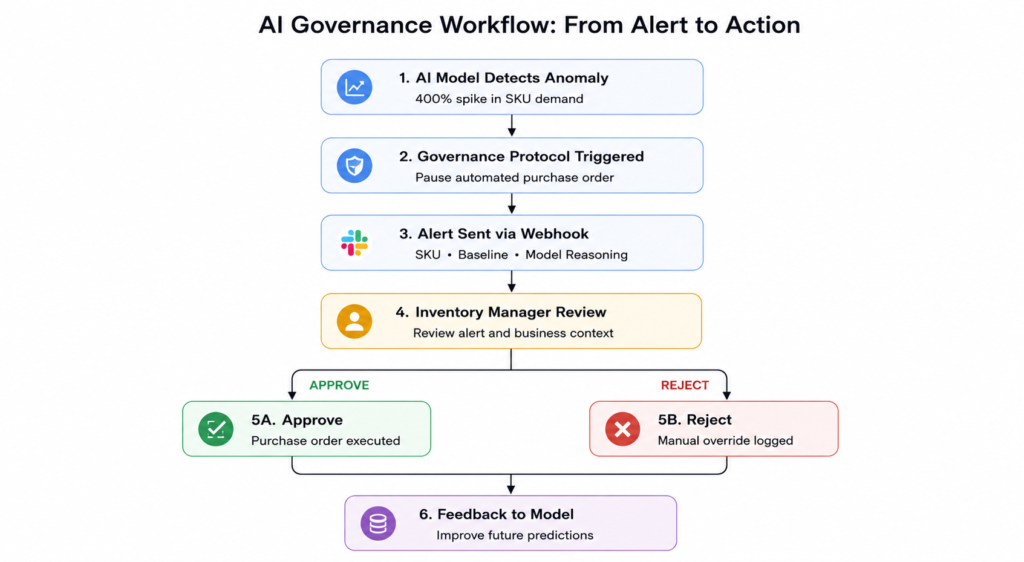
On Tuesday at 2:14 p.m., your demand forecast model finds a 400% spike in winter coat sales and makes a recommendation to place a large purchase order.
Instead of approving it automatically, the governance process steps in.
A Zapier webhook sends an alert to the supply chain team’s Slack channel of the SKU, historical sales baseline and the forecast model’s reasoning.
The inventory manager reviews the alert and realizes it was a one-time corporate gifting order that’s unlikely to happen again.
The inventory manager rejects the recommendation.
This rejection is recorded as a manual override, giving the model feedback it can use later. Therefore, the inventory that gets ordered will not be unnecessary and no cash will be tied up in inventory that won’t sell.
This is how effective AI governance works in practice, and it’s how you prevent revenue leakage.
The wrong approach vs. the right approach
| The wrong approach | The right approach |
|---|---|
| Enable AI to automate approval of vendor invoices | Allow AI to identify discrepancies, then have a person approve them |
| Use routing software without manual overrides | Allow dispatchers to hard-code route exceptions when conditions change |
| Build forecasting models using weekly batch data | Feed models with real-time inventory data through APIs |
| Treat AI mistakes as unavoidable | Treat every mistake as a sign that a workflow rule is missing. |
Operational self-audit checklist
Before putting another machine learning model into the supply chain think about looking closely at the processes in place now.
First, verify the last time the SKU Weight & Dimensional Data was updated. If it has been six months since the last update, there is a good chance that costly Freight Automation Decisions are already being made using that outdated information.
Next, determine who is responsible for taking manual override when the Routing Engine fails during a weather event. Is it the dispatcher or the shift manager? Don’t assume it is one or the other, Document it.
Last but not least, measure the latency between the loading dock and your ERP to capture the time it takes for inventory updates to reach your systems. If inventory updates are not reaching your systems quickly enough, every downstream prediction becomes less reliable.
Frequently asked questions
Is Having a Compliance Officer Required?
Not actually. In most cases your operations manager needs only to map out how data enters the business. What you’re doing in terms of AI governance is documenting the actual way that work is happening.
Will doing manual checks slow down our ability to fulfil?
It will at first.
But taking the time to confirm your data is significantly less expensive than shipping the wrong product to the wrong customer at twice the speed. Speed without accuracy creates more expensive errors.
How frequently should we audit AI decision making?
Conduct audits of workflows every Friday afternoon. Then, compare what the model said would happen with what actually happened on the warehouse floor. Typically, this will help identify where there are hidden process problems.
If the model begins to drift, what will I do?
Turn off automated execution immediately.
Go back to manual approvals while you investigate the data that’s causing the model to produce unreliable recommendations.
Can logistics teams afford to implement these processes?
The more relevant question is whether or not you can afford not to.
Recovering from an improperly automated supply chain is far more expensive than just putting basic governance rules in place to begin with.
Conclusion
Over the next 5 years, logistics companies that excel will not necessarily be the ones that are using the most AI.
The successful companies will be the ones that have the cleanest operational data and who have put in place strong governance practices.
Routing and forecasting will be increasingly seen as commodities; therefore, consistent execution on the part of a company will distinguish its operational performance from the other companies there.
Ask yourself this question:
If your warehouse management system were to fail tomorrow morning, would your warehouse managers still know how your products should be moved through your warehouse?
Your next move
Trace the alert back to the original data source that triggered the reorder. Identify which system last updated the inventory count and confirm whether that data is coming in real time or through scheduled batch updates.
Open your warehouse management system and identify the rule(s) that trigger your lowest-stock reorder alerts.