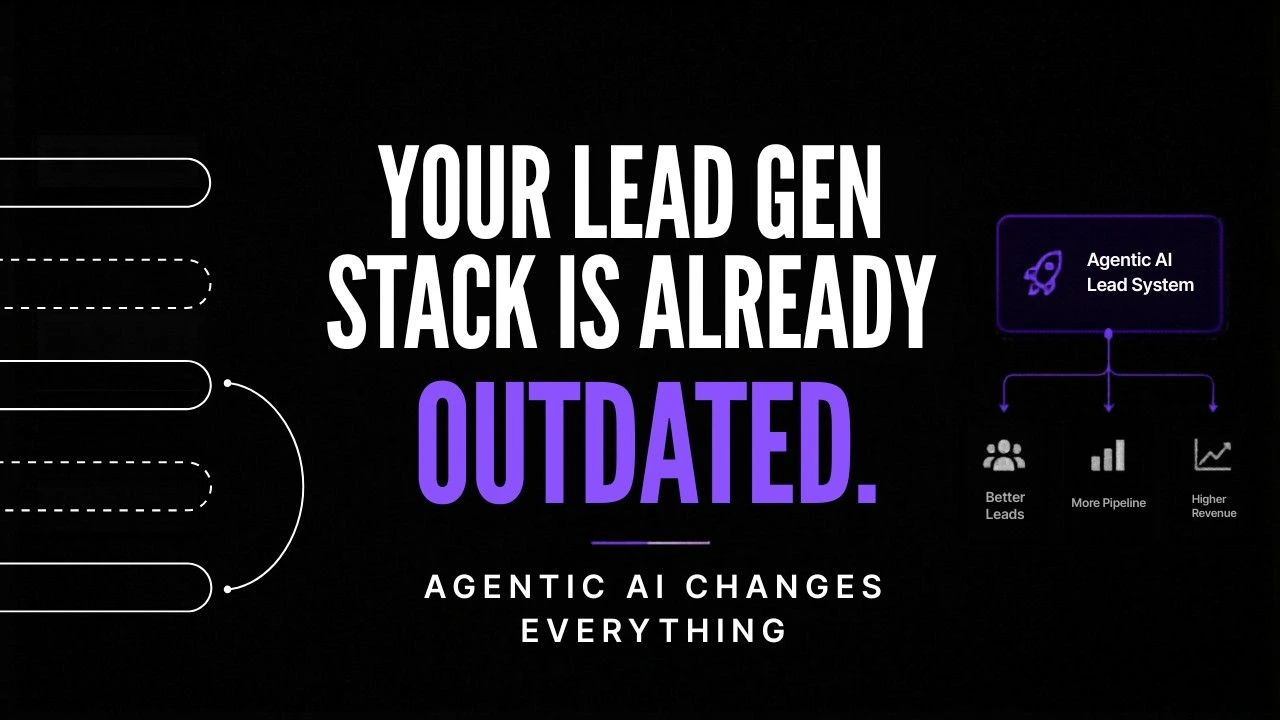
AI lead generation tools don’t fix slow teams. They expose them.
Everyone’s talking about AI lead generation tools.
Autonomous workflows.
Self-running systems.
“AI that replaces teams.”
Sounds impressive.
But here’s what actually happens in most businesses:
You plug AI lead generation tools into a slow system… and it just makes the failure happen faster.
Leads still go cold. Follow-ups still don’t happen. Decisions still take too long. Only now, it happens at scale because you lack the proper AI Workflow Infrastructure. This layering of automation over fragile foundations rapidly compiles severe AI Operational Debt that cripples your long-term efficiency.
Key Takeaways
- Speed gaps convert demand into lost revenue
- Tool adoption without system design increases failure
- Lead gen performance depends on response time, not volume
- Automation amplifies whatever already exists
Most AI lead generation systems don’t fail, they lag
Founders think their problem is:
- not enough leads
- not enough tools
- too little automation
However, if you look closer, it’s simpler.
The system works.
It’s just slow.
And in today’s market, slow doesn’t mean inefficient.
It means lost revenue.
The real shift: from AI lead generation tools to systems
Most teams today use multiple AI lead generation tools.
But they still miss leads.
Why?
Because tools don’t create speed. Systems do.
So instead of adding more tools, the real advantage comes from connecting them into a system that moves instantly.
This is where most teams ignore intent signals, the early indicators that someone is ready to buy, not just browse.
Pause for a second, how many of your leads are actually high-intent vs just noise?
Most teams miss this because they don’t understand how tools fit into a system.
If you’re thinking about structuring your stack properly, this AI marketing tools stack breakdown will help.
What an AI lead generation tools stack actually looks like
A real system is not a list.
It’s a flow.
Source Layer (intent capture)
Captures demand before competitors see it.
Tools:

Sensorhub
SensorHub AI is an AI-powered sales automation platform focused on lead generation, outbound prospecting, and workflow automation. It helps businesses discover prospects, automate sales activities, and improve pipeline efficiency using AI-driven processes.
ThreadSignals
ThreadSignals is an AI-powered lead generation tool that monitors online conversations across social platforms to identify buying intent and surface warm leads. It helps businesses discover prospects already discussing relevant problems, products, or needs.
Enrich Layer (context tools)
Turns raw leads into usable insights.
Tools:

Clay
Clay is a data enrichment and AI workflow platform that helps businesses automate lead generation, prospect research, and outbound personalization. It combines data providers, workflow automation, and AI research into one prospecting workspace.

Apollo.io
Apollo.io is a B2B sales intelligence and engagement platform that helps businesses find leads, enrich contact data, automate outreach, and manage outbound workflows. It is widely used by startups, sales teams, recruiters, and agencies for scalable prospecting.
This is where CRM automation quietly does the heavy lifting, stitching together fragmented data into something usable.
Qualify Layer (AI prioritization tools)
Decides what deserves attention first.
Tools:

Chili Piper
Chili Piper is an inbound conversion and meeting automation platform that helps businesses schedule meetings instantly, qualify inbound leads, and automate routing workflows. It is widely used by revenue teams to improve speed-to-lead and reduce scheduling friction.

Salesloft
Salesloft is a revenue workflow platform that helps sales teams automate outreach, manage buyer engagement, improve forecasting, and streamline pipeline execution. It is built for modern revenue organizations focused on improving seller productivity and pipeline performance.
Outreach Layer (AI outbound tools)
Turns intent into conversations.
Tools:

Veethi
Veethi is an AI-powered outbound sales automation platform designed to help businesses discover leads, personalize outreach, and automate prospecting workflows. It is built for teams looking to improve outbound efficiency and generate more qualified meetings.

AutoReach
AutoReach is an AI-powered lead generation and outbound automation platform that helps businesses find prospects, qualify leads, generate personalized outreach, and automate sales workflows. It is built for teams looking to scale outbound prospecting with AI agents.

GetLeads by Rainex
GetLeads by Rainex is an AI-powered lead generation platform designed to help businesses discover prospects, generate contact lists, and automate outbound sales workflows. It focuses on simplifying prospecting for B2B sales and growth teams.
Strong outbound workflows are not about sending more messages. They are about sending them at the exact moment they matter.
The real gap in AI lead generation is between intent and action
Your best leads are already ready.
- they’re searching
- comparing
- asking
But your system doesn’t act fast enough.
So the gap grows:
Intent → delay → lost opportunity
Most pipelines don’t break at acquisition, they break at response
“More leads will fix our pipeline.”
That sounds right, but it’s wrong.
Most founders don’t lose deals because they lack leads. They lose them because they don’t act fast enough.
You’ve seen this happen:
- a demo request sits in your inbox
- a prospect goes cold after one reply
- follow-ups get pushed to “tomorrow”
What delayed response actually costs you
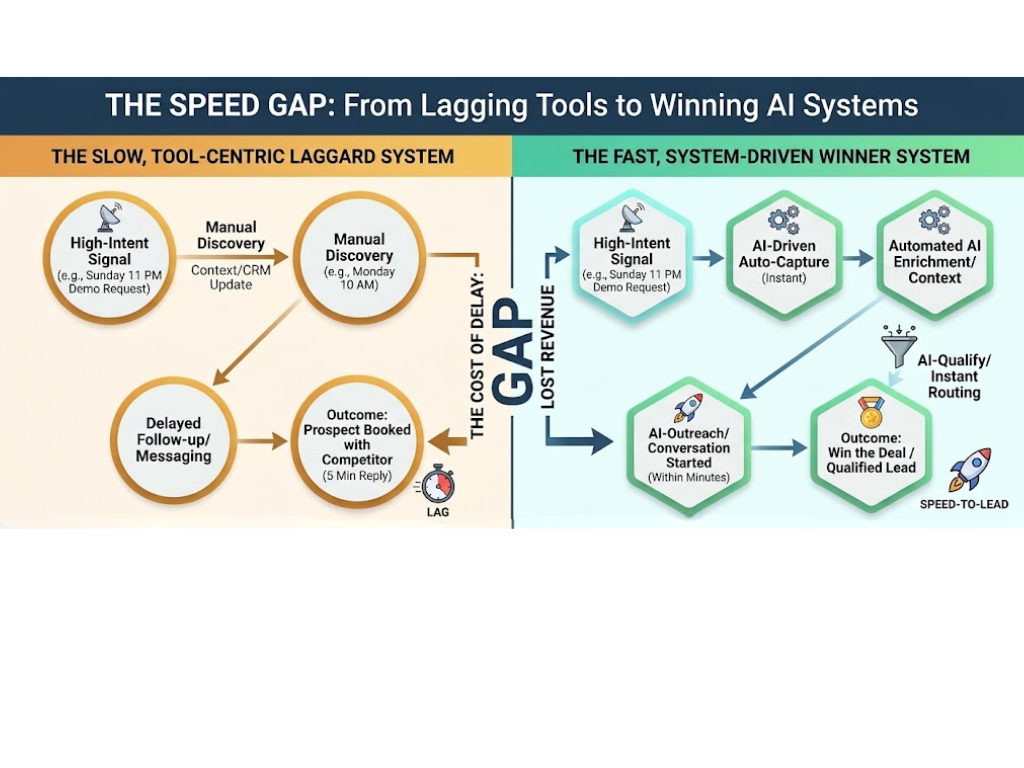
Imagine this. It’s Monday morning. A high-intent lead books a demo late Sunday night. You see it, but reply after your first meeting. By then, they have already booked with someone else who replied in five minutes. Nothing broke. It was just slower.
Meanwhile, someone else replies in minutes and wins the deal.
Here’s the uncomfortable truth:
AI lead generation tools won’t magically get you more leads. But they help you stop wasting the ones you already have.
This is where speed-to-lead systems separate average teams from winning ones.
Quick check, if a lead comes in right now, what actually happens in the next 10 minutes?
Also, most buyers don’t consciously choose faster, but quicker responses reduce decision fatigue and create a subtle trust bias.
Why faster teams win with AI lead generation tools
A mediocre message sent in 2 minutes beats a perfect message sent in 2 hours.
Every time.
Because by the time you send the “perfect” message:
- the buyer has moved on
- the urgency is gone
- or someone else already replied
Speed usually matters more than messaging.
Not always. But often enough to change how you build your system.
There is also a quieter factor at play. When a lead is exploring options, every extra delay adds friction. Too many choices, too much waiting, and the brain starts avoiding the decision altogether. Fast responses reduce that friction and tap into loss aversion. People act when they feel they might miss something, not when everything feels open-ended.
Without proactive AI Workflow Maintenance to keep these automated sequences running smoothly, errors inevitably compound. This breakdown often leads to teams relying on unmanaged Shadow Operations just to keep the pipeline moving, resulting in even more friction and missed opportunities.
According to a study by LeanData, companies that responded to leads within an hour were seven times more likely to qualify them than those who waited longer.
Outbound execution is where AI lead generation tools actually work
Most teams treat outbound like a task.
Write email → send → wait → follow up
That’s where things break.
At Aadhunik AI, we use a system:
| Layer | What most teams do | What actually works |
|---|---|---|
| Source | collect leads | capture intent signals |
| Enrich | skip context | build intelligence |
| Qualify | manual filtering | prioritize automatically |
| Outreach | send emails | trigger fast engagement |
AI doesn’t replace the human moment here. It removes the delay between intent and response so conversations start sooner.
How to use AI lead generation tools effectively (step-by-step)
Step 1: Define high-intent leads
Not every lead deserves urgency.
Examples:
- demo requests
- pricing visits
- comparison activity
A demo request hits your inbox at 9:12 AM. If routed instantly, it gets a response before the buyer checks alternatives. If delayed, it becomes just another tab they close.
Step 2: Build a response-time system
Your 3-point response system check:
triggers are set for every high-intent action routing sends leads to the right person instantly response rules ensure replies happen within minutes, not hours
You should start seeing improvement within 7–14 days.
A simple repeatable framework most teams use here: “If lead shows X intent → trigger Y response within Z minutes.” Clean, boring, and it works.
Step 3: Use AI outbound tools to execute faster
| Tool | Best For | Where It Fits |
|---|---|---|
| Veethi | Outreach sequences | Multi-touch |
| AutoReach | Cold email | Scale |
| GetLeads by Rainex | Capture + outreach | End-to-end |
Tools like ChatGPT are now used to generate and send personalized outreach in seconds, removing manual bottlenecks.
This shift is part of a broader move toward automation, where systems replace manual execution entirely.
AI lead generation tools don’t fix broken systems
If your system is slow:
- bad targeting → more noise
- weak messaging → faster rejection
- no structure → chaos
You won’t fix it. So you’ll scale the problem.
You don’t need more AI lead generation tools, you need a system
If your outreach depends on:
“I’ll reply later”
You don’t have a pipeline.
You have a leak.
If this feels familiar, your system isn’t broken, it’s incomplete see the full SEQO breakdown to understand what’s missing.
Final takeaway
AI isn’t your advantage.
Speed is.
And AI just makes that impossible to ignore.
Final question
How long does it actually take your system to respond to a high-intent lead?