Key takeaways
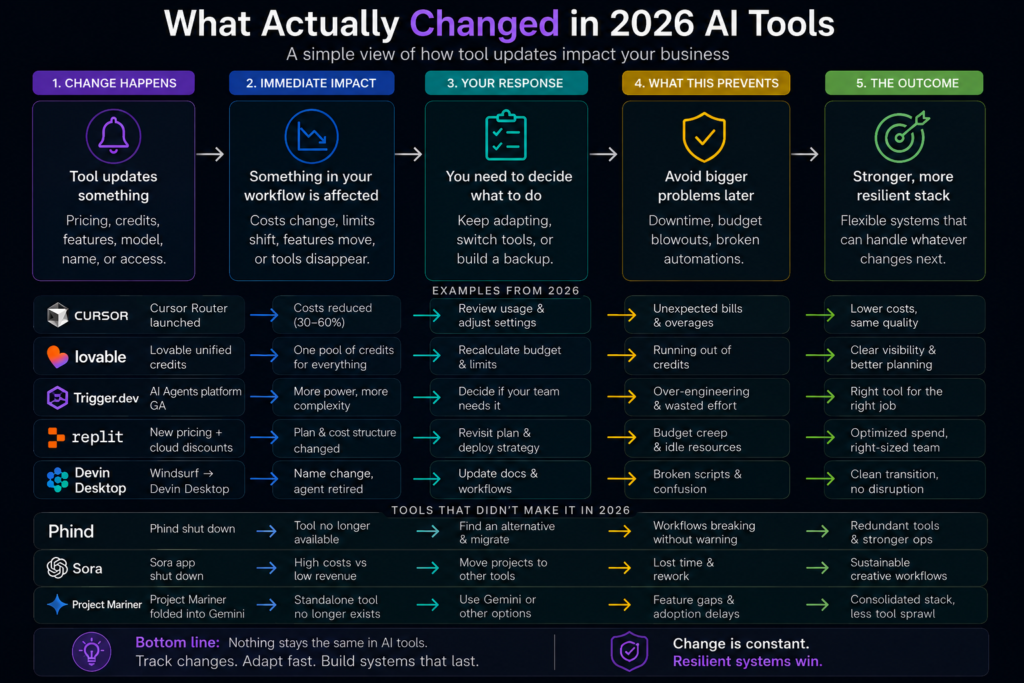
- Cursor released Cursor Router on July 22, 2026, cutting model costs for Teams and Enterprise plans by approximately 30-60%.
- Lovable unified billing for its build, cloud, and AI features under a single balance across all plans.
- Trigger.dev’s AI Agents platform became generally available on July 2, 2026.
- Replit’s per-user Teams plan was terminated and replaced with a flat-rate Pro plan in February 2026, followed by a price cut for its cloud in August 1, 2026.
- Cognition rebranded its Windsurf product as Devin Desktop on June 2, 2026, while retiring the Cascade agent on July 1, 2026.
Introduction
A tool a founder evaluated six months ago may already have a different pricing model, a different agent, or a different name entirely. Windsurf, the editor half a million developers have built habits around, no longer carries that name. Cognition rebranded it Devin Desktop in June, and the old agent stopped working July 1st.
Some tools disappeared entirely in the span of a year. Phind was shut down with no warning. OpenAI canned the Sora app, which had already generated $$1 million against roughly $2.1 million in lifetime revenue, according to the Wall Street Journal. Google killed off Project Mariner after 17 months.
This is a list of five tools that fundamentally changed in 2026, and three that vanished, altogether, focusing only on changes that would meaningfully impact a founder’s decision to adopt or pay for the tool.
The 5 tools that changed
Cursor: router changes model selection
Cursor: Cursor Router (July 22, 2026) auto-routes every request to the best model rather than letting developers pick their default. Reports 30-60% lower cost at equivalent quality. India only entry plan Cursor Start launched on July 28th at Rs649/mo. AIFBA says it’s worth it if your team reviews every ai generated line before merge, router just reduces spend vs risk.

Cursor
Cursor is an AI coding agent designed to help developers build software by delegating coding tasks to AI. It combines an AI-first development environment with agents, cloud agents, Composer, CLI tools, and access to multiple frontier models.
Before → after: Developers previously picked one model and used it for everything, even simple requests that don’t need frontier level reasoning. Cursor Router classifies every query and auto-routes to the best model (and has a cost/balance/intelligence tiering rather than a monolithic choice).
Operator’s take: Zero setup. Works in Auto mode by default. What’s a con? Hidden by default. If your team needs to audit why a particular request was sent to cheaper model (eg. to ensure it didn’t touch any sensitive data) you need to remember to turn on the visibility toggle. Would prefer manual routing if you need deterministic model choice for any kind of regulatory reason.
Lovable: one unified credit balance
Lovable: Build credits, cloud balance, and AI balance are all in one unified currency, rather than three separate budgets. Subscription costs have mostly stayed similar (Free, $25 Pro, $50 Business), but your dev budget now competes with the production app’s for the same pool of credits. Think about it as the dev budget being the combined opportunity cost rather than the sticker price.
Lovable
Lovable is an AI software engineer that lets users build websites and full-stack web applications through natural-language prompts. It is designed for both technical and non-technical users and can generate, deploy, and iterate on working software without requiring deep coding skills.
Before → after: The currency used to be three separate buckets, and a founder could burn one while another had budget left over. Now they’re unified, so a particularly busy production app or a team dev budget can consume the whole monthly allocation.
Operator’s take: Easier to track in one place, but a team not used to the unified model has to spend a few sprints learning how much is “normal” to burn in a sprint. Best for teams that have one app and want to allocate budget towards dev as a percentage of the whole. Avoid the unified model if you have multiple live Lovable apps as one noisy neighbor will negatively impact the others.
Trigger.dev: AI agents becomes core infrastructure
Trigger.dev: Its AI Agents platform reached GA on July 2nd, 2026. Now has durable chat sessions, human approval gates, and dev branches for local testing. Positioning has changed from “reliable background jobs” to infrastructure for AI workflows, the thing the agent is built on top of. Is best for teams already writing agents who don’t want to reimagine their retry logic.

Trigger.dev
Trigger.dev is an open-source platform for building and deploying long-running background tasks, AI agents, and workflows using code. It provides durable execution, retries, queues, scheduling, observability, and managed infrastructure without serverless execution timeouts.
Before → after: Previously had durable execution, but nothing specifically for agents. Was meant for background jobs, queues, and scheduling, but not specific to AI. Now has proper primitives for agents, including chat sessions that survive reloads and redeploys, and human-in-the-loop approval gates built-in rather than polling.
Operator’s take: Worth it if you’re already writing agents and need proper infrastructure to make them reliable, adds surface area if you’re a company not writing agents yourself. Can be skipped if you’re not writing agents, or if you’re a non-engineering team that doesn’t think about retries in your own code.
Replit: teams pricing and cloud costs changed
Replit: Replit cancelled its per-user Teams plan in February 2026 and instead offered a flat $100/month Pro plan (up to 15 builders) while lowering the cloud deployment and storage prices beginning on August 1st, 2026. The former will benefit everyone that exceeds the free tier (likely most teams) disproportionally less than those maxing out their Agent credits.
Replit
Replit is an AI-powered software development platform that lets users build, test, and publish applications using natural-language instructions. Its Agent can generate and modify production-ready code while Replit provides built-in infrastructure for databases, authentication, hosting, and monitoring.
Before → after: Before the update, every additional user added linearly to the bill, and therefore bigger teams were significantly disadvantaged compared to the Pro plan ($100 per 15 builders). New Pro ($100): It still costs $100 per 15 builders, which is cheaper per seat for large teams and more expensive for small ones (e.g., a 2–3 builder team would’ve had no need for 15 seats). Additionally, the cloud deployment/storage now costs less in general, beginning on August 1st, 2026.
Operator’s take: A clear win for scale-ups within the recommended range of 5–15 builders; below that, the math stops being advantageous. Meanwhile, the cloud costs are reduced overall but by a smaller margin than the usage costs of the Agents, so it’s not a good time to confuse billing with total expenses.
Windsurf becomes Devin Desktop
Windsurf → Devin Desktop: This is the story that none of the other outlines tell. Cognition, the company that created the Devin Agent, rebranded Windsurf to Devin Desktop on June 2, 2026. All existing plans and pricing were retained, and migrations continued uninterrupted. The previous agent, Cascade, was decommissioned and replaced by Devin Local on July 1, 2026. Now, make sure to check all your CI scripts, documentation, and other automations to ensure that they do not reference the old names – if so, they will need to be updated as well, lest they add another unwelcome task to your ever-growing list of AI-related maintenance chores.

Devin Desktop
Devin Desktop is the successor to Windsurf (formerly Codeium) and brings Cognition's AI software engineering experience to the desktop. It combines AI coding assistance, autonomous task execution, project understanding, and collaborative development inside a native desktop environment for individual developers and teams.
Before → after: Windsurf bundled Cascade as its local agent in a code-first editor. Devin Desktop uses an Agent Command Center (think Kanban) as the default view and carries Devin Local (replacing Cascade) and third-party agents (Claude Agent, Codex, Gemini CLI) in the open Agent Client Protocol.
Operator’s take: The migration itself was low-effort, as plans, pricing, and settings carried over automatically. The actual risk is entirely self-inflicted: any script/doc/team member that refers to “Windsurf” or “Cascade” externally is working from a mental model that is already outdated. Nothing is skipped here: every existing user should read through the Devin Local changelog at least once.
At a glance
| Tool | What changed | Pricing impact |
|---|---|---|
| Cursor | Router + Start plan | Usage-based savings |
| Lovable | Unified credits | Billing structure, not sticker price |
| Trigger.dev | AI Agents reached GA | Review usage plans |
| Replit | Teams→Pro, cloud price cut | Yes |
| Devin Desktop (was Windsurf) | Full rename, Cascade replaced | Carried over unchanged |
3 tools that shut down
Phind was shut down on January 16, 2026, with no warning, about a month after it raised $10M. The reason was that OpenAI, Anthropic, and Google all launched models with native search and code reasoning capabilities, making Phind’s single specialty less valuable. The lesson is that you shouldn’t build an important business process around a narrow AI unless you consider the possibility that a bigger company may appropriate that specialty. If Phind was a critical supplier to your business, see our Phind alternatives list. We strongly advise against building critical business processes around any narrow AI.
Sora, the standalone application, was discontinued by OpenAI in two phases: web and application access was turned off on April 26, 2026, and the API was shut down on September 24, 2026. The lesson is that even a well-funded and publicized product can be cancelled if the standalone offering does not meet economic expectations.
Project Mariner, Google’s browser-agent experiment, was discontinued as a standalone product on May 4, 2026. Its capabilities were absorbed into Gemini Agent and Chrome’s Auto Browse feature. Unlike Phind, its discontinuation does not signal the end of browser-agent technology, only that Google has chosen to focus its efforts on its other products.
What this looks like on a Monday morning
A six-person technical SaaS team has windsurf hardcoded in a CI script that no one has touched since April. The code works until July 2nd, which is one day after the cascade cut-off and 40 minutes into a new build. It takes an hour to realize that the cause was a naming change in the tool a month earlier.
Pause and think: how many times you or your team has made a similar discovery. When was the last time that you checked if the product your team uses and relies upon continues to work the same way it did six months ago?
What this actually tells us
Based on my experience, working with founders about their product roadmaps typically do not ask the critical question about where is this vendor taking the product that we rely upon and does that still make sense for us. Pricing has become a product in and of itself, and it is no longer a commodity. The risk around vendor lock is an undervalued exposure that creates AI operational debt if the tool is embedded in a critical process, and the pricing structure, API, or continued existence changes, knows what will happen if it disappears altogether.
The 10-minute AI tool stability check
┌──────────────────────────────┐
│ YOUR AI TOOL IS IN YOUR │
│ WORKFLOW │
└──────────────┬───────────────┘
↓
┌──────────────────────────────┐
│ CHECK THE LAST 90 DAYS │
│ Changelog • Pricing • API │
└──────────────┬───────────────┘
↓
┌──────┴──────┐
│ │
↓ ↓
┌───────────────┐ ┌────────────────┐
│ DID IT CHANGE?│ │ DID IT SHUT │
│ │ │ DOWN / MOVE? │
└───────┬───────┘ └───────┬────────┘
│ │
YES YES
↓ ↓
┌────────────────┐ ┌──────────────────┐
│ CHECK WHAT │ │ FIND THE │
│ ACTUALLY MOVED │ │ REPLACEMENT │
│ │ │ │
│ Pricing │ │ New vendor │
│ Credits │ │ New product │
│ Agent │ │ New workflow │
│ Model │ │ │
└───────┬────────┘ └────────┬─────────┘
│ │
└──────────┬──────────┘
↓
┌─────────────────────────┐
│ UPDATE YOUR WORKFLOW │
│ │
│ Docs • Scripts • CI/CD │
│ Budgets • Team habits │
└────────────┬────────────┘
↓
┌─────────────────────────┐
│ ASK ONE QUESTION: │
│ │
│ "What happens if this │
│ tool changes again?" │
└────────────┬────────────┘
↓
┌─────────────────────────┐
│ BUILD A BACKUP │
│ BEFORE YOU NEED IT │
└─────────────────────────┘
Self-audit before your next sprint:
- List every tool that relies on an AI model
- Check their changelogs over the last 3 months
- Research your own documentation/script for a tool’s previous name or agent
- Write a sentence for every tool: what you’d do in the first 48 hours if the tool became unavailable
Frequently asked questions
Cognition rebranded it as Devin/Desktop on 2 June 2026. The pricing and plans are similar, while Cascade was replaced by Devin Local and shut down on 1 July 2026.
Phind ( January), the standalone Sora app (April, fully discontinued by September), and Project Mariner (May)
Not exactly. The new pricing model eliminated the separate build, cloud, and AI credits and consolidated them into a single credit.
Yes, for teams that already conduct code reviews as a step before merging changes. The addition of the router provides even better value in terms of cost-saving potential.
No, both the application and the API have been discontinued as of their respective end-of-service dates in 2026.
Conclusion
The biggest change in the space this year was not in the number of features it was in the speed of transformation of the tools themselves, including their names. The practical lesson here is that it is not the adoption of AI tools that should be time-boxed, but rather the reliance on any one of them.
Your next move
Pick the tool that your business cannot imagine existing without and check its changelog right now. After ten minutes, you will be able to determine if you are using the same tool that you thought you were using. If it has been more than ten minutes since your last thorough review of your AI stack, run an audit before the next pricing or product change forces your hand.