Key Takeaways
- Four free services include tools that support the entire life cycle of an idea, from verifying its coherence with an AI research tool to automating routine activities through an AI assistant: a free research tool, Fadr, manual + chatbot, and Metaflow AI.
- According to the JPMorgan Chase Institute survey of small businesses, 55% of them adopt at least one AI service for their basic processes, and 17.7% of business owners have paid for any AI service.
- In contrast to other companies that have free versions, Minami AI doesn’t have a free version and uses a custom-quoted pricing scheme.
- Other companies have some restrictions with their free services, such as the availability of MP3 export only in Fadr, the limitation of models for Metaflow AI or the availability of beta instead of proper features.
- According to the 2025 State of AI report by McKinsey, 88% of businesses use AI in at least one of their processes, whereas two-thirds have implemented AI in various processes, but usually, it is still at the pilot stage.
Why a $0 AI stack works for new founders
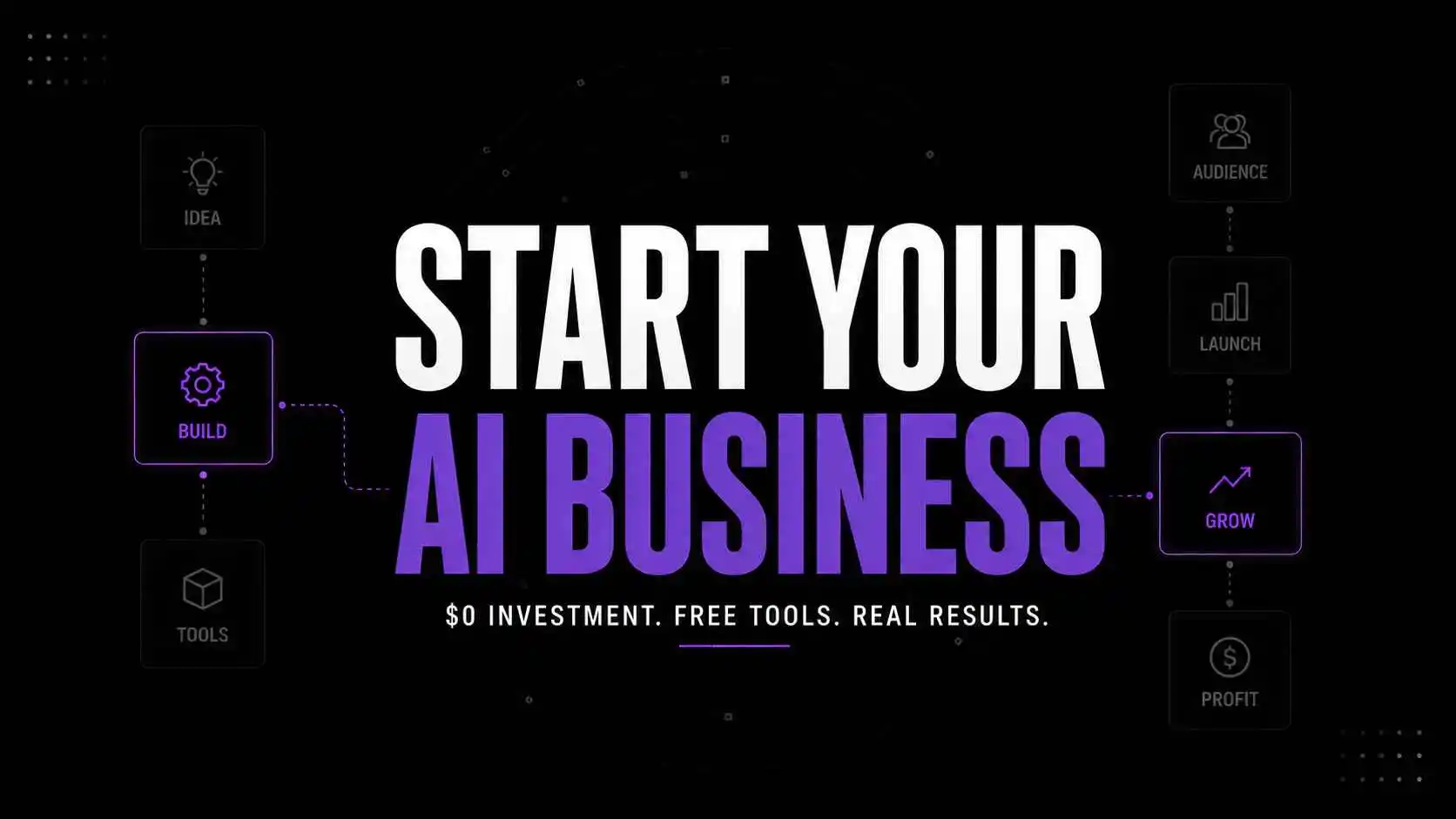
You don’t need funding, a co-founder, or a hiring budget to build a real business in 2026. A stack of free tools for startups powered by AI, used in the correct sequence, will get you to real customers and revenue. Here’s the correct sequence in a simplified format: validating the idea, content creation for discoverability, customer acquisition without a team, and operationalizing at scale.
Most founders fumbling their way through the process of building an AI-native business make the same rookie error when choosing their first tools: jumping to the cool free tier of whatever piece of AI software is popular at the moment and missing out on the critical first step of testing demand for anything they plan to sell. The spread between companies that use AI tools correctly and incorrectly is massive: according to JPMorgan Chase Institute data, only 17.7% of small businesses have paid for an AI tool, despite the overwhelming majority using at least one tool in some capacity. Tools with a generous free tier are the right place to start before paying for a tool when revenue allows.
You can build this entire workflow without paying upfront. The only time you should pay is when a tool becomes the bottleneck, not before.
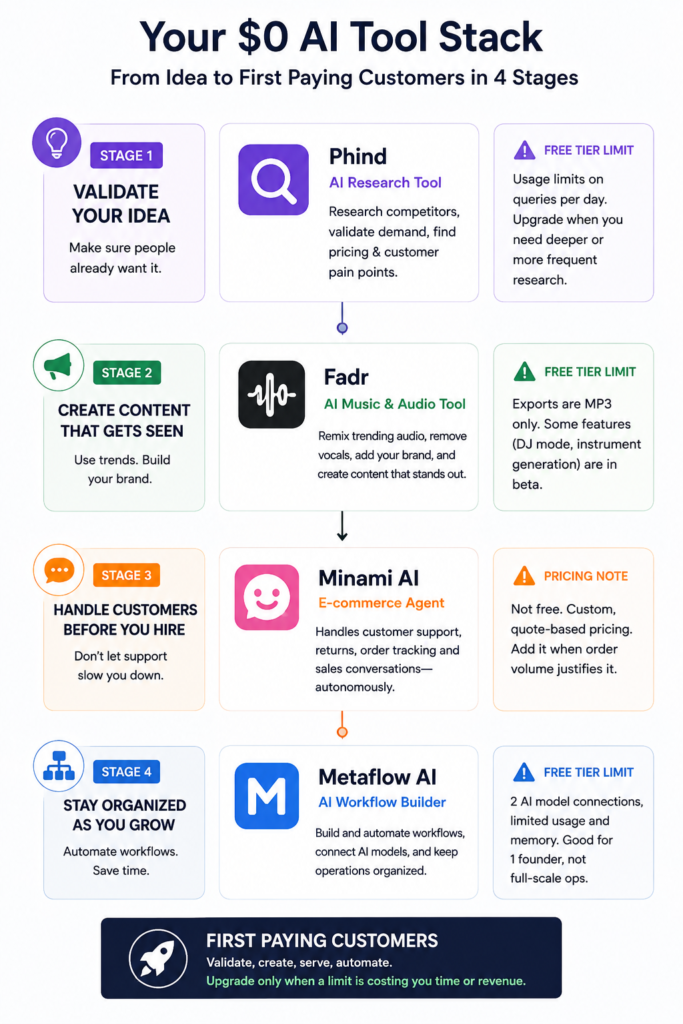
Stage 1 : Validate your idea before you build anything
Goal: Find out if people already want this, before you spend a single hour building it. This is the first and most overlooked step in any list of free AI tools for solo founders.
- Write down the problem you think you’re solving in one sentence.
- Search for that problem using a free AI research tool. Ask it who’s already solving this, and how.
- Look for existing paid solutions. Note what they charge.
- Look for complaints about those solutions on forums, Reddit, or review sites. This is where your opening is.
- Ask yourself: is anyone already paying for a rough version of this? If yes, move to Stage 2. If no, that’s useful information too don’t skip it.
Time needed: A few hours, not a week. For a deeper walkthrough of this exact step, see AI research tools for founders: Validating ideas before building.
Stage 2 : Create content that actually gets seen
Goal: Get your first pieces of content out using free tools and without hiring an editor. This is one of the most powerful entries in any best free AI automation stack list since content is one thing a $0 founder cannot avoid.
- Pick a popular short audio clip from TikTok or Reels.
- Open Fadr (fadr.com) it’s free for unlimited stem separation, remixing, and DJ-style edits.
- Upload the trend track and separate the vocals from the instrumental.
- Add your voiceover or branding on top of the instrumental.
- Change the key or tempo to make it sound different from the original trend.
- Export the audio as MP3 (on the free plan, lossless WAV requires a paid subscription).
- Post the track, you now have your content which utilizes a trend and does not require stock content or an editor.
Watch out for: Fadr’s free plan is generous, but exports are MP3 only, and two features (DJ mode, instrument generation) are still in beta. If you want more tools like this, check out our guide to Beyond ChatGPT: 7 AI tools small businesses should actually be using in 2026. It puts tools like Fadr into the bigger picture of building a business.
Fadr
Fadr is an AI music creation and remixing platform that helps users separate stems, create mashups, generate vocals, and remix tracks directly in the browser. It’s popular among DJs, producers, creators, and hobby musicians looking for fast AI-assisted music workflows without complex production software.
This kind of content-first mindset is part of why ai tools for gen z entrepreneurs tend to have more audio and video focused tools than straight writing based alternatives and why the platforms these younger entrepreneurs use focus so heavily on voice and video.
Stage 3 : Handle customers before you hire anyone
Goal: Make sure customer support doesn’t become your second full-time job.
- Start manually – When your first orders begin to appear, respond to support requests yourself or with a free chatbot service. This will be sufficient while your order volume is low.
- Identify the most frequent questions and concerns and write them down. Where is my order? Can I get a refund? Is this available in a different size? etc.
- Stick with manual support or a free chatbot while volumes are low. Once support starts becoming the bottleneck, that’s when a paid tool like Minami AI starts making sense.
- Minami’s pricing is custom and based on quotes, so it’s not something you should sign up for at the $0 plan stage.
Minami AI
An autonomous AI agent designed for eCommerce that manages order edits, shipping issues, returns, and exchanges without manual intervention.
When to automate customer support
This is the moment most “ai agent for small business free” searches lead people astray plenty of agent tools solve real problems, but not all of them are free, and pretending otherwise only prolongs the workflow fix you actually need. Even at the enterprise level, McKinsey’s 2025 State of AI report found that most companies have some form of AI either in pilot or production, but rarely do they go beyond the experimentation phase when it comes to the tools themselves. The tool was never the hard part. The systems around it are. If you’re trying to decide whether to build or buy, our guide to AI agents vs automation: which one should small businesses use in 2026? breaks it down. Running a SaaS team instead? Customer support AI workflow: how SaaS teams fix ticket chaos shows what that looks like in practice.
Pause and think: If a support ticket came up, do you know who is on call? If your team would need to scramble to understand how a new ticket would be handled, you should fix that before investing in any support tickets tool.
Stage 4 : Stay organized as you grow
Goal: Replace sticky notes and memory with something that actually tracks your workflow.
- Take a sharpie and list all the recurring tasks for your business that can currently only be done manually. For example, routing new signups, tagging company leads, or any other tasks of that nature.
- Sign up for Metaflow AI – no-code worflow & AI agent automation tool with a generous free tier.
- On the free plan, you can connect two AI agents and start building out simple automations with visual blocks.
- Take one of the tasks from the first step and build an automation around it. Try not to build too many at once.
- Test it, let it run for a week, and move on to the next task from your list.
- Note : Free for the first 14 days, then paid plans start at $19/month.
Metaflow
Metaflow is an AI marketing agent platform built for growth teams, founders, and marketers. It helps automate SEO, AEO, outbound, content workflows, paid campaigns, and growth operations using AI agents, workflows, and a visual builder.
Know the limit: the free plan has a usage and memory limit. It works well for solo workers or a small team but not for large-scale operations which is where you’re aiming to take your project. Once you’ve outgrown a couple of simple automations, our guide to The 7 roles to automate for solo founders can help you decide what to automate next.
The full free stack : Quick recap table
| Stage | Tool | Best For | Free Limit | Upgrade When… |
|---|---|---|---|---|
| 1. Validate | AI research tools | Confirming demand before building | Most core research is free | You need deep, ongoing competitive tracking |
| 2. Content | Fadr | Fast, branded short-form audio content | MP3 export only, some features in beta | You need lossless WAV or full drum/instrument separation |
| 3. Customer Ops | Manual/chatbot → Minami AI later | Handling early support without hiring | Manual/chatbot is free; Minami is paid | Support volume is eating hours you need for growth |
| 4. Operations | Metaflow AI | Automating your first repetitive tasks | 2 connected AI models, capped usage/memory | You’re running more than a couple of workflows solo |
Rule of thumb: Never upgrade because a free trial ended. Upgrade because a workflow has become the bottleneck.
Quick self-audit before you spend money on AI
┌─────────────────────────────────────────────────────────┐
│            AI STARTUP SELF-AUDIT CHECKLIST              │
├─────────────────────────────────────────────────────────┤
│ □ I validated that people already pay for this problem  │
│                                                         │
│ □ I found customer complaints online                    │
│                                                         │
│ □ I published at least 5 pieces of content              │
│                                                         │
│ □ I answered customer questions manually first          │
│                                                         │
│ □ I know my 3 most repetitive daily tasks               │
│                                                         │
│ □ I automated ONE workflow before adding another        │
│                                                         │
│ □ I know exactly which free tool limit I'll hit first   │
│                                                         │
│ □ I have a reason to pay—not just a new shiny tool      │
└─────────────────────────────────────────────────────────┘
Score yourself0–3 ✓ → Stay focused on validation.4–6 ✓ → You're ready for consistent growth.7–8 ✓ → Start investing only where your workflow is breaking.Why this stack works better than installing 30 AI tools
Most founders sell themselves short by investing in the wrong tools. Most founders invest in the wrong tools because they bought in to ten different solutions before finding a single customer that wanted what they sold. Adding more software to an unsolved problem does not solve that problem, it just makes your eventual pivot easier and more automated.
This stack works because it follows the logical progression of solving a business need in order to generate value for the company. You start with proving that there is demand, then you work on getting found by an audience, then you have to focus on the product that actual customers want and finally you need to layer the software on top of the process to automate the workflow that is now in place. This stack creates value by addressing the issues you are currently having, not the problems you think you are going to have in the future. This is an ordered stack and not a random collection of software subscriptions.
FAQs
You can get to the point of validated idea, content, customer handling, and organized operations with free options only. But rarely any of these tools will scale with you indefinitely, and most will cap out at a certain point of usage or features.
Not an integrated suite, but rather a set of specialized, browser-based tools that solve a specific problem, be it research at the idea stage, Fadr-like tools for content creation, and no-code AI tools for automations, like Metaflow AI.
Free versions of AI agents have limitations, be it in the output quality, features, integrations, or have a strict usage cap. But I think it is important to not waste time on the free tier if there is a particular bottleneck preventing you from moving forward or limiting your growth.
Final verdict
The toolset delivers an unparalleled value proposition for a solo founder: getting him from idea to his first paying customers for free. It doesn’t deliver beyond that for a reason, and not because the stack lacks flexibility. Every tool has a ceiling, be it Fadr’s export quality, Metaflow’s AI consumption or Minami’s open-ness and willingness to let you host your data on their servers for free.
The founders who build something durable treat these free tiers as scaffolding. Business.com’s 2026 Small Business AI Outlook found that small businesses that make serious investments into AI are already using it to augment not just customer-facing, but also product development, operations, and financial management processes. But that is a stage two priority, once a business has secured sustainable revenues. The way you scale an AI-native business with limited resources is to adopt the freemium software, test the water, and only pay for the specific processes, that started to become a bottleneck for your growth.
Paying for the tools in advance, without understanding which of them is a bottleneck for your operations, is what causes the founder to overpay for the wrong tools.