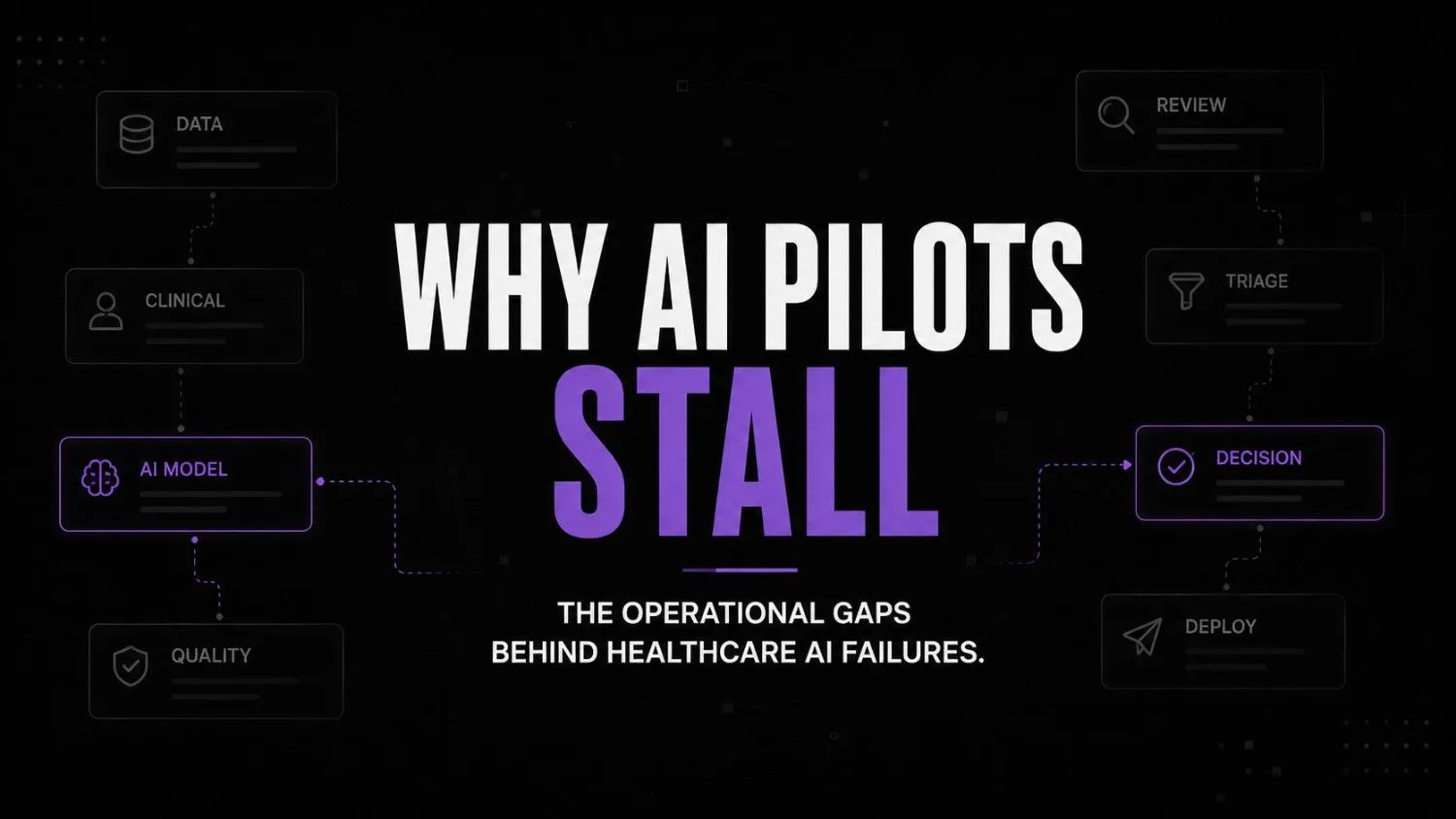
A hospital system takes eight months to build an AI tool for radiology triage. It works beautifully in the sandbox. Three weeks after going live, it was shelved. No one in the room that day thought the model was the problem. They were wrong about what was.
Key takeaways
- There are numerous healthcare AI pilots that never reach production and the industry analyses the number of pilots that never launch is likely to be around 80%.
- One of the main contributors to projects stalling includes a lack of data readiness to support an AI product as opposed to concerns about the model quality.
- Healthcare AI pilots who have defined measurable success metrics have a higher rate of successful project completion than their counterparts without success metrics defined prior to launch.
- Most healthcare AI implementation efforts breakdown at the EHR and workflow layer as opposed to the algorithm.
- Scaling of a healthcare AI product is not predicated on an increased budget; rather it is dependent upon a state of operational readiness including appropriate governance strategies, sufficient staff adoption, and effective monitoring.
Introduction
The radiology tool was correct. The tool identified the right patients at about the same level as it did during the evaluation phase. However, the tool did not account for a resident who was working after eleven hours in a shift questioning a machine which had no information as to why the image appeared the way it did that day.
Most AI implementations in the health care industry will be unsuccessful because of the space between developing a model that has been proven to work and implementing it into an operational process. Enterprise AI adoption in the health care industry has shown that out of 33 pilot projects that are launched by a health care organization, only 4 make it into production.
This is not a review of current AI trends or a comparative analysis of product offerings by vendors. Instead, this article represents what occurs over a six month period between a demo that receives standing ovations and a deployable application that either works or fails.
The radiology pilot didn’t fail because of the model, and here’s what actually happened
The team created something that truly worked well. Problems occurred due to three pre-patient chart decisions made prior to the tool being deployed. First, there were no criteria established regarding success. Therefore, the definition of success was limited solely to the performance of the model. There was also no specification regarding an acceptable override rate and what would occur should a physician disagree with its assessment.
The second reason for this failure occurred when the application was installed into the EHR by the IT department. No radiologists were involved during development. While the application functioned as expected, it did not operate as the physicians or radiologists read images.
Third, when overrides began occurring in week two, no one reviewed those overrides. Those discrepancies accumulated until administration recognized that the use of the tool had essentially come to a standstill. At that point, the narrative around the hospital became, “We attempted to implement AI and it did not work,” and that narrative ultimately led to the demise of the project. While the AI tool itself was not responsible for the death of the project; it was the decisions that were made prematurely and not owned by anyone until they could no longer be corrected quietly. Most failed AI adoptions within the health care industry follow this exact pattern. It is rarely a technological failure but instead an error based upon a decision made too soon and not revisited until it is too late.
Why healthcare AI pilots rarely make it past the pilot stage
By 2025 an analysis conducted using both RAND Corporation and McKinsey data indicated that approximately 78.9 percent of all healthcare AI projects had failed to produce the desired outcomes, and that statistic has remained relatively constant since the amount of funding available for these projects has increased significantly as well as the availability of new technologies. Data integrity issues are often the first problem encountered. Each hospital typically operates using a multitude of systems (usually around a dozen), none of which were created to interact with one another. Most organizations do not identify data integrity issues until after they have been working through problems related to implementation for at least six months, not immediately upon installation.
Governance is typically identified as the next major issue. In fact, there is no governance structure established to define success prior to the start of a pilot program. Nobody owns this until it breaks, and by then it’s a maintenance problem, not a planning one.
Pause and think : If your pilot ended today, can you name the three key performance indicators used to measure its success? If your answer requires more than a few seconds to provide, then that is essentially the true project facing you now.
Adoption by staff is typically cited as the third major issue, and yet, it is almost always the initial barrier to successful implementation. An application developed without input from those individuals responsible for implementing and using the technology will likely be unable to sustain long-term viability once it encounters “real-world” usage by staff.
That instinct to develop solutions and involve staff in future stages of the process is what causes an otherwise fixable pilot project to become just another AI adoption failure story.
The barriers that actually stop enterprise AI adoption in hospitals
Integration of an AI solution into existing EHRs is at the top of nearly every list of reasons why projects remain stalled. Claims feeds, pharmacy systems/formularies, and scheduling systems were never designed with artificial intelligence in mind, therefore retro-fitting them becomes a significant contributor to extended timelines.
Compliance with regulatory requirements presents another layer of complexity that many other industries do not encounter. Clinical validation is mandatory rather than discretionary, similar to clinical trials or research studies in academia; however, failing to include this step to meet a go-live date ultimately leads to the removal of a pilot program from production six months later instead of providing an opportunity to correct errors and continue.
The successful scaling of any business team treats their health care AI implementation first as an AI workflow infrastructure project and second as a technological deployment. Those teams which treat it as just another software product release typically rebuild the same pilot twice, usually with much less institutional buy-in on the second iteration.
Budgetary limitations also play a significant role; however, this influence is generally contrary to how most leadership teams would anticipate. Most leadership teams do not view AI as being overly expensive; rather, they tend to underestimate or fail to budget for the associated redesigning of workflows necessary for its implementation. For many organizations, actual deployment costs have been shown to be from $30-50% over and above the quoted cost, once the costs of migrating the data, training the AI model and optimizing the process are considered. These additional costs create significant financial uncertainty within finance departments and when leadership cannot address these concerns, it is frequently the signal of the end of the pilot.
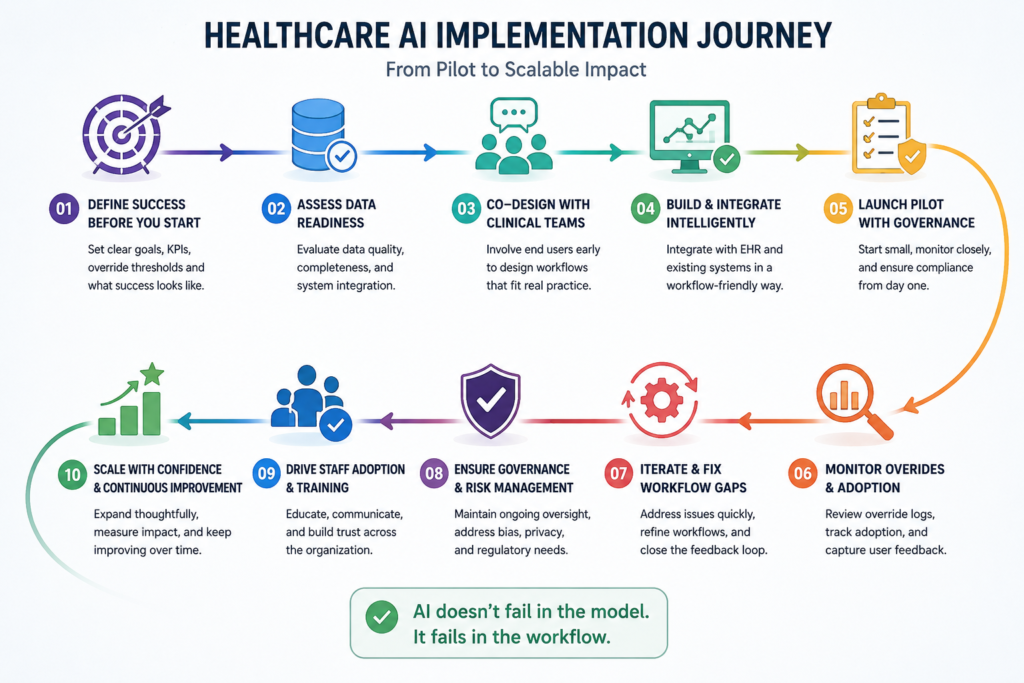
Healthcare AI Pilot ↓Define Success Metrics
(before launch) ↓Assess Data Readiness
(EHR + Claims + Quality) ↓Build With Clinical Staff
(not IT alone) ↓Launch Pilot ↓Track Overrides &
Workflow Adoption ↓Review Governance &
Compliance ↓Fix Workflow Issues ↓Scale Across
Hospital SystemWhat thinking-first healthcare AI implementation actually looks like on a Tuesday
Consider a moderate sized hospital system at approximately six weeks after initiating live deployment. At 7:15 a.m., the operational leader views a common dashboard to determine if the previous night’s AI tool operation produced any notable activity. However, he is viewing the dashboard to determine if any clinicians utilizing the tool during the prior shift had identified anything unusual related to the use of the AI tool.
By 8:00 a.m., there is a 15 minute daily meeting with IT, one nurse manager, and a member of the compliance department. Rather than serving as a status report, this is essentially a “what went wrong” discussion each morning for six weeks until reduced to twice per week (as operations begin to stabilize).
By 11:30 a.m., someone retrieves the override log from the previous week identifying those occasions where a clinician disagreed with the AI’s recommendation/decision and actually reviews it. Review of such logs by staff members has been demonstrated to be an excellent predictor of whether an organization will ultimately implement/pursue a scalable solution.
The key to an A.I. pilot scaling up in just one month (as opposed to being forgotten six months later) is the consistent rhythm of that pilot’s A.I. workflow. The other critical component of creating a scalable A.I. pilot is a common understanding across all stakeholders of what needs to be done each day.
The wrong approach vs the right approach
| Wrong approach | Right approach |
|---|---|
| IT runs the entire AI project on its own. | IT, clinicians, and compliance own it together. |
| Success is simply “the model works.” | Success is tied to clear clinical and operational outcomes from day one. |
| Data issues are fixed after deployment. | Data quality is checked before the pilot even begins. |
| Clinician feedback is gathered casually when there’s time. | Feedback, overrides, and disagreements are reviewed every week by someone accountable. |
| Leadership decides when it’s time to scale. | The decision to scale includes input from the teams using the system every day. |
Most companies don’t end up in the wrong column on purpose. They usually drift into it because nobody was assigned ownership of the right one.
Before scaling beyond the pilot stage, ask these five questions:
- Do you have an established agreement on defined success metrics before launching the project?
- Did the clinical staff participate in building out the project rather than just rolling it out?
- Is there a person assigned to take ownership if there are workflow problems after launching the project?
- Has your data been evaluated across any system that the artificial intelligence interacts with to ensure quality?
- Do you have a plan for what happens when the AI disagrees with a clinician?
If you answered “no” to more than one of these questions, the gap isn’t the technology in front of you. It’s the operational structure underneath it, and that’s something most organizations can fix faster than they expect.
The tools that actually support healthcare AI implementation, staged by where teams get stuck
Data readiness stage
Many organizations do not appreciate the value of Innovaccer, bringing fragmented EHR & Claims Data together into a single platform for the first time for their teams, providing usable data for deployment teams prior to the start of the pilot. Skipping this step is often why many pilots stall within several months of beginning the rollout instead of sooner.

Innovaccer
Innovaccer is an AI-powered healthcare data and intelligence platform that helps healthcare organizations unify clinical, financial, and operational data into a single platform. It enables providers and payers to automate workflows, improve patient outcomes, and accelerate value-based care initiatives.
At Regard, we focus on identifying gaps in Clinical Documentation, such as missing diagnoses or inconsistent entries in patient charts, which can negatively affect Model Accuracy. While Regard is likely the least visible piece of your implementation process, it will help identify potential larger problems early.
Regard
Regard is an AI-powered clinical insights platform that analyzes patient records, surfaces diagnoses, and generates proactive clinical documentation. It helps healthcare providers reduce documentation time, improve coding accuracy, and support better clinical decision-making.
Pilot and monitoring stage
While most teams track if the A.I. ran; few measure if the Clinicians are actually trusting and using the Recommendations from the A.I. As you begin to scale-up after the initial successful Pilot Phase, Qventus provides visibility into the usage of A.I.-driven Recommendations inside Hospital Workflows, highlighting where Clinicians follow Recommendations and where they Override Recommendations.

Qventus
Qventus is an AI-driven hospital operations platform that automates operational workflows across care settings. It helps health systems improve patient flow, optimize capacity, reduce delays, and increase operational efficiency using predictive and generative AI.
To ease the Administrative Burden that may cause Clinicians to be reluctant to adopt New Tools, Suki AI provides Ambient Clinical Documentation support during the Pilot Phase. Reducing this burden early builds Clinician Confidence and Encourages Adoption through-out the Rollout Process.
Suki AI
Suki AI is an ambient AI healthcare assistant that automatically generates clinical documentation, answers medical questions, and streamlines administrative tasks. It helps clinicians spend less time on paperwork and more time delivering patient care.
Scaling stage
As you continue to expand the rollout of your A.I. beyond the initial Pilot Phase, LeanTaaS supports Capacity & Resource Planning efforts. This is typically when Operational Pressure becomes evident, and where decisions regarding where to place A.I. Workloads need to be made.
LeanTaaS
LeanTaaS is an AI-powered healthcare operations platform that helps hospitals optimize capacity, improve patient access, and maximize the utilization of critical resources such as operating rooms, infusion centers, and inpatient beds. It enables health systems to increase efficiency without expanding physical infrastructure.
FAQs
Why do health care AI pilots fail despite an effective technology?
Technology is rarely an issue. The problem is usually in the workflow. A model can be right, but if no one thought through how to integrate it into day-to-day operations, it cannot function effectively.
How long should health care pilots run for before scaling up?
At least a whole quarter in order to see the edge cases. Moving too quickly is a frequent mistake, often resulting in failures during the first attempts at scale.
Who should own an AI implementation project – IT or lines of business?
Not IT, ideally – or rather, not IT alone. The most effective implementations tend to be jointly owned by operational, clinical, and compliance groups from the beginning.
What is the biggest hidden cost associated with implementing AI in health care?
The biggest hidden cost is usually the disruption to the workflow. The budget often does not account for the amount of time spent retraining, rewriting procedures, and so on.
If a hospital system’s pilot fails, does that mean that the AI was not right for them?
Usually not – more frequently, it was not ready to fully adopt the accompanying changes in operations. This is a fundamentally different challenge, requiring a fundamentally different response.
Conclusion
The next wave of health care AI implementation will not be driven by the organization who has the most advanced model; instead it will be based on an organization’s ability to treat scaling as an operational discipline rather than only as a technology milestone (the shift that is already taking place). (A similar shift is occurring in organizations that have stopped launching new pilots and have focused on fixing the governance behind their current pilots).
If the next pilot in your organization were to be evaluated based on workflow readiness rather than measured by accuracy, what would change within your organization?
Your next move
Obtain the override log for your current AI pilot project (if you currently have one) and review the last ten incidents where there was a disagreement between the tool and a clinician. This one simple exercise will provide far more insight into your organization’s readiness to scale than any vendor’s marketing pitch could possibly provide.