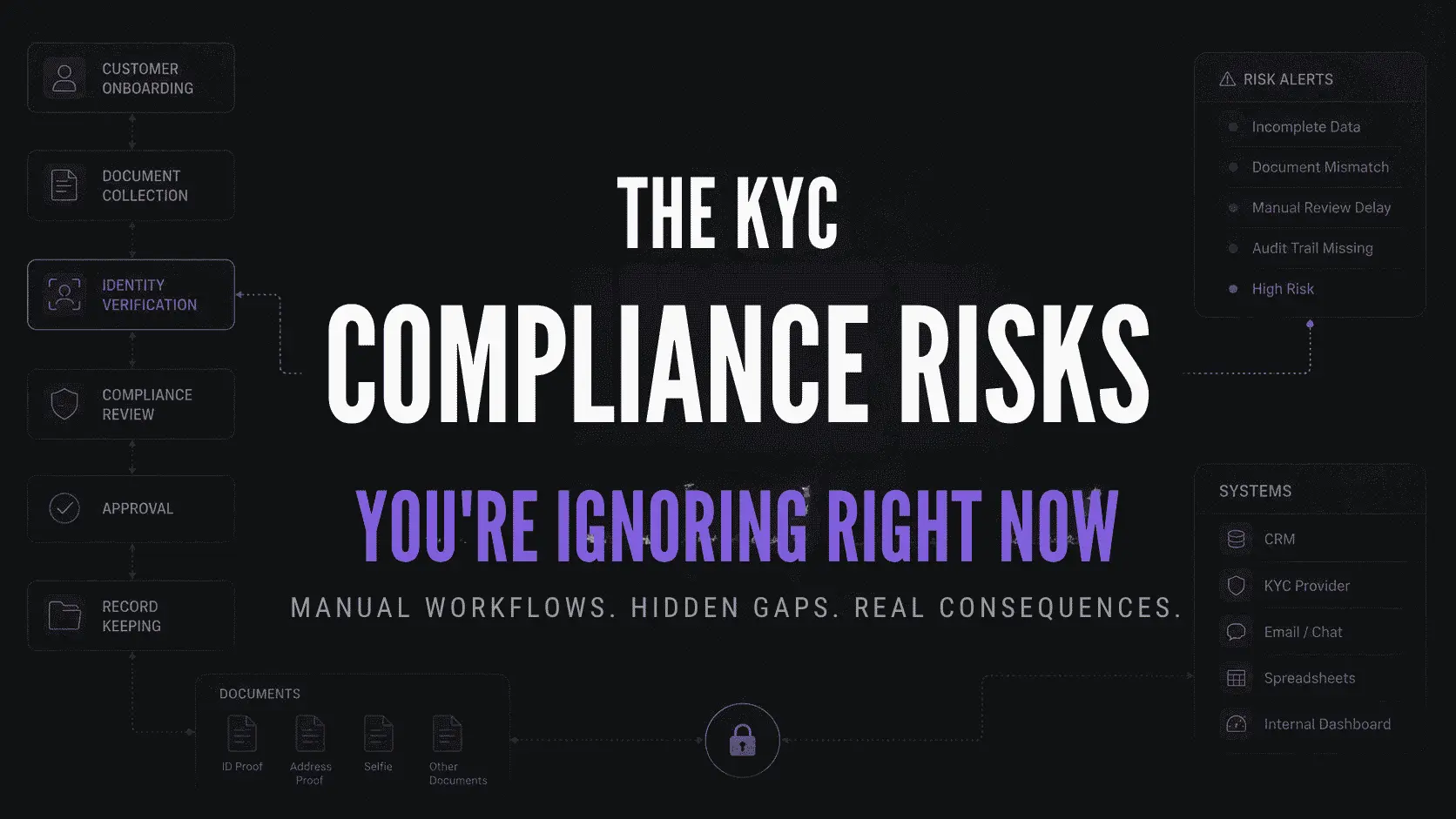
Running a fintech firm focused on daily tasks hides a quiet danger – never brought up in executive meetings. Being prepared matters when regulators show up unannounced; it’s not about if but when. Trouble builds silently through the customer entry process, fed by clunky data transfers across check systems, undocumented human steps, and workflows failing beyond small loads. Once expansion hits a threshold, what once seemed manageable turns into deep-rooted breakdowns. These flaws stop being quirks – they start breaking things. This happens every time rules get enforced. Overnight freezes follow because of how fast systems react.
According to an analysis by industry professionals, institutional compliance issues mostly occur in cases where there were manual data-related procedures that had been left unaccounted for rather than actual instances of violation of any rules. Such statistics matter a lot when it comes to understanding why institutions need to comply. In the past ten years, financial institutions around the world have spent in excess of $26 billion on penalties for failure to comply with rules. This was in the majority of cases linked to mistakes made in the process of customer due diligence and verification procedures.
Key Takeaways
- Disconnected systems create audit gaps during manual reviews.
- Fragmented KYC onboarding workflows directly increase user drop-off.
- Manual compliance tracking introduces human variance into risk scores.
- Operational scale requires unified data layers over point solutions.
Here’s when things start going wrong. A snapshot of the passport moves from one system to another, carried by the reviewer who pastes it into a second dashboard before wrapping up. Just a few seconds pass each time. Yet each move weakens the safety of the record. Doing this daily? Signs of risk pile up faster than expected. Cost might come with point solutions, yet trust in your workflow feels stronger. Still, what shows up instead is chaos – hand-driven steps piling up without clarity.
Why your current KYC verification workflow is an operational trap
Starting out, hardly any fintech firms aimed to build messy workflows on purpose. When one tool checks identification papers, while a separate system handles unusual cases, it feels logical enough. Only when the volume climbs does strain show. Fifty requests per week? Smooth sailing. The oversight group jumps in once patterns shift slightly off track.
Yet it’s not the tech itself causing trouble instead, how work gets handed out makes the difference. What matters sits in who does what, not the tools used.
Most spots needing human help start falling apart once things scale up. Confirming just one questionable file means switching back and forth messages, outside tools, central records – for the analyst. Repetition hits, then that step vanishes without notice.
The illusion of point-solution security
Out in the open, a fortress takes shape only when the state machine anchors everything beneath. Without that center, buying tools just locks data apart. One part touches the live file directly. Elsewhere, a separate setup scans through politically exposed names. Silos rise where links should run. A machine that matches faces can be found here too. Once every job finishes, everything powers down.
When those systems fail to pass updates between each other, a worker at your company steps in. Without a single source of truth, they face mismatched details floating around. Mistakes creep in once confusion takes hold. This is how you neglect the core AI workflow infrastructure required for long-term survival.
The downstream effect is just as damaging. Pipeline stalls on manual handoffs push time-to-activation up, and applicants who were ready to convert simply leave directly causing revenue leakage from fragmented deal desk workflows and slow conversion funnels.
The hidden cost of reviewer fatigue
If you submit the identical paper to two separate reviewers, you may receive two different conclusions. Because of the pressure to clear a backlog at 4:45 PM on a Friday, one reviewer may reject an energy bill because it is confusing, but another reviewer will approve it without thinking twice. For the purpose of an audit trail, neither decision can be adequately documented. Such deviation in the process can lead to a cycle of failed AI adoption because your internal tooling lacks the operational context to catch it.
- Pause and think: How long would it take you to compile the information if an external auditor asked you to provide the precise justification for each manual override your team performed last month?
What structural compliance actually looks like operationally
Imagine you’re at your desk Tuesday morning, inside the control hub of a live system. A client sends in a request for a digital loan account. Their last name rings a bell – probably just coincidence – but it flags because it looks like one on the sanction roll. Sounds odd? Maybe. But mismatches happen when names overlap.
A warning shows up in the standalone scanner’s task list whenever the setup runs on an older, manually managed structure. Should a reviewer notice the customer’s date of birth does not match what got flagged, access is made to your organization’s distinct administrative interface. There, the documents provided by the individual are examined closely. A note labeled “False positive, clearing user” lands in the private group conversation used by staff. The call gets confirmed without delay.
Still just a standalone scanner, nothing different there. A chat note once explained why it got cleared. Six months later comes a regulator asking about that account. Now the system flags the approved person as high risk, sitting right beside them. That chat explanation? Gone without a trace. Your company is going to be under investigation due to one system update. Without rigorous AI workflow maintenance, Such a kind of subtle erosion will happen all across your entire pipeline, and you will not know anything about it till the time that an auditor spots it.
Under the system-first method, none of this works. The moment it happens, a screen alert locks the user’s account on every service instantly. Talking won’t help the analyst regain access. Instead, they have to submit the standard resolution document during the real procedure.
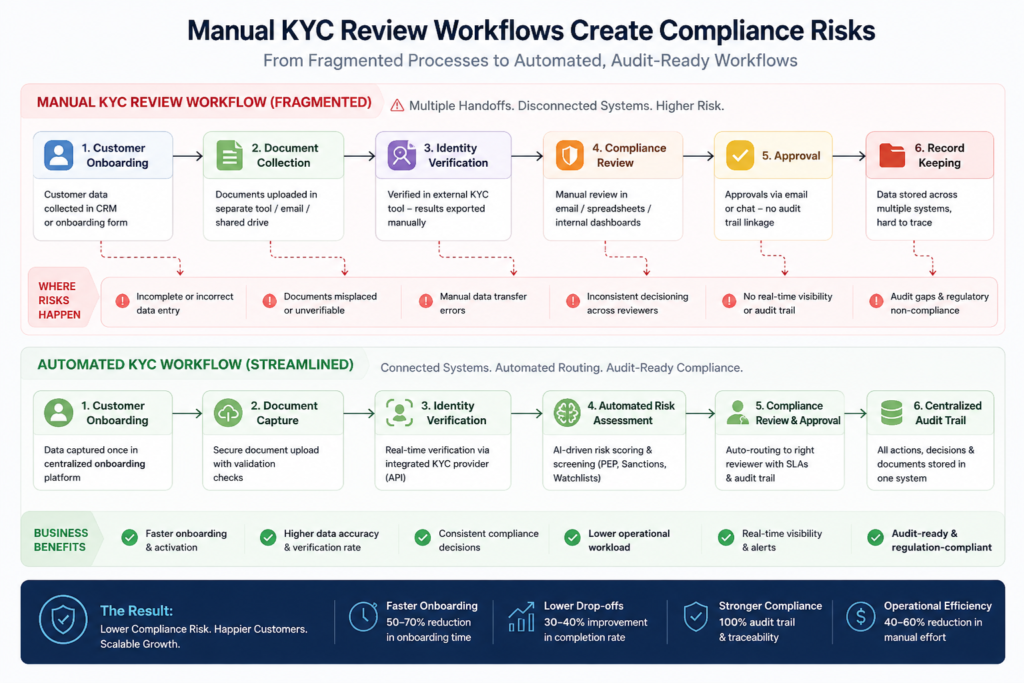
System Fragmentation Mapping
[CRM Entry]
     │
     ▼ (Manual Data Entry / Copy-Paste)
[Document Verification Portal]
     │
     ▼ (Slack/Email Approvals)
[AML Screening Tool]
     │
     ▼ (Unlogged Operations Session)
[Compliance Review Dashboard]
     │
     ▼ (Manual Spreadsheet Audit Log)
[Final Approval Output] ──► (Inconsistent decision & data gaps)
Point solutions vs system-first compliance architecture
| The point solution mess | The system-first architecture |
|---|---|
| Customer information gets re-entered across multiple verification systems, creating unnecessary handoffs and increasing the chance of mistakes. | Customer data moves automatically between verification services through a centralized workflow layer. |
| Critical compliance records end up spread across chat messages, email chains, spreadsheets, and disconnected platforms. | Every decision, API response, and reviewer action is captured within a single auditable timeline. |
| Teams rely on written policy documents and institutional knowledge to apply risk rules consistently. | Risk policies are enforced directly within the workflow logic, reducing interpretation gaps. |
| As onboarding demand increases, operations teams often need to add more reviewers just to keep pace. | Routine approvals are handled automatically, allowing specialists to focus on exceptions and higher-risk cases. |
| Different reviewers may reach different conclusions because the supporting information lives in multiple systems. | Analysts work from a shared source of truth with complete visibility into the customer journey. |
Your internal operational audit checklist
In order to get a clear idea about the vulnerabilities of your system, it’s important to pay attention to how you handle data. Take a short self-audit with regards to your current workflow:
- Does your company download user identity documents manually onto personal computers for review?
- Are manual overrides recorded separately from the main customer data base?
- Are there more than three dashboards of different software open simultaneously during a regular account review?
- Are internal chats used in order to decide whether an applicant should be approved or denied access?
If you answer “yes” to two or more of those questions, then your system has vulnerabilities that will become apparent during the next regulatory check up. No single tool purchase fixes that. It points back to a foundational failure in operational workflow design that tools alone cannot fix.
Engineering an optimized fintech onboarding process stack
Just because there are more gadgets around does not mean the problem goes away. Each one needs a clear role, placed in order so things follow naturally from one to the next.
Document and identity ingestion
Jumio

Jumio
Jumio is an AI-powered identity verification platform that helps businesses verify users through ID document checks biometric authentication and fraud detection. It enables secure digital onboarding for industries including banking fintech healthcare and online marketplaces while helping organizations meet KYC and AML compliance requirements.
This works like a basic checker for most groups. Still, calling it just that misses what it can really do. Picture this: it acts as the outer shield of your setup, running the first live-face scan on files while also checking real ID papers.
HyperVerge

HyperVerge
HyperVerge is an AI-powered identity verification platform that helps businesses automate document verification, facial recognition, KYC onboarding, and fraud detection. It is widely used by fintech companies, financial institutions, and digital platforms that need fast and reliable customer verification.
Out there, where paperwork shifts with every border, standard OCR tools fall apart quickly. Not built for that chaos. Messy scans? Blurry forms? Doesn’t matter. This system pulls readable text straight out, skips manual typing entirely. Recognition works sharp, even when images look broken. On top of that, it compares results against regional registries, adapting on its own. Every variation accounted for.
Global identity orchestration
Trulioo

Trulioo
Trulioo is a global identity verification platform that helps businesses verify customers and businesses across countries using identity data, document verification, fraud prevention, and compliance solutions. It is designed for companies that need scalable KYC, KYB, AML, and customer onboarding workflows.
Most of the cost vanishes once full AML checks happen only after customer validation. Costs climb fast if those steps come too early. Scattered sources – global databases, credit offices, utility histories – weave together to verify a person exists while matching every ID point.
Onfido

Onfido
Onfido is an AI-powered identity verification platform that helps businesses verify customers using document checks biometric verification and fraud detection. It is designed for companies that need secure digital onboarding while meeting KYC AML and compliance requirements.
Because global rules overlap unevenly, extra steps pop up when systems check identities across borders. Matching photos to official records happens locally, yet results flow directly into the processing pipeline. This delay – built into ongoing checks – is how mismatched regulations reveal themselves during verification. Each region’s paperwork demands create small hurdles that slow down seamless approval chains.
Regional compliance execution
Signzy

Signzy
Signzy is an AI-powered digital onboarding and compliance automation platform that helps financial institutions and businesses automate KYC, identity verification, document processing, and regulatory workflows. It is especially focused on banking, fintech, and enterprise use cases with strong support for India-focused digital verification requirements.
Most worldwide tools miss how tight the rules can be in certain areas. They often skip local paper layouts or bank file setups completely. Built right into country-level business registries and regional financial listings, this one pulls data straight from the source. When unique steps are required for local laws, it shapes filings accordingly – no extra pieces needed.
High-Scale Operational Onboarding Architecture
When things get big, going through each dashboard by hand falls apart. Long waits, personal judgment calls, shaky records – regulators will pounce on that mess. Something has to sit over the top of the system, guiding flow, or growth just breaks everything.
FAQs
Why can’t we just use internal spreadsheets to log our manual compliance overrides?
Spreadsheets lack immutable audit trails and access controls. Anyone can edit a cell accidentally, meaning you lose your historical accuracy and cannot prove your compliance posture to an auditor.
How does a fragmented KYC onboarding workflow impact our customer acquisition costs?
When your systems are disconnected, review times slow down drastically. Customers face long waiting periods, lose interest, and abandon the registration process to sign up with a faster competitor.
We use a premium identity verification provider so aren’t we already fully compliant?
No. An identity provider only gives you a point-in-time assessment of a document or a face. Compliance requires a secure process that connects those individual assessments to your overall account management lifecycle.
What is the fastest way to unify our disconnected verification tools?
You need to build or implement a central orchestration layer. This software acts as a single source of truth, routing data between your tools based on automated business rules rather than human actions.
Should we automate our entire compliance decision process to eliminate manual reviews?
Complete automation is rarely possible due to complex risk profiles and edge cases. The objective is to automate the simple approvals and rejections so your expert team can focus entirely on high-risk exceptions.
The structural shift ahead for fintech operations
Growing a money-handling service by adding customers while using broken setups belongs to outdated thinking now. Not long ago, regulators looked only at written rules. These days they inspect how your data flows behind the scenes. Enforcement strikes when what you claim to do splits from what your tech actually does. Without fresh offerings, without entering new areas, without logs proving compliance, services relying on human-driven checks are nearing their endpoint.
Compliance isn’t tucked away behind desks anymore. It’s front and center where things actually move. Picture it like water through pipes – identity checks, tracking money moves, saving records – all feeding into each other without hiccups. No more handoffs that slow everything down. Smoothness becomes normal when steps stop feeling separate. This shift? That is how trust sticks around.
Your next move
Start with the latest five hand-approved accounts pulled straight from your main admin system log. Trace every detail backward until you hit where it began. When reconstructing why those choices were made means digging through messy text edits, saved images of screens, or separate reporting tools, the problem lives in how things are done, not what tools are used. Get your engineering team together and build one unified table to record every compliance exception. Complete this well ahead of when the next audit forces the discussion.