key takeaways
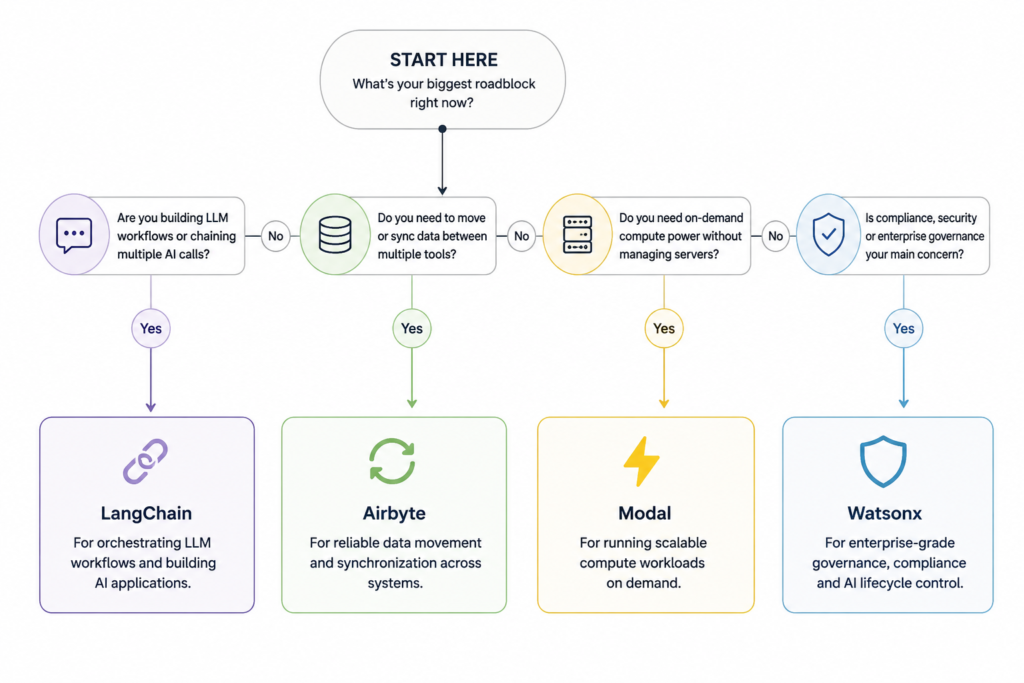
- LangChain, Airbyte, Modal, and Watsonx solve four different problems: orchestration, data movement, compute, and governance.
- A Gartner survey of 782 infrastructure and operations leaders found only 28% of AI use cases fully met ROI expectations, while 20% failed outright.
- MIT’s Project NANDA study of 300-plus enterprise AI deployments found 95% delivered no measurable financial return.
- The average company now runs over 300 SaaS applications, with roughly half of provisioned licenses going unused, according to Zylo’s 2026 SaaS Management Index.
- Most solo technical founders need one of these four tools for their current bottleneck, not all four at once.
Introduction
A solo founder Googling “LangChain vs Airbyte” is already in big trouble. Probably because the search suggests that either tool has a clear answer, and a founder who can’t distinguish between them probably has yet to define their own bottleneck. Google itself groups these under the same umbrella of “AI Infrastructure,” and thus they are presented as alternatives, but they are not. LangChain orchestrates LLM calls, Airbyte replicates data pipelines, Modal provides infrastructure for deploying code, and Watsonx governs enterprise-wide AI. Wrong choice in this list costs you a week of development time, but more importantly, wrong choice defines wrong challenge for your team.
This is expensive to get wrong. According to Gartner’s April 2026 survey of infrastructure and operations leaders, only 28% of AI use cases delivered fully realized value, and 20% were outright failures. The reason? The choice of tools was made without regard to the specific workflow that had to be automated.
LangChain vs Airbyte vs Modal vs Watsonx: why the comparison itself is the problem
A recurring pattern. A founder has a narrow, particular problem their AI feature’s responses are unpredictable, or their data is atomized across six SaaS tools, or their GPU bill is spiraling, or a customer’s procurement team is asking about compliance. They don’t search for the solution to their particular problem. They look for the best AI infrastructure tool and find an article aimed at a completely different buyer, an enterprise platform team, considering vendors for a twelve-month deployment.
That comparison format assumes you’re picking a category winner. You’re not. You’re picking a tool for a specific bottleneck. LangChain vs Airbyte vs Modal vs Watsonx isn’t really a four-way contest, it’s four separate one-tool decisions wearing the same headline.
What I’ve learned working with companies is that the founders who waste the most time doing the wrong research are the ones who never pinned down the problem well enough to know which comparison they’re really in.
What choosing AI infrastructure actually looks like operationally
Tuesday, 9 a. m. Three individuals form a technical triage at an early-stage AI start-up. Six weeks ago, one of them built a customer support assistant on top of an LLM API that works fine in a demo – but in production, it has “issues,” like erroneously pulling different account data depending on the run, and no one can say with certainty why any given query returns the result it does.
The team dynamic is such that it defaults to wanting to add a tool. Someone points out Watsonx because a competitor used it in a case study. Another one brings up Airbyte because the assistant needs to pull from 3 separate systems. They end up talking for twenty minutes without identifying what the core problem is.
Here is the critical factor and the deciding point: the assistant’s actual failure is unpredictable prompt chainings and the inability to define the exact step that went wrong. It is not a data-related issue since the data has already been processed and is available to be used, and it is not a governance-related problem, since the company does not have enough personnel to implement such governance measures. LangChain has been designed specifically for this issue, as it allows one to chain together prompts in a single run, managing the context, and tracing the run to identify points of failure.
Airbyte, while being helpful at transferring data between databases in a reliable and consistent manner, is not applicable in this situation, as it would only handle the data transfer part, thus not addressing the issue of unpredictable prompt changes. Finally, Watsonx would address the issue by providing extra governance tools, but the majority of them will be unneeded for a three-person team and a relatively simple model.
The value proposition for automation is not “buy a tool”, it’s “diagnose the right layer of the stack” and “buy the single tool that solves the problem for that layer”. That diagnosis takes fifteen minutes if you do it right. If you don’t, you’ll buy the wrong tools and pay for it twice
Pause and think: when you last evaluated an AI infrastructure tool, did you name the specific workflow that was breaking, or did you start from a feature comparison?
Wrong approach vs right approach
| Wrong approach | Right approach |
|---|---|
| Comparing four tools by the features list | Naming the specific first bottleneck, then picking the tool it is addressed by |
| Buying Watsonx governance at three different people | Adding governance software when a compliance requirement is a deal-breaker |
| Considering Airbyte as an LLM tool due to it being in the “AI stack” | Utilizing Airbyte only for the data integration problem it was bought to solve |
| Sitting on a GPU-based cloud platform running jobs 24/7 | Switching to Modal when servers’ maintenance starts costing too much engineering time |
| Getting on board with all four tools because they were found in the same search query | Using one tool per a specific problem, only the ones that were actual bottlenecks |
The four tools, by the problem they actually solve
LangChain: LLM orchestration
Problem solved: Chaining multiple LLM calls together, managing memory/context throughout a conversation, and providing insight into why a particular chain of reasoning has generated a given output.
Where it fits: Any product where the core function is some kind of multi-step LLM reasoning process an assistant that uses information from another LLM call to determine how to respond is the textbook example. This is the space where the Tuesday case study above failed catastrophically.
Why it matters: Without such a layer, companies write these chains by hand in application code, which is brittle and hard to reason about at scale.

LangChain
LangChain is an open-source framework that helps developers build, test, and deploy AI-powered applications and agents. It’s designed for engineers who want to connect LLMs with data, APIs, and workflows.
Airbyte: AI data integration
Problem solved: Being able to reliably sync data from various disparate sources, CRMs, support tools, product inventories, etc., into whatever the AI is pulling data from (the prompt).
Where it fits: Where the prompt determines the value of the AI response, but the data in the prompt is fragmented across five different tools that can’t talk to each other
Why it matters: A well-designed LLM chain that nonetheless has poor data inputs will still give poor results. This is a plumbing issue, not a reasoning issue, and a new plumbing tool is needed.
Airbyte
Airbyte is a data integration platform that helps teams move data from multiple sources into warehouses, lakes, and databases. It’s designed for engineers and data teams who need flexible, scalable, and customizable ELT pipelines.
Modal: serverless AI infrastructure
Problem solved: Running compute heavy or GPU intensive AI workloads without having to manually provision, patch, and scale servers.
Where it fits: Teams that are running their own models, fine-tuning, or doing batch inference, as a complement to teams that are making API calls to an external service and doing not other compute intensive work
Why it matters: A founder spending their engineering time on this is spending their time on a problem that could be solved by Modal, and therefore wasting time that could have gone into developing their product.
Modal
Modal is a serverless cloud platform designed for AI engineers and developers who need to run machine learning models, batch jobs, and GPU workloads at scale. It removes infrastructure complexity so teams can deploy AI workloads faster with minimal DevOps overhead.
Watsonx: AI governance platform
Problem solved: Creating compliance, audit trails, access controls, and risk management for AI systems at enterprise scale.
Where it fits: Teams selling into regulated industries or enterprise procurement functions where a documented governance process is required to close deals.
Why it matters: This is the only tool on the list that’s aimed at solving an organizational challenge, versus a technical one, and it rarely makes sense as a first hire for a team of less than ten.
IBM watsonx
IBM watsonx is an enterprise AI and data platform designed to help organizations build, deploy, govern, and scale artificial intelligence solutions. It combines AI development tools, foundation models, data management, and governance capabilities to support trusted AI adoption across industries.
AI WORKFLOW BOTTLENECK
│
▼
What is actually broken?
│
┌─────┼─────┬─────┐
▼ ▼ ▼ ▼
Reasoning Data Compute Governance
/ LLM │ │ │
Chaining │ │ │
│ │ │ │
▼ ▼ ▼ ▼
LangChain Airbyte Modal Watsonx
│ │ │ │
▼ ▼ ▼ ▼
LLM calls Data GPU / Compliance
Context sync compute Audit
Tracing Scaling Controls
Operator opinion
LangChain is the fastest to adopt and the one that most solo founders will touch first because orchestration tends to be the first source of production issues. The limiting factor is that it is a framework the logic is still the responsibility of the adopting entity, it only provides scaffolding. Teams that want to embrace something more end-to-end should look elsewhere.
Airbyte has the best ROI once data has to live in more than two places. Before that, it does not offer much value over a simple single-source-of-truth architecture.
Modal is the easiest to adopt if the team already has a GPU workload – the limitation is a bursty utilization pattern that can cause costs to spiral out of control for unpredictable utilization.
Watsonx is the slowest and most expensive to adopt, disproportionately to team sizes. Founders in solo or sub-5 person teams should avoid it unless there is a contractual obligation or a regulatory requirement. It adds governance overhead that is hard to justify without someone on the team whose sole responsibility is governance.
Self-audit: which layer is actually broken
Before adding any tool from this list, answer these questions honestly:
- Can you describe the exact workflow that fails in one sentence, excluding any particular tool?
- Is the failure in the logic/chain of reasoning, data quality/availability, compute/power, or something else?
- Does your team have an owner for this tool, or is it going to languish in the wilderness in three months?
- Would fixing this hypothetical production catastrophe not require any new tools at all?
If you can’t answer the first question, you’re not ready to start comparing tools yet. Go back and spend some time understanding what the exact bottleneck is before moving on.
FAQ
Not necessarily. LangChain orchestrates chains of reasoning by large language models (LLMs). Airbyte helps to move and transform data between different systems. It is often useful for a team to have both, as they operate at different layers.
Probably not at all. Watsonx is meant for larger enterprises which require a higher degree of governance and compliance. It is better to not adopt it until a specific deal, audit, or regulation requires it.
When they start to waste time and resources on provisioning, maintaining, and scaling servers for their AI applications instead of working on their product.
One certainly can, but it is unlikely that anyone will need them. A typical startup has at most one layer of their stack which is not sufficiently automated, and thus they adopt one tool at a time to fix it.
Conclusion
The AI infrastructure sector is set to become increasingly fragmented. Orchestration, data movement, compute, and governance are all fundamentally different domains with different buyers. Founders that understand this will dominate the conversation, as they’re the ones who can identify a specific constraint well enough to avoid comparisons altogether. The next time an interesting link appears in your search results under “AI infrastructure,” ask yourself not “how is this better than what I’m using,” but “do I even have the problem that this is solving?”
Your next move
Write one sentence to describe the exact step in a current AI workflow that is failing in your system not “we need better infrastructure,” but the precise point in the process where things go wrong and what is wrong with it. This sentence will tell you which of the four tools you need. It will take you ten minutes to do this. No new tools yet.