key takeaways
- ClipTalk, available at cliptalk.pro, is a legitimate and actively maintained AI video creation tool that converts text prompts, articles, or website content into short-form videos for YouTube Shorts, Instagram Reels, and TikTok.
- The parent company, ClipTalk. Pro Inc., owns the trademarked name ClipTalk and offers a free plan and three paid subscription options: $19 (Basic), $39 (Starter+), and $59 (Pro).
- The free plan includes 500 credits or approximately five videos, while the paid options can generate up to 18,000 credits or 90 videos per month on the Pro plan.
- The tool offers features such as automatic captioning, B-roll insertion, natural language editing, voice cloning from a 30-second sample, and a library of 140+ AI voices in 30+ languages.
- A search for “is ClipTalk real” reveals similar research about other software, indicating that 15-30% of small business spending on tools goes to subscriptions that were not thoroughly researched before purchase.
Introduction
“Is ClipTalk real” is currently one of the fastest-growing branded searches driving short-form video content creation these days. The query’s popularity is not a sign of the tool’s quality, but a hint at purchase intention. A found ad, a trial video, and a search for validity before card payment: that is a typical decision-making scenario for a buyer of this niche. Software audit practices performed by consulting agencies at the end of a subscription contract term reveal that fifteen to thirty percent of all tools bought by small companies on a yearly basis are never reviewed.
The initial impulse to purchase is rarely rational. ClipTalk is a legitimate AI-powered software developed by Cliptalk.pro, Inc. The service is not a scam or a fake but a genuine asset. In any given team, the most pressing concern in regard to the video creation tool will be the value it drives. The purchase of a suboptimal solution with an unreliable onboarding track record often results in wasted budgets and poor ROI. This article’s aim is to review ClipTalk’s features and discuss how the “is ClipTalk real” query reflects the buyer’s behavioral conditioning.
Why “is ClipTalk real” is trending in search
A large part of the reason why “is it real” searches are spiking are discoverability reasons. Someone scrolls on their social media feed, sees a talking-fruit AI character extolling the virtues of some product in a 20 second clip, and has no useful mental context for the brand beyond what this ad is saying. There is no TechCrunch post about it, no friend who mentioned it, nothing beyond this vague claim and a CTA to download.
In that vacuum, Google searches are a natural discovery path for anyone who wants to distinguish between a genuine creator tool and a confidence trick. Because the space currently has a credibility problem (founded or not), “is it real” queries are a symptom of that, and one that companies should take as a signal to make credibility-checking a part of their onboarding process for any new tool they intend to use. A significant number of independent developers have been burned by overhyped, unavailable, or discontinued “AI” tools, many of which vanished months or years into a paid subscription or development workflow.
“Is it real” queries reflect this credibility concern, and are in many ways the natural counterpulse to the discontinuities of the AI boom. Search traffic to “is ClipTalk real” spiked, unsurprisingly, at the same time as products that had discovered distribution via these channels had acquired critical mass. But before word-of-mouth or organic “best-of” lists can catch up to a viral launch, “is it real” questions from confused but inquisitive consumers are a valuable barometer for any company looking to avoid another Meta-style commercial catastrophe.
In short, “is it real” queries are an early warning system for credibility gaps and should be treated as such by companies in the sector. It’s not enough to rely on the goodwill of a viral launch or a glowing review. Check the company behind the tool, every time, before paying for anything.
Is ClipTalk real: what the official site confirms
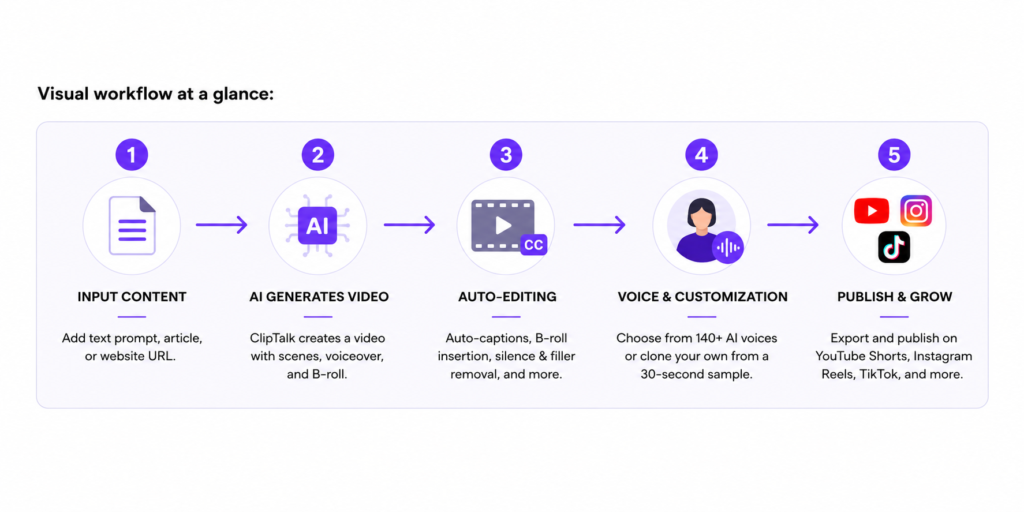
The direct answer to is ClipTalk real is yes. Cliptalk.pro is a live service that offers text to video production. Simply put in a script, an article, or a URL and make a video with captions, voiceover, and B-roll.
Confirmed details from the official site:
- Company: ClipTalk is a registered trademark of Cliptalk.pro, Inc.
- Core function:Turns text prompts, articles, or web content into publish-ready videos for YouTube Shorts, Instagram Reels, and TikTok.
- Editing tools: Auto-captioning, AI B-roll insertion, natural language editing, silence and filler-word removal, auto-clipping.
- Voice and character library: 140+ premium AI voices across 30+ languages, plus a roster of stock AI characters (UGC creators, professionals, “talking fruit,” everyday people) or a custom character built from one photo.
- Voice cloning: 30 seconds of speech required to clone a voice.
- Editor:Timeline-based editor for manual editing after generation.
- Media mentions listed: New York Times, Shopify, TechCrunch, MSN, and Yahoo News (on the “as seen on” page).
- Community claim: Over 4,500 creators on the site.
- Support: Email contact form and affiliate program.
None of that sounds like a shell page. There are live product shots, a link to the working dashboard, published comparisons to the likes of Runway, VEED, and Opus Clip, and even a cancellation flow embedded right in the dashboard. This is the real thing, folks.
What vetting an AI tool actually looks like operationally
Tuesday afternoon a two-person content agency is in between client calls. One of the partners opens up instagram and lands on a ClipTalk ad, a talking-fruit character promoting a product in under 20 seconds. It’s exactly the kind of content three of their clients have been looking for.
Here’s what a five-minute vetting workflow actually looks like before the card gets charged:
- Search the exact question. Not “ClipTalk review,” the very phrase in your head is “is ClipTalk real.” That’s helpful because it shows I’m thinking about trust.
- Check the official site directly, not just the landing page where you saw the ad, but also an actual pricing page, a FAQ page, a company name linked to the trademark, and a cancellation policy.
- Cross-check on a third-party listing like Capterra or G2. That’s right, a product that hasn’t independently shown up on review sites after months of advertising is a bigger red flag than one that has yet to appear on them.
- Match the free tier to one real deliverable. Don’t just test in an abstract sense. Actually attempt to make the kind of video that a prospect would want to order last week, and then see if it works
- Assign an owner. One person decides whether to upgrade to the paid plan after “testing the free version.” One person isn’t going to spend thousands of dollars in trial and error.
That’s the whole check. Five steps, done in the time it takes to finish a coffee, before any commitment gets made. We ran the same check on Mintlify when we asked whether the tool was still worth using.
┌─────────────────────────────┐
│       FIND A NEW TOOL       │
│      ClipTalk or similar    │
└──────────────┬──────────────┘
               ↓
┌─────────────────────────────┐
│        VERIFY IT            │
│ Company · product · pricing │
│          · support          │
└──────────────┬──────────────┘
               ↓
┌─────────────────────────────┐
│       TEST ONE REAL         │
│          USE CASE           │
│   Use the free tier first   │
└──────────────┬──────────────┘
               ↓
        ┌───────────────┐
        │   DOES IT     │
        │     FIT?      │
        └───────┬───────┘
            YES │ NO
                │
       ↓        │        ↓
┌───────────────┐│┌────────────────┐
│ CHOOSE A PLAN │││      STOP      │
│ Match cost to │││ Don't subscribe│
│ actual usage  │││ just for the   │
└───────┬───────┘││      demo      │
        │        │└────────────────┘
        ↓
┌─────────────────────────────┐
│       ASSIGN AN OWNER       │
│ Someone reviews the tool    │
│       before renewal        │
└──────────────┬──────────────┘
               ↓
┌─────────────────────────────┐
│        30–60 DAY REVIEW     │
│                             │
│ Keep · Downgrade · Cancel   │
└─────────────────────────────┘
Pause and think: how many tools in your current stack would survive that same five-step check today, if you ran it retroactively?
Business autopsy: a two-person content agency example
Company type: boutique content agency, which produces short-form video for three retained clients. Team size: two founders, no one else. Workflow issue: one of the founders saw the ad for ClipTalk, tested the free tool once and fell in love with the results. Upgraded to the Pro subscription, which costs $59 per month, the same day, without actually calculating how much they needed the tool.
What broke: the agency only used the tool for creating approximately 12 videos per month for all three clients, whereas the Pro subscription is designed to be used for 90 videos per month. This error was not identified in time and the subscription was renewed for four months before it was canceled, after one of the partners happened to take a closer look at the company’s expenses.
Why it failed: the decision to make the video creation faster was made subconsciously and the new costs simply were not taken into consideration after the initial excitement. Moreover, no one had scheduled a follow-up conversation or planning session to rethink this decision. In other words, an internal reminder mechanism was absent.
What should change: every new subscription to an AI-based tool should be put on a 30-day trial period, with a specific note to discuss the volume of work that the tool would be needed for. If this amount did not correspond to the subscription plan (either lower or higher), the tool’s settings should be adjusted or unsubscribed before the next billing date.
I have noticed that when working with businesses, it is not the tools, per se, which often lead to the financial waste rather, it is the absence of an adequate internal dialogue after a tool has been introduced.
Wrong approach vs right approach
| Wrong approach | Right approach |
|---|---|
| Subscribing right after seeing a convincing ad | Testing the free tier against one real, named deliverable first |
| Judging a tool only by whether it’s a scam | Judging a tool by whether it fits an owned workflow and actual volume |
| Letting a subscription auto-renew untracked | Assigning one person to review tool spend and usage every 30 to 60 days |
Where ClipTalk fits in a content workflow
Problem solved: Currently, a single creator producing short-form videos for multiple client accounts or niches must spend excessive time on each piece – scripting, recording, captioning, sourcing, and more.
Where it fits: The product will appeal most strongly to teams already using some sort of content calendar or scheduling tool for their short-form videos, who need someone to take existing written material (or heavily-edit it) for publishing as a video.
Why it matters: Auto-editing and voice cloning remove the two biggest time sinks from the short-form creation process, namely syncing footage to a script and recording a voiceover, without needing the creator to appear on camera.

ClipTalk
ClipTalk Pro is an AI-powered video generator that converts text, blogs, or ideas into fully edited short-form videos. It automates editing, captions, voiceovers, and visuals—making it ideal for creators scaling content quickly.
Operator opinion:
- Speed improvement: critical to teams editing manually; timeline editing is mostly automated away with script-to-video conversion.
- Ease of adoption: no editing experience needed, and you can test-drive the output on a free tier before paying.
- Limitation: credit-based plans mean output volume is capped, so a team with unpredictable or spiky content demand needs to actively monitor usage against the plan tier, not assume it scales automatically. If cost and output limits are the deciding factors, see how it stacks up against free AI video tools before committing to a paid plan.
- Who should avoid it: If you need maximum flexibility in fine-tuning every frame, or you already have an in-house fast editor and don’t have a volume problem, this is not for you.
Self-audit: is this the right tool for your workflow
A good rule of thumb before buying any tool from the ad (in this case, clip talk), is to ask these questions:
- Can you name the deliverable this tool has to produce, in one sentence?
- Have you tested the free plan against that deliverable, and not some generic demo?
- Does the plan you’re about to pay for, reflect your actual monthly production, and not what you want to produce?
- Will someone specific review this subscription in 30-60 days?
- Would this tool survive a Google search for “is [tool name] real”, with no other context?
Any answer other than yes to these questions, and the tool may well be real, and worth using later; it’s just not a good idea to invest in it right now.
FAQ
Yes. ClipTalk is a video creation platform powered by an AI, developed by Cliptalk.pro, Inc. The company offers a working product, clear pricing, and support contact.
It is used to turn text prompts, articles, or website content into short-form videos for YouTube Shorts, Instagram Reels, TikTok, and other platforms, complete with captions, B-roll, and voiceover.
Yes. There is a free plan with 500 credits (about 5 videos).
The price per month starts at $19 (Basic), $39 (Starter+), and $59 (Pro), with an option for an annual subscription at a discounted rate.
Yes, according to the official FAQ, as they are considered original content.
Conclusion
More AI tools will appear in advert channels before they organically establish themselves, so “is [product] real”, queries will proliferate as a category. The tools themselves will largely be fine. What will prove more difficult to stop is a business that buys into things reactively, one convincing demo at a time, without anyone really being in control of what subscriptions actually get used.
Is ClipTalk real was never the problem, the scary question is whether your own business has adequate processes in place to prevent another potentially expensive subscription from renewing for the fourth month in a row.
Your next move
Open your bank or card statement right now and locate one paid software subscription that you can’t explain in one sentence. Don’t cancel it yet, just put down on a piece of paper what it was supposed to replace. That one sentence is the beginning of the vetting process most small teams skip.