Key takeaways
- Consultants using AI as a content starting point are producing credibility signals that don’t convert
- AI-generated content gets 34% lower engagement than human-authored posts, per Content Marketing Institute’s 2024 B2B research
- The problem isn’t using AI. It’s using AI before thinking anything worth saying
- Seven underrated tools cover each stage of a thinking-first content system
- The gap between consultants who generate inbound leads through content and those who don’t is a process gap, not a talent gap
You’re posting on LinkedIn three times a week. You’re using AI to speed it up. You’ve got a consistent schedule, decent formatting, and a niche that’s clearly defined. And your pipeline hasn’t moved in four months.
Here’s the uncomfortable part: the content might be the actual problem, not the consistency.
When consultants use AI to generate posts instead of to develop thinking they already have, they end up with content that reads clean, sounds credible, and means nothing specific to the person reading it. It doesn’t build the kind of precise authority that makes a potential client think “this person understands my exact situation.”
According to Content Marketing Institute’s 2024 B2B research, generative AI is now used by 73% of B2B marketers for content production, but AI-generated content underperforms human-authored content by 34% in engagement. That gap gets worse in high-trust service categories like consulting, where buyers are literally evaluating your thinking before they pay for it.
So the question isn’t whether to use AI. It’s what you’re using it for.
You’re not building authority. You’re mimicking it.
Most consultants using AI for content are running the same loop: feel pressure to post, open a tool, type a vague prompt, accept what comes back, make minor edits, hit publish.
What comes out is a polished version of average. It sounds like consulting content. It uses the right vocabulary. But there’s no specific observation that came from your actual work. And buyers, even if they can’t name what’s missing, feel that absence.
What I’ve noticed working with businesses is that the consultants generating consistent inbound leads through content all share one thing: they had a real opinion before they opened any AI tool. And that opinion came from somewhere specific. A client engagement that fell apart. A pattern they’ve seen across seven different projects. A decision they made that turned out to be embarrassingly wrong.
AI cannot manufacture that. It can only help you say it more clearly.
What’s actually happening to your posts
Imagine this: you sit down Monday morning and decide to post about stakeholder management. You open your AI tool, type that topic in, and get back a structured post about aligning stakeholders early and communicating often. You publish it. It gets some reactions. Nobody messages you about working together.
Now imagine instead you wrote this at 10 PM on a Tuesday after a rough client call: “Engagement fell apart this month because the CFO didn’t know what the project was. CEO assumed he’d briefed him. He hadn’t. Six weeks of work, paused. Nobody flagged it because everyone assumed someone else owned that relationship.”
That’s a real observation. That’s the thing that makes a potential client think: this person has been in the room I’m currently standing in.
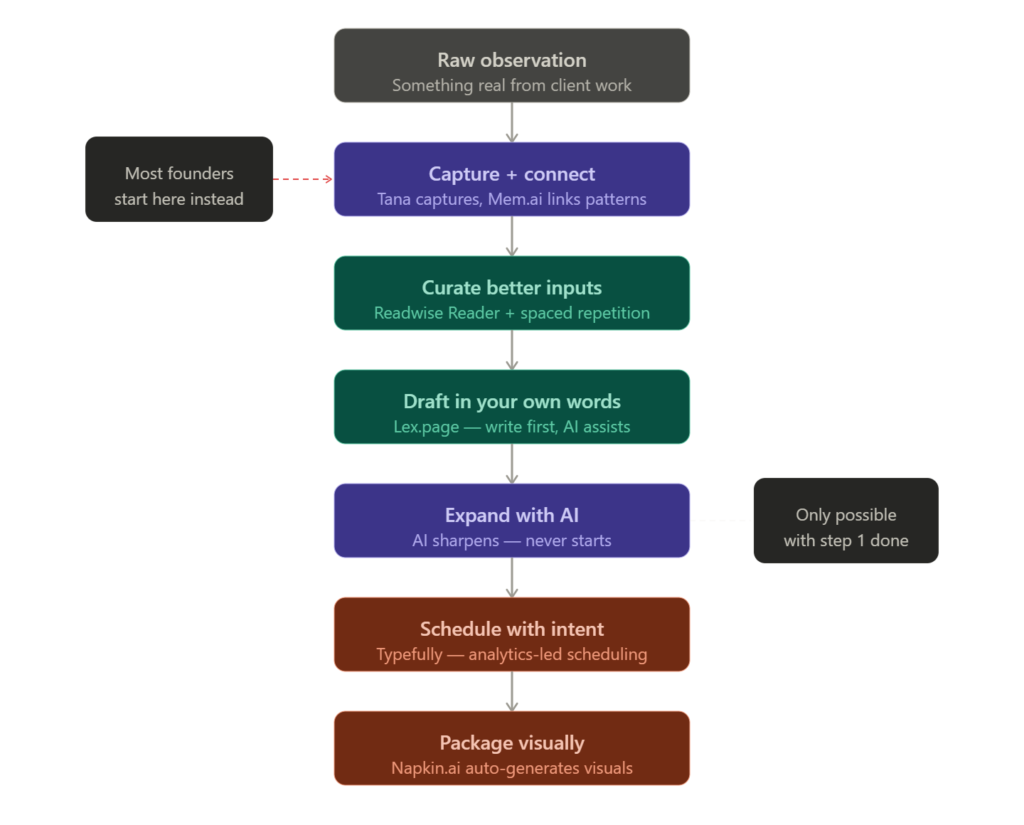
Then you take that to AI and ask it to help you develop it into something sharper. Now AI is doing expansion work, not creation work. That shift in sequence is the entire difference between content that builds a pipeline and content that fills a feed.
Pause and think: When did you last write down a content idea before opening an AI tool? If your honest answer is “I don’t do that,” that’s the process gap this whole pipeline problem traces back to.
The seven tools that actually build this system
These aren’t the tools everyone already knows. They’re the ones that handle specific gaps in a thinking-first content workflow without adding friction.
Stage 1: capture your actual thinking
Tool 1: Tana
Tana is a structured knowledge system built around supertags and linked data. It’s not trying to be a project manager or a wiki. It lets you tag raw observations, client patterns, and half-formed ideas in a way that surfaces connections later, automatically. When you sit down to write, you’re not starting from nothing. You’ve got a library of actual thinking to pull from. Tana is where your intellectual property lives before you know it’s intellectual property.
Tana AI
Tana AI is a next-gen knowledge management and note-taking tool that transforms raw notes into structured data and workflows using AI. It’s designed for professionals who manage complex information like projects, research, and meetings.
Stage 2: feed yourself better inputs
Tool 2: Mem.ai
Mem uses AI to actively connect your notes to each other without you having to organize anything manually. You write, and Mem finds relationships between your ideas over time. For consultants with scattered observations from client work, it turns accumulated noise into patterns you can actually write from. It’s a second brain that compounds in the background while you’re doing client work.

MEM.AI
Mem is an AI-powered note-taking and knowledge management platform built for professionals who want fast capture, smart organization, and contextual search. It automatically connects notes, emails, and ideas so users can spend less time organizing and more time thinking.
Tool 3: Readwise Reader
Your content is only as distinct as the quality of what you’re consuming and retaining. Readwise Reader is a read-later and highlight tool with built-in spaced repetition, meaning it resurfaces the ideas you’ve already flagged as important on a review schedule. According to Nielsen Norman Group’s research on reading retention, readers retain about 10% of what they read without any active system. With review built in, retention jumps toward 60%. Better retention creates better synthesis. And synthesis is where the content nobody else could write actually comes from.

Readwise Reader
Readwise Reader is an AI-powered reading and knowledge management app designed for heavy readers, researchers, and productivity enthusiasts. It combines read-it-later workflows, highlighting, spaced repetition, and AI-assisted reading into one unified system.
Stage 3: draft before you prompt
Tool 4: Lex.page
Lex is a writing environment with AI built into the document, but it works differently. You write first, in a clean editor, and Lex helps you continue or restructure what you’ve already started. It’s built for thinking through writing, not prompting instead of writing. For consultants whose best ideas emerge through drafting rather than outlining, Lex removes the friction from that process without taking the wheel.

LEX
Lex is an AI-native writing platform designed for drafting, editing, and collaborating on long-form content. It combines a distraction-free editor with AI suggestions and premium model access.
Stage 4: let AI expand what you already have
Tool 5: Typefully
Typefully handles LinkedIn and X scheduling with a level of analytics and writing experience that standard tools don’t. It shows you which post structures are actually performing for your specific account, not generic platform benchmarks. Its writing mode strips away formatting until you need it, which keeps you focused on the idea rather than the presentation. For a consultant managing content on one or two platforms seriously, that specificity changes how you iterate. It’s also where the agentic AI tools category starts to get practical for solo content workflows.
Typefully
Typefully is an AI-powered writing and scheduling platform built mainly for X (formerly Twitter) and LinkedIn creators. It helps users draft threads, schedule posts, analyze performance, and collaborate on content workflows more efficiently.
Stage 5: refine for clarity
Tool 6: Napkin.ai
Napkin takes your raw text, your notes, your draft, and generates visual diagrams and concept maps automatically from the content. No design work. No template hunting. You paste in your thinking and it produces visuals that reflect your actual ideas. For consultants who explain complex processes or frameworks in their content, this cuts hours out of the packaging step without turning everything into a generic Canva slide. It’s one of the least talked-about tools doing genuinely useful work right now.

NAPKIN AI
Napkin AI transforms written text into visuals like diagrams, charts, mind maps, and infographics. It helps professionals communicate ideas faster without manual design work.
Stage 6: package and distribute
Tool 7: Capacities
Capacities is an object-based note-taking tool where you create types, person, project, idea, meeting, and link them to each other. It’s built for people managing relationships and ideas at the same time, which is exactly what a service-based founder is doing. Instead of dumping everything into a flat document or a generic tag system, Capacities structures your thinking around the actual entities in your work. Pull up everything related to a client, a theme, or a recurring problem in seconds and you’ve got content briefs that write themselves.
Capacities
Capacities is an AI-powered note-taking and knowledge management tool that organizes ideas as connected “objects” instead of folders. It’s built for individuals who want to think, learn, and create more effectively.
What “thinking-first content” actually looks like operationally
Nobody is asking you to sit quietly with a journal for an hour before you’re allowed to open a writing tool. That’s not what this means.
Here’s what Tuesday at 9 AM actually looks like when this is working.
You open Tana. Not LinkedIn, not ChatGPT. Tana. You write one sentence about something from client work this week. It doesn’t need to sound good. It just needs to be honest. Something like: “Client keeps requesting new features. Real problem is they don’t trust the ones they already paid for.”
Done. You close it and get back to actual work.
Later that day, Mem.ai has already surfaced two other notes from the past couple of months that connect to that same pattern. You didn’t organise anything. It just found the thread. Now you have something more than a single frustration. You have a pattern you’ve seen across multiple clients, and that’s a completely different thing to write from.
You open Lex.page. You write one rough paragraph from that pattern. You ask it to sharpen one sentence. You’re not generating content from nothing. You’re cleaning up something that already came from your actual work.
That whole sequence is about eleven minutes. And what comes out of it is something no competitor could replicate, because they weren’t in those rooms with those clients.
Pause and think: Most consultants spend longer than that trying to think of a topic before they’ve written a single word. This workflow moves the thinking out of the writing session entirely. By the time you open a writing tool, the hard part is already done.
The comparison that clarifies this
| Generic AI content workflow | Thinking-first AI workflow |
|---|---|
| Open AI tool, type a topic | Write raw observation in Tana or Capacities first |
| Accept output, minor edits | Bring specific insight to Lex for expansion |
| Publish immediately | Review, then schedule through Typefully |
| Content sounds like the category | Content sounds like your specific experience |
| Metric: likes and reach | Metric: DMs and inbound inquiries |
| Any competitor could post it unchanged | Impossible to replicate without your client context |
FAQ section
Does this workflow work if I post on platforms other than LinkedIn?
Yes, and honestly the platform matters less than people think. The capture, connection, and drafting stages have nothing to do with where you’re publishing. Typefully is built around LinkedIn and X specifically, but swap that out for whatever scheduler fits your platform and the rest of the system stays identical. Newsletters, Instagram, long-form blogs, it all runs on the same foundation.
How long does this actually take per week?
Less than you’re probably spending right now staring at a blank prompt. The capture habit is two to three minutes whenever something from client work catches your attention. The actual drafting session, one time per week, runs thirty to forty minutes. That’s it. One post, forty-five minutes total, with something real to say when you sit down.
Do I need all seven tools or can I start smaller?
Start with just two: Tana for capturing observations and Lex.page for drafting. Those two close the biggest gap, which is opening an AI tool with nothing in your head. The other five add layers once the core habit exists. Don’t set up the whole stack on day one and abandon it by day three.
What if nothing from my client work this week felt worth writing about?
That’s worth sitting with because it’s rarely a content problem. If a full week of client work produced zero observations that made you think differently, that’s a signal about the work or about how closely you’re paying attention to it. The writing habit and the noticing habit build together over time.
Does this work for a small team or just solo consultants?
It works for teams with one tweak. Individual capture stays individual, everyone logs their own raw observations. But the pattern-finding layer needs a shared home, and Capacities handles that well at team level. One person’s client frustration connecting to another person’s repeated observation is where the most interesting content actually comes from.
Where most consultants actually break this
The three failure points that show up repeatedly:
- Skipping the raw capture step because it feels unproductive compared to just posting something
- Opening the AI tool first when there’s deadline pressure, which defeats the entire sequence
- Publishing content that passes a quality check but fails the “could only I have written this” test
And the last one is the filter that actually matters. If a competitor could copy your last five posts and publish them without anyone noticing, you haven’t built any real positioning. You’ve just maintained a posting schedule.
According to Edelman’s Trust Barometer, audiences evaluating professional services rank demonstrated experience and specificity as the top credibility signals, above credentials, follower count, or publishing frequency. Generic insight, no matter how cleanly formatted, doesn’t register as experience. It registers as noise.
If you already suspect your content fits the pattern of what’s described as AI content sounds generic, the underlying structural reasons are worth looking at before you change tools.
Before you publish anything, run this check
- Did you write this observation down before opening any AI tool?
- Does this post reference a specific situation from your actual client work?
- Would it still land if you stripped every bullet point and subheading?
- Could someone read this and think “this person has seen my exact problem”?
- Are you saying what you actually believe, or what you think a consultant is supposed to say?
But here’s the one that most people skip: could this post have been written by someone who has never done your actual work? If yes, it probably was.
What’s coming that makes this more urgent
AI tools are improving faster than most consultants are improving their thinking habits. The volume of polished, credible-sounding, completely interchangeable content is going to increase sharply over the next 12 months. According to HubSpot’s State of Marketing report, over 60% of marketers already report AI as their primary content production tool, and that number is still climbing.
The consultants who break through that noise aren’t the ones with better prompts. They’re the ones who built a system for capturing and developing their own observations before AI ever touches the idea. That system is a process moat. And right now, almost nobody in the consulting space has deliberately built it.
So here’s the question worth sitting with before your next post: if you removed AI from your content process entirely tomorrow, would you still have something specific enough to say?
Your next move
Pick one client observation from this week. One thing that surprised you, frustrated you, or made you rethink something. Open Tana or Mem.ai right now and write it in one sentence. Don’t edit it. Just capture it.
That single sentence is worth more to your personal brand than the next five AI-generated posts you were about to schedule.
If you want to build the full system behind this, start with the tool stack and work backwards from the content you already wish you were publishing. The workflow exists. The thinking has to come from you first.