Key takeaways
- Liveblocks, Convex, and Velt are solving different parts of the collaboration stack, and are not direct 1:1 alternatives to each other.
- Liveblocks’ pricing is billed as $25 per month (Pro, billed annually), and has additional charges depending on usage of realtime minutes, storage, and comments.
- Convex Professional costs $25 per developer per month and has 25 million function calls before any overage fees, regardless of the number of end users.
- Velt’s only self-serve, public plan is priced at 100 monthly active documents, and doesn’t cover production deployment.
- Convex is a general-purpose reactive backend while Liveblocks and Velt are purpose-built collaboration SDKs meant to be layered on top of an existing backend.
The short version
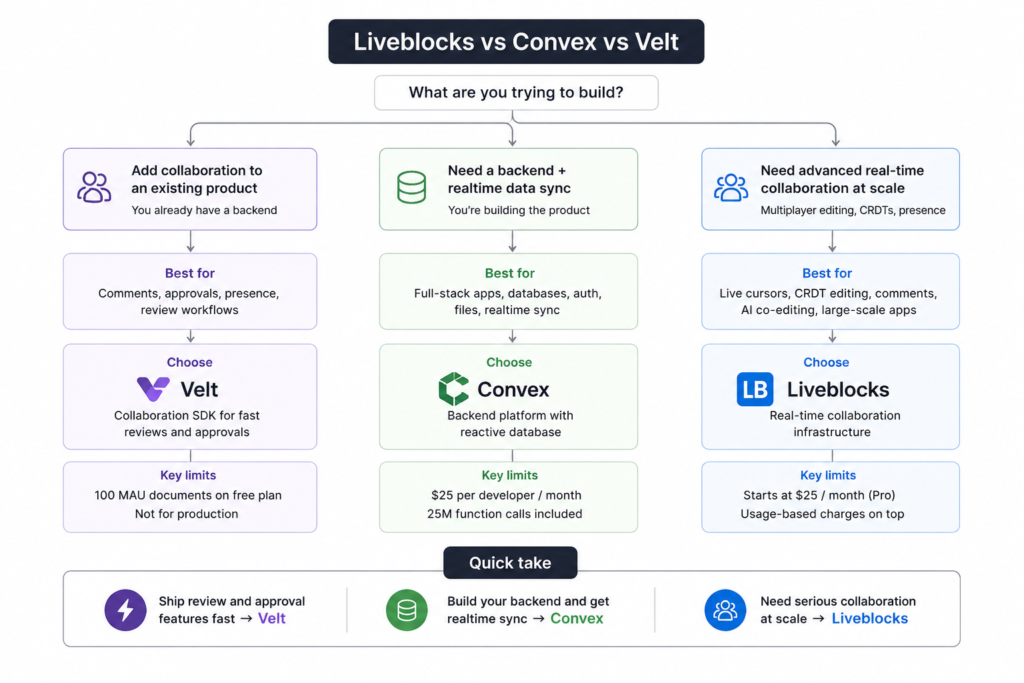
For most teams, the decision will be informed by what they already have. Attaching comments and cursors to an existing product with a backend leans towards Velt. Having to select a backend plus syncing in realtime as part of the decision leans towards Convex. Building a collaborative editing stack on top of your own backend with CRDTs, cursors, presence, threads, etc. at a scale where “we’ll build it ourselves” is no longer a viable option leans towards Liveblocks.
What each one actually is
A team of five spent six weeks last spring wiring WebSocket reconnection logic by hand before shipping even a single collaborative feature. That’s the week these three products exist to prevent (though not in the same way) which is the part a feature checklist tends to flatten out.
Liveblocks is realtime collaboration infrastructure, full stop. It ships presence, live cursors, CRDT-backed multiplayer storage, threaded comments, notifications, and, as of 2026, primitives for AI copilots that can co-edit documents alongside human users. It assumes you already have a product and a backend, and you’re adding a collaboration layer on top.
Convex isn’t a collaboration SDK at all. It’s a reactive backend-as-a-service: a TypeScript-native database, serverless functions, file storage, and auth, where realtime sync is a side effect of how its queries work rather than a dedicated product feature. If you need collaboration, you build the UI for it yourself on top of Convex’s data layer.
Velt is a comments, presence, and approval-workflow SDK aimed at teams that want to ship review and collaboration features fast without owning the realtime infrastructure underneath. Its 2026 positioning leans hard into AI-native review flows: agents produce work, humans approve it, inside the product.
┌──────────────────────────────┐
│ What does your product need? │
└──────────────┬───────────────┘
↓
┌──────────────────────────────┐
│ Need a collaboration layer │
│ on an existing backend? │
└──────────────┬───────────────┘
↓
┌──────┴──────┐
↓ ↓
┌──────────────┐ ┌─────────────────┐
│ Comments + │ │ Advanced │
│ cursors + │ │ collaboration │
│ approvals │ │ + presence + │
│ │ │ CRDT editing │
└──────┬───────┘ └────────┬────────┘
↓ ↓
┌──────────────┐ ┌──────────────┐
│ Velt │ │ Liveblocks │
└──────────────┘ └──────────────┘
OR
↓┌──────────────────────────────┐
│ Need a backend + realtime │
│ data sync together? │
└──────────────┬───────────────┘
↓
┌──────────────┐
│ Convex │
└──────────────┘Setup and developer experience
Liveblocks has the broadest and most advanced developer surface of all three. The company provides official SDKs for React, Next.js, Redux, Zustand, and has deep integrations with Tiptap, Lexical, Blocknote, Slate, Quill, Monaco, CodeMirror, and other popular editors and frameworks. There is also a browser extension for DevTools, a next.js project template, and an interactive tutorial. For most companies that have already chosen a rich-text or canvas-based framework, there is a good chance that Liveblocks has an officially maintained integration.
Using Convex requires a broader paradigm shift. Instead of SQL databases and ORMs like Prisma or Drizzle, Convex uses its own document model and query language. This also means there is no easy way to migrate from a SQL database to Convex there is no analogue to an ALTER TABLE migration in Convex. However, the price to pay for this complexity is much lower exposure to operational overhead: Convex has excellent tooling for Next.js, Vercel, Clerk, Auth0, and other products, and AI-assisted code generation helps get up to speed with the platform faster. It’s worth double-checking if any of your existing developer tools have experimental or official support for Convex, as using a different data layer can be challenging to justify once the product begins to rely on specific database features.
According to the company, Velt’s customers integrate the service in less than 30 minutes on average. The wide variety of supported frameworks speaks for themselves: React, Angular, Vue, and Next.js are on the frontend, while the company supports editors, canvases (React Flow), and data grids (AG Grid, TanStack Table). On the free tier, customers get access to a developer console with a debugger and activity feed.
My own experience working with companies that have had to choose between infrastructure vendors has taught me that these decisions usually reveal themselves with the most salient impact eight months after launch: during the third iteration of product development. The initial decision to adopt one solution over another rarely proves to be strategically impactful on a regular basis, and the supposedly small differences in setup time and complexity often turn out to be much more expensive to reverse than initially thought.
Pricing at different scales
| Tool | Free tier | Small app (~1K MAU) | Growing app (~50K MAU) |
|---|---|---|---|
| Liveblocks | Free monthly credits, no card required | Pro: $25/mo (billed annually), $30 in monthly usage credits, then metered per minute/comment/GB | Team: $500/mo (billed annually), $600 in credits; Enterprise likely needed for higher per-room connection limits or multi-region hosting |
| Convex | Free/Starter: $0, pay-as-you-go beyond included limits, up to 6 developers | Professional: $25/developer/month, includes 25M function calls, 50GB storage, 50GB egress before overage | Same per-seat model plus usage overage ($2/1M calls, $0.20/GB storage); Business & Enterprise starts at a $2,500/month minimum once seats or SSO needs grow |
| Velt | Hacker: free forever, 100 monthly active documents, dev environments only | Growth: contract-based, no public price, requires a sales call regardless of size | Same, contract-based Growth or Enterprise, still no public number |
The surprise at the small end is not the listed sticker price. It is that each vendor does not publish costs beyond their narrow offer. Convex’s cost is based on developer seats, not end-users; a small team has cheap seats but sees costs skyrocket when someone needs SSO or they cross the 20-seat threshold and have to pay $2500 per month as a minimum. Liveblocks’ pricing is public at all levels but with a cap on the number of rooms connected simultaneously; a small app budget does not budget for a larger app in terms of rooms. Velt does not offer self-serve production support at any level; the free tier is strictly for development, and everything else needs a demo and a call to understand the costs.
Pricing verified directly from vendor pricing pages on August 27, 2026. Confirm current figures before publishing, since all three vendors adjust pricing without much notice.
When each one breaks down
Liveblocks is not replacing the backend. It is adding a second realtime system to be operated in parallel with your primary database and auth layer. Teams are sometimes surprised to find this when they model Liveblocks as their ‘collaboration backend’ rather than a UI layer glued on to an existing one.
Liveblocks
Liveblocks is a real-time collaboration platform that helps developers add multiplayer features to apps quickly. It’s designed for teams building collaborative products like editors, whiteboards, dashboards, and design tools without managing complex backend infrastructure.
Convex provides you with realtime sync, but not a single built-in comment thread, cursor, or notification component. The whole collaboration experience up to collaborative editing still has to be designed and built on top of Convex’s reactive queries. Teams that expect Convex to behave like Liveblocks with a database attached quickly realize this gap and there’s no SQL escape hatch if the document model turns out to be the wrong fit.
Convex
Convex is an all-in-one backend platform for building applications with a reactive database, backend functions, file storage, search, authentication, and scheduled jobs. It is designed for developers who want real-time application behavior without assembling and maintaining multiple backend services.
Velt’s limitation is the price, as the usage of the product for actual production is tied to a sales conversation where the number is not disclosed. It is indeed the amount of secrecy around the cost that makes developers hesitant to adopt a service that is essentially an SDK for building and maintaining web applications.
Velt
Velt is an embeddable collaboration and review SDK that lets product teams add comments, approvals, notifications, review agents, audit trails, multiplayer editing, presence, recordings, and other collaborative features directly into their applications. It is particularly positioned for AI-native products where agents can propose changes while humans review and approve them.
The wrong and right approach
| Wrong approach | Right approach |
|---|---|
| Picking based on whichever demo looked flashiest | Picking based on which layer of the stack the tool actually replaces |
| Assuming “collaboration SDK” means the same product everywhere | Confirming whether the tool is a backend, a UI layer, or a review workflow |
| Testing the free tier and assuming it ships to production | Checking, in writing, whether the free tier is production-eligible |
| Comparing sticker prices in isolation | Modeling cost against your real MAU or MAD number, not the tier name |
Pause and think: if a tool can’t tell you what production will cost without a phone call, that’s not a minor inconvenience; that’s information about how the vendor prices at scale and should be taken into account before you start integrating it into anything.
Our recommendation by use case
Adding comments or cursors to an existing app, quickly but without touching the core backend: Velt, once you’ve confirmed the Growth plan’s contract pricing fits your budget, the free tier won’t get you to production on its own
Building collaboration as a feature within a broader real-time backend you also need to everything else: Convex, assuming the team has already been comfortable giving up SQL for a native TypeScript data model.
Needing mature, dedicated collaboration primitives (CRDT storage, presence, comments) at scale and not wanting to write that layer in-house: Liveblocks, particularly for teams standardized on React or Next.js.
This same pattern of selecting tools based on what a given product happens to replace rather than its category, is actually seen throughout broader AI workflow infrastructure decisions, not just collaboration ones. It’s also the same reason behind a recent breakdown of LangChain, Airbyte, Modal, and watsonx, where the four tools were superficially similar on a feature page, but weren’t once you started digging at what layers of the stack each was actually replacing.
Self-audit before you commit to one
- Do you need a full backend, or only a collaboration layer running on top of your existing one?
- Have you seen in writing that the free tier you’re testing is indeed production-ready?
- Have you budgeted at the actual cost per your live or projected MAU/MAD, rather than the marketing tier names?
- Does your compliance/HIPAA/SOC2/SSO requirements only kick in on a plan you can’t yet see a pricing sheet for?
- Would a migration be rewriting most of your code or just your config?
Asking these questions about any given tool is basically the same as doing an AI stack audit, just on a smaller scale.
FAQ
Yes, and they’re actually a common stack. Convex provides database, business logic, and auth, and Liveblocks is used on top purely for the collaboration UI surface, cursors, comments, presence since these products solve different layers rather than being competing alternatives.
Velt is a production ready product, but not through self serve sign up. Their own pricing page states that the free Hacker tier is for dev environments only, no production deploys, and that for production you must use Growth or Enterprise, both of which are sold via contract on a phone call.
It depends on if the side project could take off and have real users. Convex’s free/Starter tier has no MAU cap and includes file storage, vector search, and up to 6 developers for free. The free plan for Liveblocks includes monthly credits with no card required and no hard MAU limit. Velt’s Hacker tier is the easiest to understand in terms of numbers, 100 monthly active documents, but can’t be deployed to production so rules itself out for anything beyond a demo.
Conclusion
The market for realtime collaboration infrastructure is not yet settled on a taxonomy based on problems addressed, rather than categories, and it is not yet settled. As an increasing number of products begin to absorb AI agents that must collaborate, review, and approve their own work alongside humans, the meaningful division between Liveblocks and Convex and Velt et al will not be relevant for long. The important question will instead be whether your backend was architected in the assumption that the only source of approval is a human, or whether it has been adjusted to accomodate cases where approval can also be provided by an agent. On which side of that fault line will your product fall, six months from now?
Your next move
To get to the bottom of this, you need to open each vendor’s own pricing page and start throwing in the numbers that are relevant to your own organization. The difference in the cost between these three services is only explained when you put in numbers instead of labels from this article, and for Velt, it only makes sense after you schedule a demo call to have a better understanding before committing to any particular solution.