
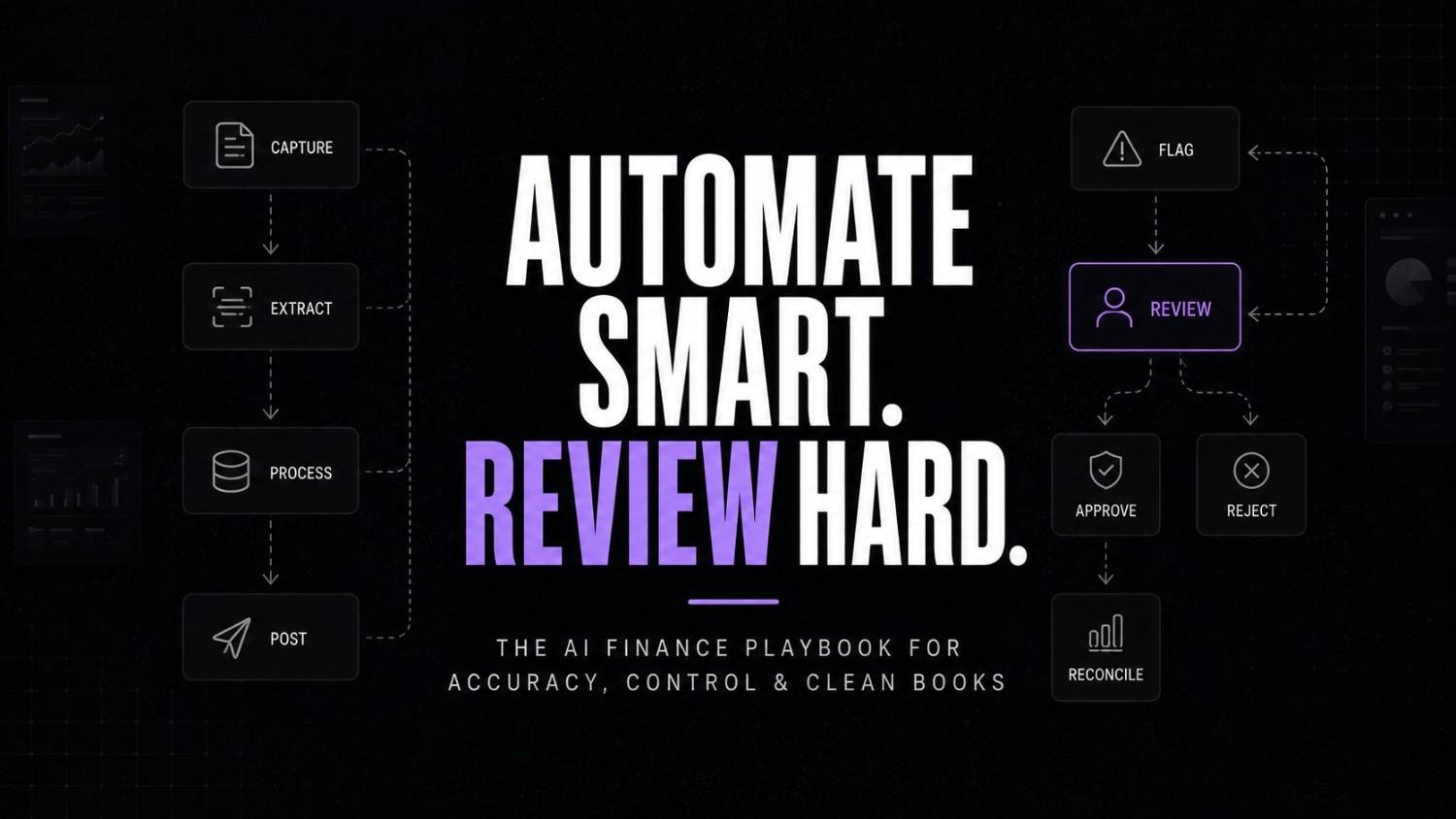
Key takeaways:
- Invoice capture accuracy is negatively affected when the vendors do not use standardized formatting.
- Automated reconciliation requires rule-based exception routing to ensure that the general ledger is not misappropriated.
- Human verification is required for multi-entity allocations of taxes, and abnormal variance analysis.
- The speed of the system integration determines the extent to which a company can reduce its monthly close cycle, making AI workflow infrastructure critical to keeping financial data moving reliably between systems.
Relying on blind automation to control corporate treasury is a great way to ensure continuous and significant losses of capital. Many founders try to solve day-to-day operations using the most advanced financial AI systems. Still, they often realize too late that their software had been incorrectly categorizing expenses, including sizable tax deductions, for months or even years.
The problem is that using such software with no hierarchical control of data input creates incompatible distortions in general ledger data. According to Gartner´s recent analysis, in 61 percent of all corporate finance operations, data gets corrupted if financial automation is introduced without proper human evaluation. One cannot blindly rely on robotic bookkeeping.
What I observe when working with different companies is that throwing the most sophisticated software at invoice approval chains often creates more problems than before. People need to separate clearly the robotic and strategic sides of financial operations . Without such structuring, one may spend the first two weeks of every quarter undoing various automation errors instead of studying cash flow dynamics.
Why most software adoption breaks down in lean operations
A founder mentioned last week that they accidentally turned on auto-reconciliation and thirty thousand dollars worth of servers got expensed as office supplies. Speed made the business process confusing to the point of losing contextual nuance, and that happened because software lacks the foundational context of actual business activities.
The real reason why most of these issues occur is rarely found in the implementation code. Usually, procedures codified before AI adoption have some undocumented business-specific intricacies, and automation makes these irregularities the new normal. If your team traditionally approves invoices in whatever channel was open during invoice arrival, automating this process will make these approvals significantly more challenging. You must clear this operational debt before introducing robotic execution stages.
The hidden cost of automated approval blind spots
When software systems process transactions without hiccups, no one pays attention to the small details until the end of the fiscal year. Therefore, minor mishaps soon add up to major liabilities. According to research by Accenture, seventy-three percent of automated financial processes fail within six months due to overlooked edge cases.
SaaS vendors may suggest that their cutting-edge algorithms can eliminate an entire accounting department by Tuesday. However, such proclamations neglect critical nuances regarding fiscal regulations and data security. Savvy managers know that effective automation follows the exact opposite principle: software applications should perform dull and repetitive tasks, and people should have the final say in all financial decisions.
How to deploy AI finance tools without breaking compliance
The secret to integrating AI-powered applications in accounting is to divide the entire process into discreet segments and delegate them to bots with varying degrees of oversight. This approach creates checks and balances at every stage, removing the chances of unauthorized ledger alterations while reducing human effort.
The AI Finance Stack: At-a-Glance Operator Comparison
| Tool | Workflow Stage | Core Job (What it replaces) | The Operational Edge | The Catch (Operator Critique) |
| Nanonets | Data Capture & Ingestion | Manual PDF scraping with 2 day invoice mapping. | Processes messy, irregular vendor table data 3x faster than standard OCR engines. | The UI is utilitarian and unpleasant to look at – it’s designed like an internal engineering app in 2018. |
| Docsumo | Data Capture & Ingestion | Manual reconciliation of international billing and foreign tax codes. | Flags fields with low OCR confidence as red herrings demanding immediate human intervention. | Limited customization for domestic invoicing irregularities – focused on enabling messy multinational contractor workflows |
| ApprovalMax | Fraud & Approvals | Chaos-filled slack/email reminders with dangerous accounting software permissions | Allows CFOs to approve 5,000 dollar invoices from their phones in 3 seconds without checking their bank account | Requires excruciating conditional logic upfront to avoid internal routing failures. |
| Numeric | Reconciliation & Close | Version controlled excel sheets and disorganized month-end communication | Functions as a project management tool for engineers – shortens 10 day month-end closing procedures to 3 | No flashy presentation layer – focuses on enabling collaborative team audits and variance tagging |
| Digits | Audit & Visual Search | Time-sinking spreadsheet searches with hours spent preparing board facing documents | Can perform natural language searches across thousands of historical general ledger entries | Prioritizes slick animations over spreadsheet bloat – standard controllers will feel right at home. |
Best tool by use case: Quick decision guide
Forget the software bloat, for the time being. If you need to solve an immediate operational bottleneck, here is where each platform shines :
- Best for chaotic domestic invoice parsing Nanonets – If you’re dealing with homegrown, multi-page PDFs from legacy suppliers and need the sheerest possible throughput of extracted data, Nanonets ‘ frictionless OCR will outperform any other tool on this list.
- Best for international contractor billing Docsumo – If you’re paying a distributed workforce of contractors in multiple currencies and need a human-exception dashboard to spot foreign tax code errors, Docsumo’s visual reconciliation layer will be your fastest path to onshore spend under control.
- Best for mobile expense approvals ApprovalMax – If you want to secure approval for $5,000+ checks in 3 seconds from a phone, without exposing your treasury at the same time, ApprovalMax’ mobile-first approach to spend control is hard to beat.
- Best for collaborative month-end close Numeric – If your finance team is spending days hunting for elusive balance sheet reconciling entries between spreadsheets and messaging platforms, Numeric’s collaborative project management layer around accounting data will make them heroes at the end of the quarter.
- Best for instant visual audit / board readiness Digits – If you are a visual founder who wants to query your ledger in natural language and see intuitively understandable burn rate graphs appear in real time for your investor reviews, Digits delivers native visualization and discovery layer that makes your data speak.
Pause and think: Look at the last three bookkeeping errors your company committed. Was it the software that incorrectly calculated figures, or did an employee approve a fraudulent invoice?
Data capture and invoice ingestion
Data entry is the simplest process to automate, as it requires the least amount of judgment to standardize line item parsing. However, specialized platforms are required to parse disorganized vendor documents without disrupting into the general ledger. Generic OCR software fails at invoices with altered table structures or encoding formats.
Nanonets excels at initial document parsing, as it extracts structured data from chaotic vendor PDFs. It accomplishes this by quickly scanning the line item tables (3x faster than standard OCR software) to learn unique vendor formatting.
Nanonets
Nanonets is an AI-powered intelligent document processing platform that automates data extraction from invoices, receipts, purchase orders, bills of lading, and other business documents. It helps finance, operations, and accounting teams reduce manual data entry while improving processing accuracy through AI-powered OCR and workflow automation.
- Operator opinion & UI review: The UI is extremely utilitarian and reminds me of enterprise software from 2018. However, the software compensates by quickly extracting the data you care about, and the fields are easy to customize for unique document types. It takes ~5 mins to map out fields for unpredictable, multi-page shipping/hosting invoices, but you won’t have to do it again.
Docsumo offers a specialized alternative to both invoice-level and transaction-level processing of complex international billing formats and foreign tax codes. Its strongest niche is processing unstructured bills from overseas contractors (with differing table layouts).

Docsumo
Docsumo is an AI-powered intelligent document processing platform that automates data extraction from invoices, bank statements, tax forms, receipts, purchase orders, and other business documents. It helps finance and operations teams reduce manual processing while improving accuracy through AI-based OCR and workflow automation.
- Operator opinion & UI review: Docsumo’s UI is significantly more modern and intuitive than Nanonets’. One of its strongest assets is the exception handling screen where potentially incorrect fields are highlighted in red. This allows for quickly identifying fields requiring manual input without spending time evaluating the extraction quality.
- The verdict: For companies only dealing with a small number of domestic vendors, Nanonets’ high-speed processing of standard formats would be more efficient. However, for firms relying on a large pool of international contractors with varying billing formats, Docsumo’s visual exception interface and tailored field selection would be more effective.
Approval workflows and fraud prevention
Once data is entered by the system, approvals in accordance with financial regulations must be applied automatically to ensure financial governance across all departments. The algorithms in charge of facilitating wire transfers on their own should be programmed accordingly. For instance, the Association for Financial Professionals reports that payment-routing fraud has jumped by 42 percent among thin staffs who rely on automation to approve payments.
ApprovalMax works by scanning the extracted data and applying a series of authorization rules before clearing the payment for dispatch. It takes the pain out of chasing down invoice approvals by replacing chaotic email reminders with intuitive conditional approvals based on department-specific budgets or vendor tier.

ApprovalMax
ApprovalMax is a cloud-based approval workflow automation platform built for finance teams. It helps businesses enforce multi-level approvals, budget controls, and purchase authorization workflows before transactions are sent to accounting systems like Xero and QuickBooks Online.
- Operator opinion & UI review: ApprovalMax stops revenue leakage with a simple yet effective interface. It takes less than 3 seconds for an executive to grant approval for a $5,000 invoice from a marketing agency on their mobile phone during their morning commute.
- Why it beats standard accounting tools: Most accounting systems have built-in approval functionality, but they are ill-suited for growing companies that want to limit access to their main financial data. With ApprovalMax, there is no need to grant managerial-level access to the accounting software. It lets executives approve invoices without giving them insight into the company’s bank account.
Reconciliation and general ledger hygiene
Matching of bank feed transactions to invoices is a boring and error-prone process, which makes it perfect for automation. At the same time, automated reconciliation often fails at split payments, currency conversion, and timing differences, which is why transactions still require manual intervention when their amount differs from what was forecasted.
Numeric turns month-end close routines on their head, streamlining reconciliation by contextualizing each item within a set of assigned categories. It serves as an operational dashboard to your accounting data, notifying you of historical anomalies right before month-end.

Numeric
Numeric is an AI-powered accounting close platform that helps finance teams manage reconciliations, journal entries, variance analysis, and month-end close workflows. It centralizes financial close tasks, automates repetitive accounting work, and improves visibility across the entire close process.
- Operator opinion & UI review: Numeric is much closer to a PMS (Project Management Software) than to a traditional accounting tool. It has a clean, modern UI and prioritizes collaboration features over number-heavy computations. If a reconciliation anomaly occurs (e.g., the AI-assisted reconciliation module failed to explain a certain discrepancy in the balance sheet), it is now much easier to share relevant context with a specific department manager directly in Numeric. Instead of spreadsheet failures and fragmented communication, you can reduce the time needed to close a month from ten days to three while retaining full control over the process.
Digits excels at providing an immediate visual search of the whole general ledger using natural language processing tools and custom machine learning models. It allows operators to ask chatbot-style questions and find discrepancies in historical spending with ease.

Digits
Digits is an AI-powered accounting and financial reporting platform that gives businesses real-time visibility into financial performance. It automatically categorizes transactions, generates live financial reports, and lets users explore accounting data using natural language search and AI-driven insights.
Operator opinion & UI review: Digits offers one of the slickest and most modern financial accounting dashboards available on the market. The ability to whip a visualization of one’s burn rate up on-screen in a matter of seconds is simply remarkable and facilitates faster communication with investors and other stakeholders. That said, the tool’s UI sometimes prioritizes flashy graphics over functionality – so a seasoned controller might feel frustrated by the lack of traditional spreadsheet-based options and features. A tool like Numeric would be a better fit for such experts in terms of sheer day-to-day usability.
The verdict: The tool is best suited for visual founders who want to get to the bottom of significant analytical issues right away – and leave number crunching to the dedicated in-house accounting team. Numeric, on the other hand, is more geared towards managers who need to focus on motivating and organizing their distributed workforce. It provides precise control and accountability functions to ensure that day-to-day operations run smoothly and all expenses are properly accounted for.
Conducting a system-first workflow audit
Before buying another software license, operators must audit the organization’s financial and data flows. Most issues arise because of insufficiently defined rules between what the software automates and what requires human-decision making. By performing an AI workflow audit, the operators will ensure that the company only automatizes stable and consistent processes and not the broken ones.
The following checklist can be used by the company to perform a self-audit of its financial processes:
- Every invoice from a vendor has a purchase order number before entering the payment processing pipeline.
- Automated payments are set to a maximum of five thousand dollars, with any higher amount requiring executive approval.
- The monthly reconciliation procedure includes a two-hour walkthrough of the unclassified expenses and vendor exceptions.
- System administrators review user permissions to all banking and accounting software every three months as part of routine workflow maintenance.
What thinking-first actually looks like operationally
It is a Tuesday morning, 8:30 AM. Instead of logging onto a shared inbox to download forty attached PDF invoices, the operations lead opens up Nanonets. The program has already extracted the billing line items from overnight emails and identified three documents with mismatched tax identification numbers.
By 8:45 AM, the three flagged PDFs have been pushed to a Slack channel for manual review while thirty-seven other invoices have been sent directly to ApprovalMax for processing. Because rules are hard-coded, a routine software hosting bill for under $2,000 is automatically approved, while a legal consulting retainer sends a push alert to the founder’s phone for manual approval.
It is Thursday, 4:15 PM – the day of the monthly financial close. Instead of searching through Excel sheets for misplaced receipts, the controller opens Numeric and immediately sees which balance sheet accounts are out of whack. With the click of a button, she can tag departments for follow-up in the software. Because of this operational efficiency, the finance team closes the books on Friday afternoon – instead of the nineteenth of next month.
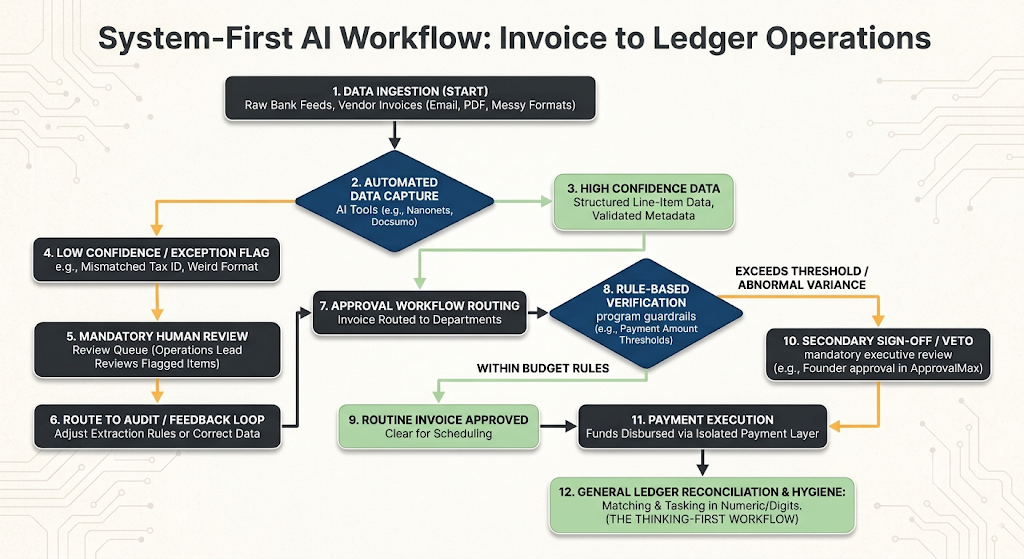
The wrong approach vs the right approach to finance automation
Many scaling teams make the same critical mistake of thinking about software as a replacement for financial controls. High-performing operators use automation to impose far more robust governance on a day-to-day business than is typical for the same type of operations. The table below provides an overview of the difference between reckless tool adoption and system-first financial management.
| The wrong approach | The right approach |
| Connecting raw bank feeds directly to categorization algorithms without validation rules. | Establishing confidence thresholds that determine when a transaction falls to a human for review. |
| Allowing AI to approve and schedule vendor payments below a threshold amount. | Forcing invoices through a specific, role-based approval workflow before payout. |
| Assuming automated extraction tools can accurately parse custom or foreign tax codes. | Hard-coding mapping rules between systems and reviewing exceptions manually every day. |
| Treating daily ledger reconciliation as an afterthought that happens automatically within the software. | Automating liability management processes in a separate ledger and designating a person to own balance sheet variances through a project management tool. |
Three non-negotiable rules for AI finance workflows
When implementing AI finance tools across the stack, leaving operational guardrails to software design choices creates catastrophic risks. Teams should design rigid operating procedures around the use of automated financial utilities, lest minor miscalculations snowball into
major reporting errors.
- Do not automate ingestion pathways. If contractors are texting, emailing, and postal mailing invoices, software cannot resolve this inconsistency. Create a single access point for all invoices before allowing any automation to take over.
- Leave a human in the loop for all tax asset depreciations. AI systems frequently misread software licenses as immediate expenses rather than multi-year capitalized assets. A competent accountant should always review computer software purchases at the end of each quarter to prevent tax discrepancies during audits.
- Segregate payment execution layers. Finance parsing tools should not have direct access to production checking accounts. The separation of duties between data extraction, approvals, and wire transfers is paramount in securing a lean startup’s finances.
+————————————————————————-+
| THE DECOUPLED PAYMENT SECURITY ARCHITECTURE (ZERO-TRUST) |
+————————————————————————-+
[ LAYER 1: DATA INGESTION & PARSING (UNTRUSTED ZONE) ]
├── Vendor Invoices / Billing Emails / PDF Uploads
└── AI Extraction Engine (e.g., Nanonets / Docsumo)
│
▼ (Read-Only Data Push via Native API)
+————————————————————————-+
| [ LAYER 2: GOVERNANCE & VETO GATE (HUMAN CONTROL ZONE) ] |
| ├── Rule Engine: Checks PO match, vendor ID, and budget thresholds |
| ├── Threshold < $5,000 ──► Automated Department Lead Sign-Off | | └── Threshold >= $5,000 ──► MANDATORY Executive / Founder Veto Push |
+————————————————————————-+
│
▼ (Cryptographic Token / Approved Batch Export Only)
+————————————————————————-+
| [ LAYER 3: AIR-GAPPED PAYMENT EXECUTION (ISOLATED BANKING ZONE) ] |
| ├── Accounting Ledger (Xero/QBO) receives Approved Payable Batch |
| ├── Batch routes to Dedicated Disbursement Tool (No AI Write Access) |
| └── Secondary Multi-Factor Auth (MFA) triggered for Bank Wire Release |
+————————————————————————-+
│
▼ (Read-Only Bank Feed Sync)
+————————————————————————-+
| [ LAYER 4: SUPERVISORY AUDIT LOOP (CONTINUOUS HYGIENE) ] |
| └── Real-Time Ledger Matching & Variance Tagging (Numeric / Digits) |
+————————————————————————-+
Frequently asked questions about AI finance tools
Not unless they want to sell you software; automation handles data entry, receipt scans, and some level of categorization, but strategic CPA expertise remains invaluable. For nuanced accounting interpretations, tax-saving strategies, and audit assistance, a qualified CPA is necessary for optimal financial management.
If you begin with a hundred+ invoices processed monthly by a team, a structured ingestion pipeline typically saves ten to fifteen hours of data entry per week on average. The real gains in productivity, however, are derived from the elimination of the cognitive load of chasing down approving authorities through various messaging platforms.
The most frequent risk factor occurs when users grant write access or make software payment authorizations possible without rigorous human oversight and approvals. In general, reconciling live balances through a third-party reader is standard practice and rarely problematic. By contrast, unrestricted automated fund transfers open the door to severe financial misappropriation risks.
The most frequent risk factor occurs when users grant write access or make software payment authorizations possible without rigorous human oversight and approvals. In general, reconciling live balances through a third-party reader is standard practice and rarely problematic. By contrast, unrestricted automated fund transfers open the door to severe financial misappropriation risks.
When the data preparation time in spreadsheet software outweighs the analysis and forecasting duration. If the time spent on month-end close exceeds ten working days due to manual receipt processing, it indicates a need for immediate automation.
The future of finance operations is supervisory
We are crossing into an era where finance will stop being the creators of data and start being the auditors of machine-created data streams. Within the next 36 months, autonomous agents will score 95% of all standard journal entries with every passing month. The only thing left for humans to do is to ensure that the machines are doing the right things. Continuous financial reporting will become the new operating standard for all serious enterprises.
When your software does your mechanical sorting for you, the value of your operations team is extracted into other realms entirely. They will stop being measured by how fast they can close the books and start being evaluated by the intelligence embedded in the rulesets they design for their autonomous agents. Software is just a lever that people use to magnify their existing behaviors.
If your automated financial stack stopped working tomorrow morning, how many days is it before anyone even notices that there are incorrect numbers in your cash balances?
Your next move
Go to the main portal for your corporate bank right now and extract the last 30-day file of all account transactions in spreadsheet view. Study the vendor column to detect software subscriptions and supplier payments mistakenly categorized as misc or general expenses by your accounting software. What are the 3 most frequent vendors in this category? Hardcode these 3 vendor names as exceptions in your accounting software by the end of the day.
