Updated: April 2026
TL;DR: The best AI tools for ecommerce automation in 2026 are Gorgias (customer support), Minami AI (post-purchase operations), Inventory Planner by Sage (stock forecasting), MESA (workflow automation), and Zapier (cross-app integration). Combined, they automate the majority of repetitive daily tasks for Shopify and WooCommerce stores.
In 2026, if you’re still manually overlooking return requests, answering the same “where’s my order?” ticket for the 100th time, or updating inventory spreadsheets at midnight before sale – then you’re running a 2026 business with 2019 habits.
As an e-commerce business owner, you have to automate the redundant tasks so that you are not just losing on time, but also on a lot of margins.
The listed 5 AI Tools for Ecommerce are not your another generic automation tool list. These tools are tried, tested, and also reviewed by thousands of people. These tools have also been fact checked for pricing and features as of April 2026 so you’re not walking into a sales call with outdated numbers.
The reason they made it to this list is because they actually help your efficiency 2x. Each tool below targets a specific bottleneck that kills lots of margins for growing ecommerce stores.
Your 5-AI Tools stack for Ecommerce at a Glance
| Tool | Automates | Starting Price | Best For |
| Gorgias | Customer support tickets | $10/month | High-volume stores |
| Minami AI | Post-purchase operations | Custom (demo) | D2C brands with returns |
| Inventory Planner | Stock forecasting & reorders | $244.99/month | Multi-channel retailers |
| MESA | Shopify workflow automation | $12/month | Shopify merchants |
| Zapier | Cross-app data automation | Free, then $19.99/month | Any store size |
[Browse all ecommerce automation tools at AI for Business Automation Here]
1. Gorgias
Stop Answering the Same Ticket Twice
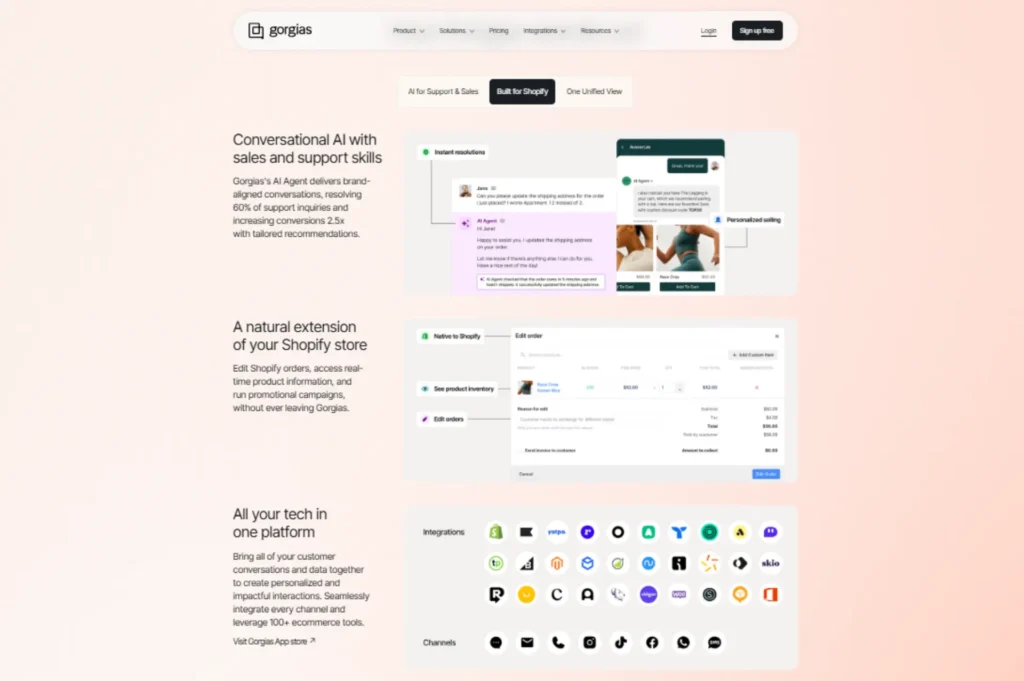
What it automates
- Gorgias automates your customer support tickets.
- From order tracking requests, customer tracking queries to FAQ’s – all these are automated without bringing a human in the loop (which resolves up to 60% of incoming tickets).
When a customer asks “where’s my package?”, Gorgias already has the tracking data and can reply automatically, because it pulls the live order data from Shopify, WooCommerce, or BigCommerce directly into the ticket interface.
Pricing (April 2026):
- Starter $10/month (50 tickets)
- Basic $60/month (300 tickets)
- Pro $360/month (2,000 tickets)
- Advanced $900/month (5,000 tickets).
The AI Agent resolutions are billed separately at $0.90 – $1.00 per fully resolved conversation. Gorgias gives you a 7 day free trial as well for you to get familiarised with it.
Good for:
- The Stores that are handling 300+ support conversations per month.
- The ROI math is simple – if an agent costs $3,000/month and AI resolves 60% of their workload, you’re saving real money (fast).
Not for:
- Offline or brick and mortar sellers. These sellers require completely different AI tools for their businesses.
- Gorgias is built around digital channels like email, live chat, social.
Important note: If your support workflow is phone-heavy, you’ll hit limitations quickly.
Honest take: Keep an eye on the double billing issue. An AI-resolved ticket counts toward your helpdesk ticket limit AND triggers the AI Agent fee. On a busy month, your bill can be nearly double the plan’s headline price. So, budget accordingly and track your actual ticket volume for 30 days before committing to a tier.
Try Gorgias free trial

Gorgias AI
Gorgias AI is a customer support platform designed for eCommerce brands, enabling automated responses, centralized communication, and faster support across email, chat, and social channels.
2. Minami AI
Your Post-Purchase Ops on Autopilot
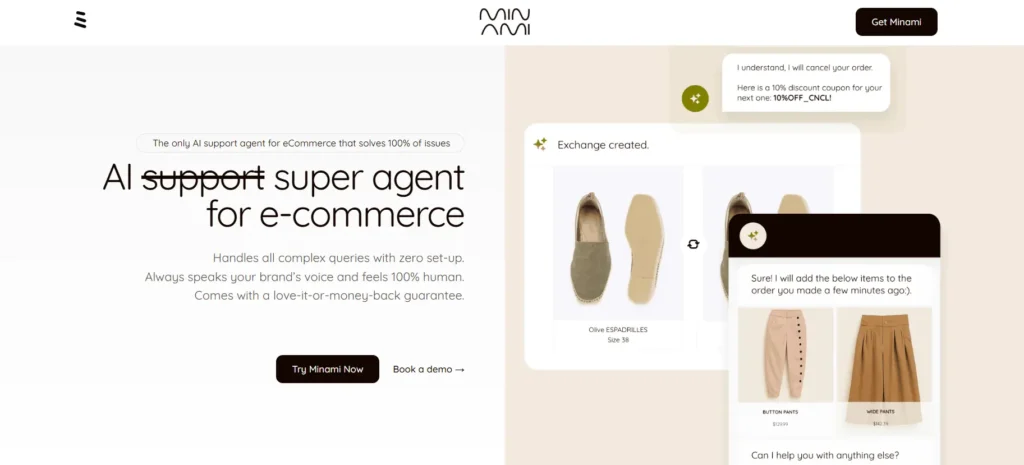
What it automates:
- The entire post purchase experience.
- This includes the multi step challenges like -resolving lost packages, editing paid orders, communicating with couriers, handling delivery issues and managing returns & exchanges.
- All of this without routing a single one to a human agent.
Minami is the most operationally deep tool on this list. It doesn’t just respond to customers; it quickly acts. For D2C brands with high return rates like fashion, beauty, homewares – this is where your ops bleed the most.
It files carrier claims for lost shipments, processes exchanges end-to-end, edits paid-but-unshipped orders, and handles delivery delays directly with logistics providers. and where Minami hits hardest.
Pricing: Custom – Minami does not publish public rates. You’ll need to book a demo to get a quote based on your order volume. This is standard for enterprise grade ops tools at this level.
Good for:
- DTC brands doing consistent volume with high post-purchase complexity
- Fashion, seasonal products, electronics -anything with frequent returns or delivery issues.
Not for:
- Stores under 200 orders/month.
- The tool is purpose built for operational scale.
- At low volumes, the ROI won’t justify the setup.
Honest take: The lack of public pricing is a friction point. That being said, the depth of automation it provides has no real equal in this space for ecommerce specific post-purchase work. If post-purchase chaos is your biggest pain point, request the demo.
[Book a Minami AI Demo →]
Minami AI
An autonomous AI agent designed for eCommerce that manages order edits, shipping issues, returns, and exchanges without manual intervention.
3. Inventory Planner by Sage
Stop Guessing What to Stock
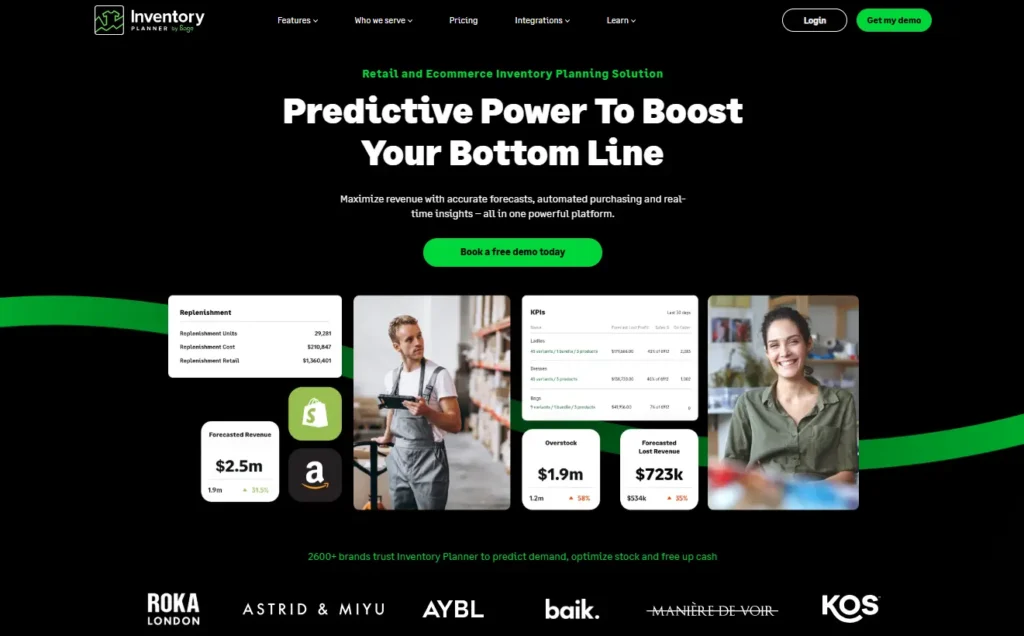
What it automates:
- Demand forecasting
- reorder point calculation
- purchase order generation
All based on your actual sales history, seasonality, and trends.
If you’ve ever over ordered before a slow season or run out of stock during a campaign, you know the damage it causes. As the name says, Inventory Planner analyzes your historical data across Shopify, WooCommerce, Amazon, and 20+ other channels and tells you exactly what to buy, when, and how much.
It integrates with QuickBooks, Xero, and major ERPs, which means your purchasing and accounting stay in sync without manual exports.
Pricing (April 2026): Revenue-based custom pricing.
- Starts at $244.99/month for smaller operations
- Free trial also available. You have to contact their team for a quote based on your annual revenue and SKU count.
Good for:
- Stores managing multiple product lines, seasonal demand spikes, or multi-warehouse operations.
- Especially strong for brands where a stockout directly kills revenue like electronics, beauty, seasonal apparel etc.
Not for:
- Digital product sellers or service-based stores.
- Forecasting inventory you don’t physically hold is not what this tool was built for.
Honest take: If your annual revenue is under $500K and you’re managing fewer than 100 SKUs, you can likely get by with a cheaper tool or even Shopify’s native analytics for now. Come back to Inventory Planner when the manual work genuinely starts costing you more than the subscription.
[Start Inventory Planner Free Trial →]

Inventory Planner (by Sage)
A data-driven forecasting tool that helps retailers avoid stockouts, clear overstock, and optimize purchasing through intelligent replenishment suggestions.
4. MESA
Automate Any Shopify Workflow Without Code
What it automates:
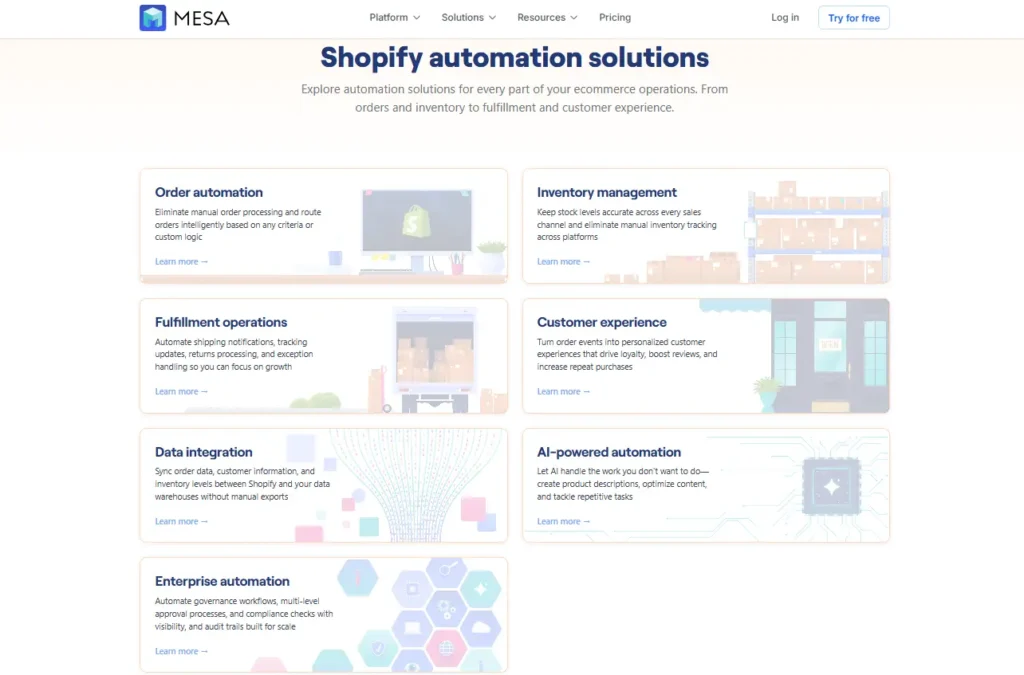
- Custom Shopify workflows
- Order tagging, inventory sync, customer segmentation, cart recovery triggers, email automation chains, and more
- All with built in plain language, without requiring code.
MESA’s AI assistant Yedric will build your workflow. Just tell Yedric what you want to happen.
For example: “When inventory drops below 10 units, send a Slack alert and pause the Google Ads campaign for that product.” Yedric builds the workflow and you run it. Earlier, that used to require a developer.
MESA connects 100+ tools in the ecommerce stack and works natively inside Shopify. It extends what Shopify Flow can do by connecting to external apps and services that Flow doesn’t reach.
Pricing (April 2026):
- Starts at $12/month
- Unlimited workflows at $299/month. 7-day free trial.
All plans include the AI workflow builder and support from their US based automation team.
Good for:
- Any Shopify merchant who has repetitive multi-step processes that span more than one tool.
- If your current workflow involves opening three tabs to do one thing, MESA probably has a template for it.
Not for:
- Non-Shopify stores
- MESA is built exclusively for the Shopify ecosystem
- If you’re on WooCommerce or Magento – Zapier (below) will serve you better.
Honest take: For stores new to automation, this removes the biggest barrier: not knowing where to start.
The support team is genuinely one of MESA’s best features because they’ll build your first workflow with you in a live session at no extra cost.
[Try MESA Free for 7 Days →]

MESA
MESA is a no-code workflow automation platform built for Shopify merchants. It helps ecommerce teams connect apps, automate repetitive tasks, and build complex business workflows without coding, improving operational efficiency and reducing manual work.
5. Zapier
The Glue That Holds Your Stack Together
What it automates:
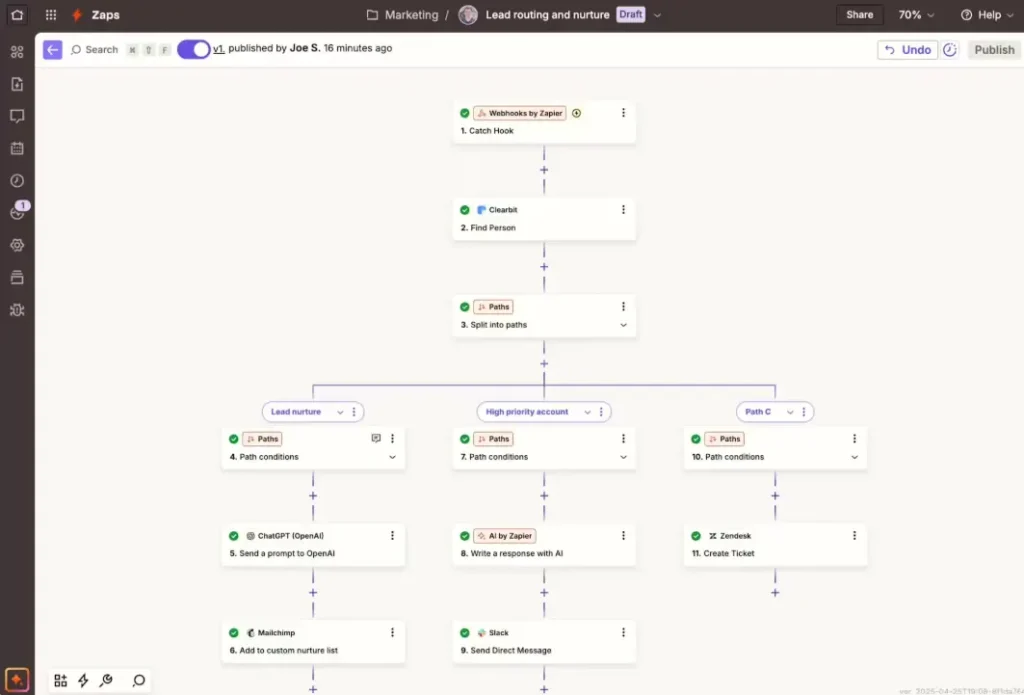
- Data movement and triggers between any apps in your stack
- CRM, email, Slack, spreadsheets, ads platforms, inventory tools – you name it
Think of Zapier as the connective tissue.
When an order is refunded in Shopify → tag the customer as VIP in your CRM → notify the ops team on Slack → update the return tally in Google Sheets.
That’s one Zap. You built it in 10 minutes and it runs forever.
It has 8,000+ app integrations and an AI Copilot that builds Zaps from a plain language description- Zapier is the most universally useful tool on this list. Every other tool in this stack becomes more powerful when connected via Zapier.
Pricing (April 2026):
- Free (100 tasks/month, 2-step Zaps)
- Professional $19.99/month billed annually (750 tasks, multi-step Zaps, premium apps)
- Team $69/month (2,000 tasks, shared workspaces)
- Enterprise – custom pricing
- 14-day free trial on paid plans.
Good for:
- Every store, regardless of platform
- Zapier is platform-agnostic – Shopify, WooCommerce, BigCommerce, custom builds
- If you use more than two tools in your business, you need Zapier.
Not for:
- High-volume workflows where every order triggers 5+ actions
- At scale, task counts add up fast and you’ll hit the ceiling of lower tiers
- Run the math on your actual monthly actions before choosing a tier.
Honest take: The free plan is useful for testing, but useless for production. The $19.99/month Professional plan is where most small to mid ecommerce stores should start. It covers multi-step workflows and premium app access, which is what you actually need.
[Start Zapier Free →]

Zapier
Zapier Central is a no-code AI automation platform that lets you build intelligent agents to handle tasks across thousands of apps. It’s designed for businesses and teams who want to automate workflows, delegate tasks to AI, and reduce manual work without coding.
Which AI Tool for Ecommerce Pays Back Fastest?
| Tool | Time Saved | Starting Cost | Fastest Win | Payback |
| Gorgias | 60% of support time | $60/month | Ticket drop from day 1 | 1–2 months |
| Minami AI | 80–90% of post-purchase ops | Custom | Returns reduction | Demo-dependent |
| Inventory Planner | 23 hrs/week on replenishment | $244.99/month | Stockout prevention | 2–3 months |
| MESA | 5+ hrs/week on workflow tasks | $12/month | First workflow, same week | Under 1 month |
| Zapier | Varies by stack complexity | Free / $19.99/month | Same-day automation | Immediate |
[Browse all ecommerce automation tools at AI for Business Automation Here]
How to Roll This Out Without Overwhelming Your Team
If you try to implement everything at once, nothing will work. To start out without overwhelming the team – start with this order. This will help in understanding the tool better.
Week 1
Start with support
- Set up Gorgias and connect Zapier
- These two together give you immediate visibility into your ticket volume and start resolving the most repetitive queries automatically
- Measure your ticket count before and after
Week 2
Stabilize operations
- Add MESA for your most painful Shopify workflow (start with one).
- If post-purchase is your biggest cost center, book the Minami demo this week (implementation typically takes a few days).
Week 3
Forecast forward
- Bring in Inventory Planner once your support and workflow layer is stable
- Use the free trial first to run a backtest against last season’s stock decisions
- The gap between what you ordered and what you should have ordered is usually a convincing enough argument for the tool
Start Here
Narrow down your biggest daily pain point and pick the one AI tool that matches with that pain point. Then run the free trial and measure what changes have happened since you onboarded the new tool. Add the next tool only when the first one is running smoothly.
If you think you can rebuild the complete workflow by next tuesday using these AI tools, you’re gonna lose out on more time trying to understand what’s happening. These AI tools are meant to be integrated in your current workflow to increase efficiency and margins.
Bottom line: In 2026, automation for e-commerce isn’t a ‘nice to have’. Stores ignoring AI tools for ecommerce automation lose 20-30% margins to competitors running lean.
Bookmark this stack, try two tools today, and watch redundant tasks vanish. Your store really scales, when ops do.
[Browse all ecommerce automation tools at AI for Business Automation Here]
Last verified: April 2026. Pricing subject to change confirm on each tool’s official pricing page before purchasing.