Obsidian

Your second brain for connected thinking

4.8/5 Rating Free - $4/month Sync and Publish sold separately Free Trial Available

Enterprise Technology Specs

Underlying Engine Markdown knowledge graph systems, Community AI plugins, Local-first knowledge architecture
Compliance & Security Enterprise Grade Security
Data Privacy Zero Data Retention
Deployment Time <5 minutes

The Deep Dive

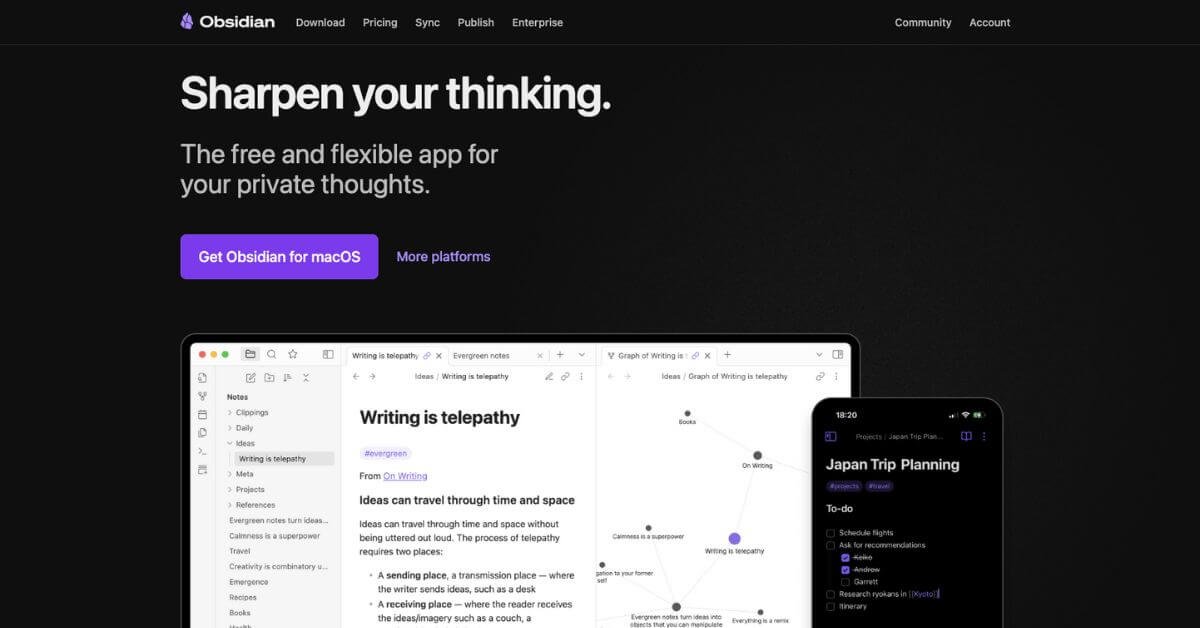
Obsidian feels less like a normal note-taking app and more like a tool for building your own thinking system.

At first, it can seem deceptively simple, just Markdown notes and folders. But once you start linking ideas together, the app changes how you organize information. Notes stop feeling isolated and start becoming part of a connected knowledge network.

What makes Obsidian stand out is ownership and flexibility. Your notes live locally on your device, not locked inside some proprietary cloud system. Combined with the huge plugin ecosystem, users can shape the app into almost anything: a writing hub, research database, journal, task manager, or full “second brain.”

It definitely has a learning curve, especially compared to simpler apps like Notion. But for people who think deeply, research heavily, or create long-term knowledge systems, Obsidian becomes incredibly hard to leave once your workflow clicks.

Key Capabilities

Linked note system
Graph visualization
Markdown-based editing
Local-first storage
Canvas visual workspace
Plugin ecosystem
Daily notes and journaling
Offline access

Top Use Cases

  • Personal knowledge management
  • Research organization
  • Journaling
  • Writing and drafting
  • Study notes
  • Idea mapping
  • Second brain systems
Verified ROI & Case Study

“Many knowledge workers report dramatically faster idea retrieval and research organization after building connected “second brain” systems inside Obsidian.”

Frequently Asked Questions

What is Obsidian?

Obsidian is a local-first knowledge management and note-taking app that helps users create linked notes and build connected knowledge systems. It’s widely used for research, writing, journaling, and personal knowledge management.

What is Obsidian mainly used for?

Obsidian is mainly used for note-taking and personal knowledge management. Users create linked notes to organize research, ideas, projects, and long-term learning systems.

Is Obsidian free to use?

Yes, Obsidian offers a free personal-use plan. Optional paid services include Obsidian Sync and Obsidian Publish for syncing and sharing notes online.

Does Obsidian store notes locally?

Yes, Obsidian is a local-first app. Notes are stored as Markdown files directly on your device, giving users full ownership and portability of their data.

How is Obsidian different from Notion?

Obsidian focuses more on connected thinking, local storage, and customization, while Notion is more collaborative and workspace-oriented. Obsidian is often preferred for long-term personal knowledge systems.