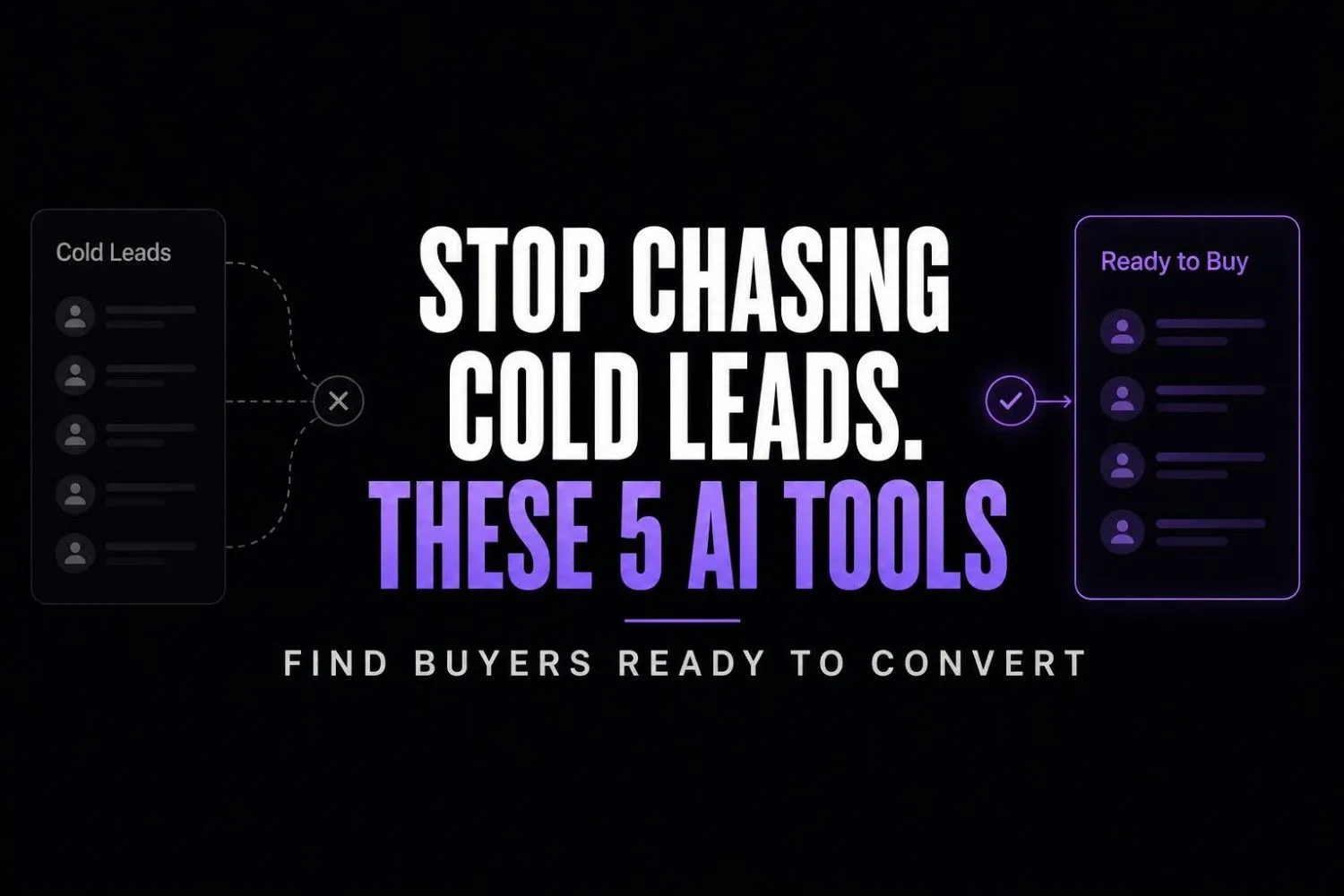
You don’t need more leads. You need the right 20 and these tools find them.
Takeaway Points
- Volume-based B2B prospecting is an unnecessary burden on expensive sales
- Precision targeting yields fewer leads but more meaningful interactions and better closing
- Five tools can identify companies that have already shown intent to purchase your product
- Modern web prospecting tools beat traditional database-based prospecting tools on signal strength
- Agentic AI is making world-class B2B prospecting available to lean founder teams
Why high-ticket founders need a different prospecting strategy
Most founders think more leads automatically create more revenue. In reality, the best B2B prospecting tools aren’t built to flood your CRM with contacts, they’re built to help you identify stronger buyers faster.
Founders love talking about pipeline growth: more contacts, larger sequences, and more booked calls. However, without a repeatable AI lead generation system, all that activity often gets mistaken for real pipeline movement.
If you’re selling a high-ticket service, enterprise software, or a consulting offer above $10K, volume can quietly become your most expensive habit. At first, a bloated pipeline feels productive. Yet by quarter-end, many teams realize half their “qualified leads” were never remotely qualified. As a result, the real issue isn’t lead quantity at all, but how their prospecting workflow creates friction much earlier in the pipeline.
That is the problem.
It is not about trying or being without the right tools or even reaching out. Most likely, the entrepreneurs have been going after the wrong targets at the wrong times.
It’s reaching out to those who never had any intention of buying.
This won’t be an acceptable excuse in 2026.
According to Salesforce’s State of Sales,73% of business buyers now expect companies to understand their unique needs and expectations. At the same time, the McKinsey State of AI report continues to show that while businesses are rapidly increasing AI adoption, many still struggle to translate tool investment into measurable business outcomes.
Translation: more noise won’t save you.
Better signals might. The shift isn’t about stacking more tools.Instead, the smarter move is building an AI lead generation workflow that identifies, qualifies, and prioritizes prospects before your team wastes hours chasing the wrong accounts. This shift sounds simple, but the operational impact is bigger than most founders expect.
The hidden cost of poor prospecting is easy to ignore
Here’s how most high-ticket founders leak revenue without noticing.
You spend:
- 12 hours building lists
- 6 hours researching prospects
- 5 hours personalizing cold emails
- 2 weeks following up
You make six phone calls. Four don’t even qualify, while one lacked a budget. The last one finishes with the classic line, “Let’s circle back next quarter.”
Everything appears healthy on paper. However, revenue barely moves while your team quietly burns hours on low-probability deals. For founder-led teams or lean sales functions, that lost time can easily translate into thousands of dollars in wasted payroll, opportunity cost, and delayed pipeline momentum each quarter.
This is why the issue usually isn’t lead quantity at all, it’s lead filtering.
The thing I’ve observed about entrepreneurs is that they purchase lead-generation tools as if they are shopping for larger fishing nets.
How modern B2B prospecting tools work in layers
Teams operating at peak performance will not rely solely on features or data size when selecting their prospecting tools. They will first analyze the exact point in the pipeline that is preventing growth and fix the particular bottleneck right away.
Layer 1: Accurate Data
Effective prospecting requires accurate data first of all. Otherwise, working with incorrect job positions, fake email addresses, or wrong target accounts may make other processes difficult to carry out. Therefore, even the most advanced and well-planned outreach will not bring results, as the groundwork will be wrong. This is exactly why enrichment and contact validation should precede any personalization efforts.
Layer 2: Live Discovery
The moment you feel comfortable about the accuracy of your data, you move on to its relevancy. As different businesses have changing priorities over time, which makes some aspects of them less relevant due to organizational changes, it becomes ineffective for you to use your static data. The need for web-based live discovery becomes extremely important when you think of expanding opportunities.
Layer 3: Commercial Suitability
All interested parties cannot necessarily become commercial for you. In some cases, your company may like your product but it does not have sufficient finances, time, and organizational approval for that purpose. In that case, you will need to do your qualification process much sooner than before. Screening based on revenue suitability or purchase readiness saves you a lot of unnecessary demonstration and poor conversion rate.
Layer 4: Timing Indicators
Even a well-qualified company will ignore if the timing is wrong. The buyer generally acts on something happening inside or outside their organization. This can be a change in funding, a change in hiring, a change in regulations, or even a change in the competition. But the more important part here is that these indicators offer a chance to give priority to companies that might act.
Layer 5: Pain Indicators
Prospecting cannot be better than discovering companies having problems that you are capable of solving. Instead of convincing them that they need your product, you are approaching the potential customer knowing that they need assistance. Or to say it another way, prospecting will become irrelevant instead of persuasive
5 B2B Prospecting Tools Built for High-Ticket Sales Teams
These tools aren’t interchangeable.
Each solves a different prospecting bottleneck. The strongest B2B prospecting tools solve different stages of pipeline inefficiency rather than trying to replace your entire workflow.
Quick Comparison: Which Prospecting Tool Matches Your Bottleneck?
| Tool | Best For | Live Web Data | Intent Signals |
|---|---|---|---|
| SalesTarget | Clean data + ICP list building | No | No |
| Wuobly | Real-time lead discovery | Yes | Yes |
| ProximValue | Budget-fit filtering | Partial | Yes |
| TradeWind AI | Timing-based outreach | Yes | Yes |
| NOS Agent | Pain-point prospecting | Yes | Yes |
1. SalesTarget
Best for: Founders with a clear ICP who need clean data fast
Most teams don’t need more leads.
They need fewer wrong ones.
SalesTarget helps founders build targeted prospect lists from a large contact database while validating emails before outreach starts.
How teams actually use it
- Upload top-performing customers
- Identify common firmographic patterns
- Generate lookalike companies
- Pull verified decision-makers
- Export ready-to-contact list
Instead of manually researching for hours, you begin with cleaner inputs.
That matters more than people admit.
Why it works
- Large contact database
- Built-in email verification
- ICP-based filtering
Watch out
This only works if your ICP is already defined.
Without that, a huge database is just organized chaos.

SalesTarget
SalesTarget AI is an AI-powered outbound sales automation platform that helps businesses automate lead generation, prospect research, and personalized outreach. It is positioned as an AI sales agent for teams wanting more qualified meetings without scaling SDR headcount.
2. Wuobly
Best for: Founders who need fresh, real-time prospects from the live web
Databases are snapshots.
Wuobly behaves more like a live prospecting engine.
Instead of pulling stale records, it searches the web in real time using natural language queries.
That changes everything.
Example workflow
A founder searches:
“Series A SaaS companies in Europe hiring RevOps leaders”
Wuobly:
- Finds matching companies live
- Surfaces verified contacts
- Pulls contextual data
- Drafts personalized outreach
Now your first message references what they’re actively doing.
Not what they did last year.
Why it works
- Live web discovery
- Natural language search
- Verified contacts
- AI outreach assistance
Watch out
AI drafts should still be reviewed manually.
Bad automation at scale is still bad.
Just faster.
Wuobly
Wuobly is a lead generation and data intelligence platform focused on helping businesses discover fresh prospects and automate sales workflows. It emphasizes real-time data access, prospect discovery, and outbound pipeline acceleration.
3. ProximValue
Best for: Teams tired of demos with companies that can’t afford them
Not every attractive logo is a viable customer.
This is where many founders waste months.
ProximValue helps teams evaluate account quality through value-fit and commercial signals.
In simple terms: it helps you stop pitching broke companies.
How teams use it
- Define ideal revenue or spend thresholds
- Filter out low-fit accounts
- Monitor vendor-switching signals
- Prioritize accounts with stronger commercial likelihood
This means fewer discovery calls that end in “love this, maybe later.”
Why it works
- Commercial fit filtering
- Spending signals
- Vendor-switch intelligence
Watch out
Works best after your offer and ICP are already stable.

ProximValue
ProximValue is an AI-powered B2B sales intelligence platform that helps teams identify anonymous website visitors, discover companies, and convert buying intent into qualified leads. It focuses on real-time lead discovery, visitor intelligence, and outbound sales enablement.
4. TradeWind AI
Best for: Founders struggling with timing, not targeting
Sometimes your prospect is perfect.
You’re just early.
Or late.
TradeWind focuses on timing intelligence.
It identifies market or company shifts that create urgency.
Typical triggers it tracks
- Funding announcements
- Expansion signals
- Regulatory changes
- Industry shifts
- Competitor disruption
This gives founders a reason to reach out now.
Not eventually.
And timing can dramatically change reply rates.
Example
A compliance automation company monitors regulation updates.
TradeWind flags companies affected by a new policy, and outreach begins the same week.
Now the conversation starts with urgency built in, not manufactured.
Why it works
- Timing intelligence
- Trigger-based outreach
- Global buyer monitoring
Watch out
You need clarity on what buying triggers matter for your market.
Otherwise you’ll collect signals you can’t use.
TradeWind AI
TradeWind AI is an AI-powered trade intelligence and outbound automation platform built for manufacturers, exporters, and industrial businesses. It helps teams discover global buyers, enrich contacts, and automate outreach through email, WhatsApp, social channels, and AI voice.
5. NOS Agent
Best for: Founders selling to sharp pain points
This is probably the most interesting shift in prospecting right now.
NOS Agent doesn’t primarily search for companies.
It searches for problems.
That sounds small.
It isn’t.
How it works
It scans:
- forums
- reviews
- news
- job boards
- public discussions
Then identifies businesses actively experiencing relevant pain points.
Example
A cybersecurity firm tracks companies discussing breaches or vulnerabilities.
Their outreach references the exact issue, not a generic pitch.
The difference is massive. You’re entering a conversation already in progress.
Why it works
- Semantic search
- Problem-based targeting
- AI-generated personalized outreach
Watch out
Broad offers won’t benefit as much.
This tool shines when your solution solves a clearly defined problem.

NOS Agent
NOS Agent is an AI-powered outbound sales and lead generation platform that automates prospect discovery, personalized email writing, and outreach workflows. It is designed to help businesses identify ideal customers and run outbound campaigns with minimal manual effort.
Most Founders Don’t Need Another Tool – They Need A Good Bottleneck Diagnosis
Which B2B prospecting tools should you buy first?
Don’t purchase all five!
This is how tool graveyards arise!
Pick according to bottleneck.
SalesTarget is appropriate in case:
Your ICP is well-defined
List building is slow
Bad data ruins deliverability
Wuobly is better if:
You’re looking for fresh leads weekly
Databases are old-fashioned
Recency is important
ProximValue is useful if:
You are getting low budget leads
Prospects are not qualified enough
TradeWind AI will be great if:
Timing kills opportunities
Your prospects reply “not now”
Go for NOS Agent if:
Your offer resolves one business problem sharply
Context is your competitive advantage
Easy!
Bottleneck diagnosis should precede tool selection.
Not the other way around.
What most prospecting blogs get wrong
Most prospecting articles compare features. However, comparing B2B prospecting tools purely by features often leads founders toward the wrong software stack.
That’s the wrong comparison.
Founders shouldn’t ask:
- Which tool has more contacts?
- Which tool has more integrations?
- Which dashboard looks nicer?
Those are secondary.
Don’t ask:
Why hasn’t anyone invented a better tool yet?
Since the best technology doesn’t make the system.
It amplifies an already existing system.
Bad process and good tools equal bad process with slick UI.
The future of B2B prospecting is precision
The future of prospecting for business is not all about growing larger databases.
It’s all about signal compression, reduced list sizes, and increased buyer intent.
But more than anything else, the new competition will revolve around timing, qualification speed, and context.
The best sales teams in 2026 won’t be those who can send the most emails.
Instead, they will be the ones able to enter the conversation first.
Which is a completely different ballgame.
What if you needed only three perfect leads within the next month to fill your pipeline? Would your tech stack make it easier to find them or drown you in data?