Your AI Lead Gen Is Fake. Stop Looking for Tools.
TL;DR:
- AI amplifies what you feed it
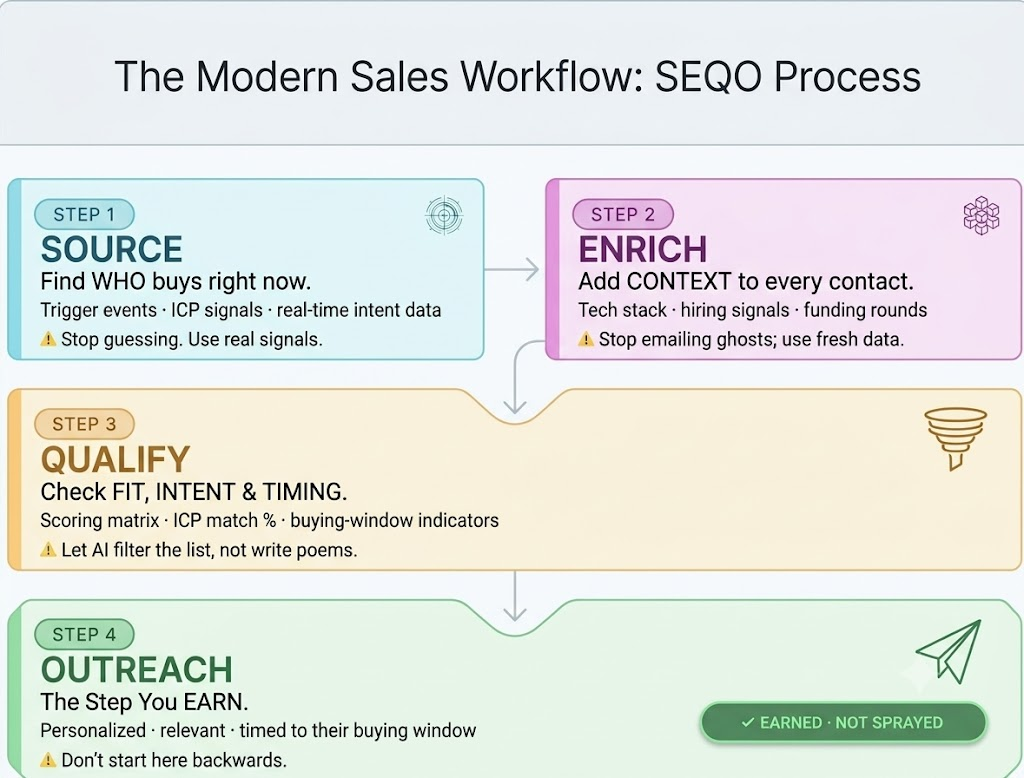
- SEQO is the sequence that works: Source, Enrich, Qualify, Outreach
- Fewer tools. Deeper usage. Systems that talk.
The majority of AI-driven solutions fail because they lack a functional AI lead generation system. Most people simply stack automation over total chaos and then wonder why nothing works often leading to massive Revenue Leakage. Specifically, if your targeting is vague, no machine will sort it out for you, turning manual bottlenecks into automated Spreadsheet Workflow Failures.
Do you identify with this loop?
- A new AI tool drops making waves
- Twitter says it’s “revolutionary”
- LinkedIn fills up with screenshots
- Someone calls it the end of agencies
- You buy it. Nothing changes.
Enterprises are already fixing this. The ones winning in 2026 don’t have more tools. They have better sequences.
Fewer tools. Deeper usage. A sequence that never breaks.
SEQO Framework At a Glance 2026
| Stage | What It Does | Common Mistake | Time Saved |
| Source | Finds who actually buys right now | Using vague personas like “SaaS Founder” | 5 hrs/week |
| Enrich | Turns raw data into context | Contacting ghosts (30% data decay) | 4 hrs/week |
| Qualify | Checks fit, intent, timing | Writing poems instead of filtering | 3 hrs/week |
| Outreach | The last step you earn | Starting here instead of ending here | 2 hrs/week |
Source: The Foundation of Your AI Lead Generation System
Source is where your business truth lives. It is not about a vague persona, but rather the specific constraint that makes someone buy right now. Of course, this is where you define the intent patterns that the AI will eventually scale.
What it automates:
- Eliminates guessing about who to target
- Focuses outreach on buyers with actual intent
- Stops wasted effort on unqualified leads
Time saved: 5 hours per week
Good for:
- Teams who are guessing instead of knowing
- B2B companies with long sales cycles
Not for:
- Solo founders with 10 customers
- Teams who already have a working sequence
Honest take: AI can help identify patterns, but a human still needs to define the constraint.
Enrich
Enrich turns raw data into context. Names and companies mean nothing without funding indicators, tech stack, and hiring trends. In reality, industry statistics indicate that B2B leads have an average decay rate of 30 percent each year. Without enrichment, your AI lead generation system is literally contacting ghosts.
What it automates:
- Pulls firmographic and technographic data
- Flags outdated or incorrect contact information
- Surfaces buying signals from job changes
Time saved: 4 hours per week
Good for:
- Teams who are guessing instead of knowing
- B2B companies with long sales cycles
Not for:
- Solo founders with 10 customers
- Teams who already have a working sequence
Honest take: This is the most skipped stage and the one that kills most pipelines.
Qualify
Qualify means checking fit, intent, and timing. AI’s real power isn’t writing poems. Instead, its power lies in filtering reality and scoring leads based on behavioral data. However, if you skip this, no clever copy will save you.
What it automates:
- Scores leads based on behavioral data
- Prioritizes prospects showing active buying signals
- Removes dead leads from active workflows
Time saved: 3 hours per week
Good for:
- Teams who are guessing instead of knowing
- B2B companies with long sales cycles
Not for:
- Solo founders with 10 customers
- Teams who already have a working sequence
Honest take: Let the machine qualify, not guess; your sales team will thank you.
Outreach
Outreach is the last step, and you have to earn it. When you have done Source, Enrich, and Qualify right, outreach becomes fast and obvious. Consequently, your AI lead generation system finally starts producing actual meetings rather than just noise.
What it automates:
- Personalized messaging at scale (after qualification)
- Follow-up sequencing based on engagement
- Timing optimization for when prospects are most responsive
Time saved: 2 hours per week
Good for:
- Teams who are guessing instead of knowing
- B2B companies with long sales cycles
Not for:
- Solo founders with 10 customers
- Teams who already have a working sequence
Honest take: Most teams start here, which is exactly backwards.
Real example:
A B2B SaaS team was sending 1,000 cold emails per week. Reply rate? Less than 2%.
They fixed Enrich and Qualify only.
Emails dropped to 300. Reply rate went to 11%. Meetings doubled.
Same tools. Same people. Different sequence.
Tool Overload Section
Marketing handles leads while sales handles the close. Unfortunately, no one handles the system. As a result, productivity drops sharply after the third tool. These workers make 39 percent more mistakes managing software instead of solving problems.
| Number of Tools | Productivity Impact |
| 1-2 tools | Peak productivity |
| 3 tools | Diminishing returns |
| 4+ tools | Cognitive collapse |
How to Build Your AI Lead Generation System Without Breaking What’s Working
Week 1: Fix Source
Stop guessing who buys. Define the specific constraint that triggers a purchase.
Week 2: Add Enrich
Stop contacting ghosts. Add context: tech stack, funding, hiring trends.
Week 3: Layer Qualify
Stop writing poems. Check fit, intent, and timing before outreach.
Week 4: Automate Outreach
Only after the first three stages are solid. Then let AI help you scale.
Remember: SEQO Alone Is Not the Strategy
The sequence only works if you actually follow it. Don’t skip Source because it is hard. Don’t skip Enrich because it is boring. In fact, if you skip steps, the automation will just scale your mistakes. Subtraction is often the key to growth, which is why running an occasional AI Workflow Audit is so essential. Ultimately, you need to clear up your AI Workflow Handoffs and fix the system first, ensuring successful AI Adoption before you let the machine help you grow.
Last verified: April 2026. Results vary by team and data quality.