
key takeaways
- AI agent startups raised $1.32B across 20 rounds in Q3 2026, and the average check size doubled from July to August.
- Vertical AI agents captured 82.64% of all agentic AI capital: $3.038B across 22 deals.
- Factory’s $200M round tripled its valuation to $5B in five months.
- Enterprise AI agent security pulled in $435M across 12 rounds between April and September 2026.
- A funded vendor is not the same thing as a reliable vendor. The gap between the two is where most founders get burned.
Introduction
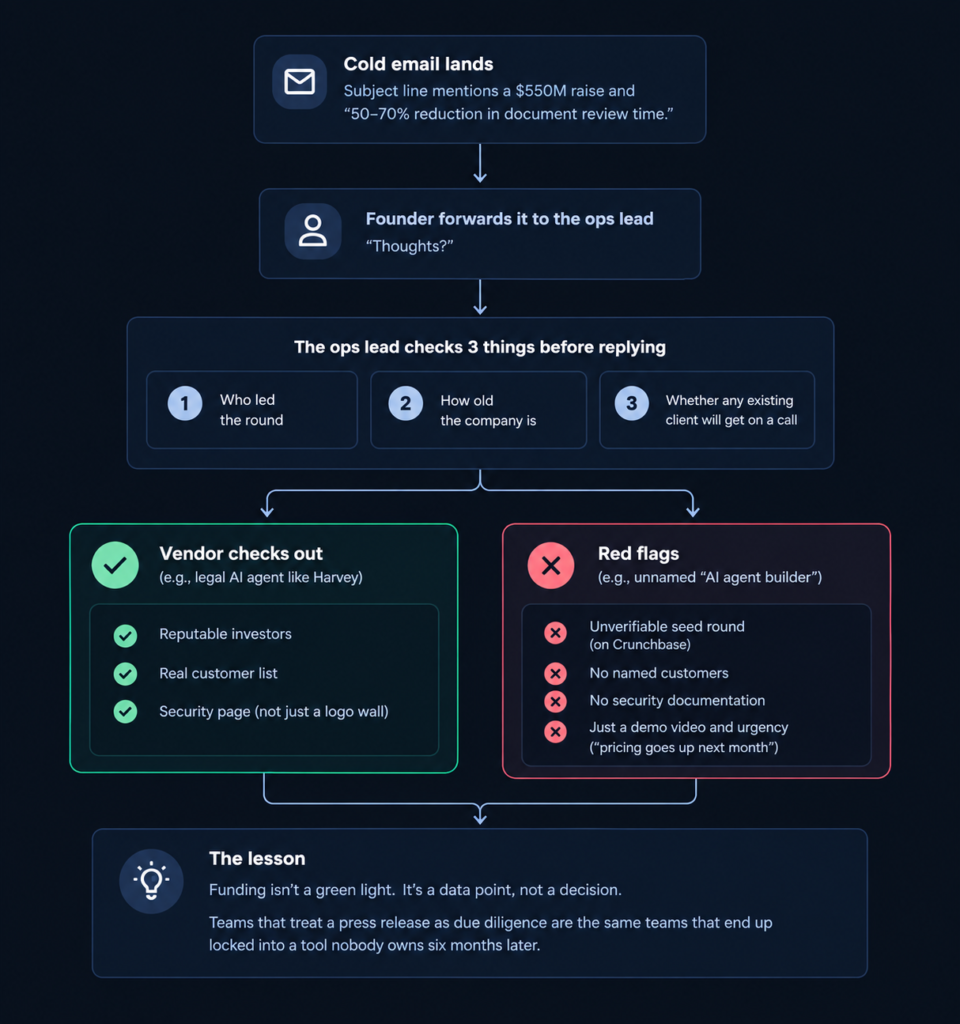
Most founders misread funding headlines. They see $550M raised and conclude that the product it surrounds must be good. It could be. But it could also be betting on the market opportunity and not its ability to produce a functioning tool for end-users.
AI agent platform startup funding 2026 has been talked about a lot. $1.32B has been raised in Q3 alone and the checks are getting bigger, not smaller. That doesn’t give you reason to buy faster. That gives you reason to ask smarter questions before you sign a contract with a company that raised money six weeks ago and have never touched your workflow.
This isn’t a funding roundup for investors. It’s a buyer’s guide for founders who are about to be pitched an “agent platform” and need a quick way to differentiate the ones worth trusting from the ones riding the wave.
What AI agent funding actually looks like operationally
AI agent funding by the numbers: Q3 2026 snapshot
Q3 2026 has seen 20 revealed AI agent financing rounds totaling $1.32B, and August alone generated $681.5M in only seven deals.
The concentration story:
- July 2026: 13 rounds, $643M total, $49M average check
- August 2026: 7 rounds, $681.5M total, $97M average check
- Average check size doubled in a single month
Year-over-year comparison:
- H1 2025: $538M raised by agentic AI startups
- H1 2026: over $1B raised, nearly double
- Q2 2026: 39 deals, $1.30B raised, the busiest quarter on record
From Q2 2025 to Q2 2026, there have been 101 revealed agentic AI financing rounds, summing up to $4.69B, with vertical AI agents alone pulling in $3.038B or 82.64% of all capital.
Why it matters: the investors are not risking their money on multiple categories, but rather investing heavily into areas that have a proven path to revenue, which highlights the most promising tools and the ones that appear to be overhyped.
The biggest AI agent platform funding rounds in 2026
Five rounds define AI agent platform startup funding 2026 so far. Each figure below links to the company’s own announcement plus independent reporting.
Factory: $200M, $5B valuation (Sept 2026)
AI coding agents (“Droids”) for enterprise engineering teams, backed by Blackstone, Khosla Ventures, Sequoia, and others. Valuation tripled from $1.5B in five months. Factory’s announcement | WOWTALE
Temporal: $550M Series E, $12.55B valuation (Sept 2026)
Workflow orchestration that keeps AI agents running reliably at scale, co-led by Lightspeed, Wellington, and Goldman Sachs Alternatives. The “picks and shovels” layer every agent deployment eventually needs. Temporal’s blog | GeekWire. Comparing infrastructure options? See Langchain vs Airbyte vs Modal vs Watsonx.
Harvey: $550M, $15.5B valuation (Sept 2026)
Legal workflow agents for document review and research, co-led by Diffusion and Lightspeed, with Sequoia and a16z also in. Harvey’s blog | TechCrunch. Already using contract review software? Watch this category for overlap.
Clay: $115M Series D, $7.1B valuation (Sept 2026)
Sales prospecting and AI research agents for GTM teams, led by Wellington, valuation more than doubled in 13 months. Clay’s funding page | BetaKit
AIR Security: $50M seed (Sept 2026)
Inline firewall vetting skills, plugins, and MCP servers, co-led by Sequoia and Greenoaks. Part of the $435M security-funding wave since April. Newswire launch | SecurityWeek
Wrong approach vs right approach
| Wrong approach | Right approach |
|---|---|
| Buy the vendor with the biggest headline | Buy the vendor that fixes a workflow you can name |
| Treat a funding round as proof of reliability | Treat a funding round as one data point among several |
| Stack more agent tools onto a broken process | Fix the process, then automate what’s left |
| Sign based on a demo | Sign based on a reference call with an existing customer |
Five tools worth actually looking at
These aren’t generic recommendations. Each one solves a specific operational problem, and each has a real limitation you should know before you buy (see the pricing and fit breakdown in the table below).
1. Factory: enterprise coding agents
The tool is built around the concept of “Droids”, autonomous agents that plan, construct, test and release code under human supervision. The tool was found to provide significant gains in velocity, but only for projects with a clean code base and review process. It will not improve fundamentally the state of a chaotic repository.
Factory
Factory is an agent-native software development platform built around autonomous coding agents called Droids. It helps engineering teams generate, test, review, document, migrate, and maintain software while giving enterprises controls for security, permissions, deployment, and governance.
2. Harvey: legal workflow agents
Covers legal research, drafting, document analysis and due diligence for law firms and legal departments. Strong ROI proposition for large firms, but would expect a sales-led approach, rather than self-service.

Harvey
Harvey is an AI platform built specifically for legal and professional-services teams. Its agents can research, analyze, draft, review, and execute complex legal workflows while returning cited, review-ready work products.
3. Clay: sales automation agents
Unifies lead prospecting, data enrichment, and AI research agents to your CRM. It will accelerate processes that already have a good sales methodology, it will not create one. Teams that lack proper data in their CRM will only automate poor targeting decisions.

Clay
Clay is a data enrichment and AI workflow platform that helps businesses automate lead generation, prospect research, and outbound personalization. It combines data providers, workflow automation, and AI research into one prospecting workspace.
4. Temporal: agent orchestration infrastructure
Handles retries, state, and recovery so agent processes don’t silently fail mid-run. It’s infrastructure, not a plug-and-play product. Skip it unless you have engineers who’ll own it.
Temporal
Temporal is a workflow orchestration platform that helps developers build reliable distributed applications without managing complex failure handling logic. It simplifies long-running processes, microservices coordination, and business-critical automation at scale.
5. AIR Security: inline firewall for AI agents
Discovers and validates every skill; plugin; and MCP server used by your agents. Seed-stage as of September 2026: an auspicious sign for a nascent standard, not yet fully baked.

AIR Security
AIR Security is an AI-agent security platform that sits between agents and external inputs. It analyzes skills, MCPs, plugins, sub-agents, websites, and internal data to detect and filter threats before they reach an agent's context or become runtime actions.
Operator opinion: Adoption speed ranges from “plug in this week” (Clay, Factory) to “plan a quarter” (Temporal, enterprise Harvey). None of them fix a workflow that doesn’t already have an owner. If you’re still deciding what your actual automation gaps are, start with a free AI automation tools audit rather than a paid platform.
| Tool | What it does | Official pricing | Best for | Avoid if |
|---|---|---|---|---|
| Factory (factory.ai) | Autonomous coding agents (“Droids”) for planning, building, testing, and shipping code | $40/mo Standard, $200/mo Pro, custom Enterprise | Engineering teams with clean CI/CD discipline | Your codebase and review process are already messy |
| Harvey (harvey.ai) | Legal research, drafting, document review, and due diligence for law firms and legal teams | No public rate, enterprise sales only | Law firms and legal departments with high review volume | You’re a small business wanting self-serve pricing |
| Clay (clay.com) | Sales prospecting, data enrichment, and AI research agents synced to your CRM | Free, $149/mo Starter, $349/mo Explorer, $800/mo Pro, custom Enterprise | Sales teams with a defined ICP and clean CRM data | Your CRM data is messy or your ICP isn’t defined yet |
| Temporal (temporal.io) | Durable workflow orchestration so agent processes don’t silently fail at scale | Free open source, $100/mo min Cloud Essentials, $500/mo min Business, custom Enterprise | Engineering teams building custom agent workflows | You have no engineers to own the infrastructure |
| AIR Security (AWS Marketplace listing) | Inline firewall that vets skills, plugins, and MCP servers agents rely on | Enterprise-only, annual per-unit contract | Companies running agents against production data | You need a mature, long-track-record vendor today |
Where the money is actually going: five funding trends
1. Vertical AI agents dominate: 82.64% of capital Industry-specific agents (legal, sales, security) are getting funded over general-purpose “AI agent platforms.” Investors prefer them because t’s easier to justify the ROI and the sales cycle is shorter.
2. Infrastructure and “picks and shovels” are surging Temporal, Composio, and smaller infrastructure plays are capturing capital because every company running agents at scale eventually needs orchestration, not just a chat interface.
3. Security funding hit $435M in five months AIR Security, Comp AI, and HelmGuard all raised rounds tied to one demand: enterprises won’t deploy agents without audit logs and access controls.
4. Average check sizes are doubling: concentration, not democratization The jump from $49M to $97M average checks in a single month means capital is going to fewer winners, not more startups.
5. Chip-aligned investors are becoming quiet power players Strategic investors with GPU supply chains have a reason to back agent companies beyond returns. It drives demand for their own hardware.
Pause and think: if a vendor’s biggest selling point is the size of their last round, and not a specific number tied to your industry, that’s worth noticing before you sign anything.
Should you sign with this vendor? A 60-second decision flow
          A new "AI agent platform" pitch lands on your desk
                               |
                               v
          Can you name the exact workflow this tool
                   is supposed to fix?
               |                          |
              NO                         YES
               |                          |
               v                          v
      STOP.                    Is it funded in the last
      Don't buy yet.           18 months, with a named
                                reference customer?
                                 |                |
                                NO               YES
                                 |                |
                                 v                v
                          RED FLAG.        Does it have real
                          Walk away.       access controls +
                                            audit logging?
                                             |            |
                                            NO           YES
                                             |            |
                                             v            v
                                      RED FLAG.     Who owns this
                                      Walk away.    tool after
                                                     week one?
                                                      |        |
                                                 Nobody      Named
                                                 yet          owner
                                                      |        |
                                                      v        v
                                                STOP. Fix   GREEN LIGHT.
                                                ownership   Sign the
                                                gap first.  deal.
Skipping this flow is how founders end up burned. It’s the same pattern that shows up whenever a hyped AI product turns out to be thinner than the pitch, worth remembering the lesson from what actually happened to Articoolo, a funded AI company that didn’t survive its own hype cycle. It’s also why claims worth double-checking, like the ones behind whether Cliptalk is real and what it actually does, deserve the same scrutiny before you hand over a contract.
Business autopsy: the agency that automated the wrong layer
A 15-person marketing agency signed a six-figure annual contract with a newly funded “AI agent platform” promising to automate client reporting end to end.
What failed: three months in, reports were still going out late. The agents pulled data fine, but nobody had assigned a single owner to review outputs before they reached clients, so errors sat unnoticed for days.
Why it failed: the agency bought the tool to skip a broken review process instead of fixing it first. The vendor’s funding and demo were both legitimate. The workflow underneath was not.
What should have changed: define who owns quality control before automating the step that used to force a human to check the work. The agent didn’t create the problem. It just removed the accidental safety net a slow manual process used to provide.
FAQ: AI agent platform startup funding 2026
Not on its own. Runway matters more than round size. A $97M average check with high burn can still leave a company with under 18 months of runway if engineering and GPU costs are heavy.
No, a company can be pre-seed or bootstrapped and still be the right fit for a narrow workflow. Treat recent funding as one signal of momentum, not a requirement.
Vertical agents are built around one industry’s specific data, compliance rules, and workflow steps (legal review, sales prospecting). Horizontal platforms offer general agent-building tools you configure yourself, which usually means more setup work and less out-of-the-box ROI.
Most of the case studies above (Factory, Harvey, Clay) cite results after a full quarter of use, not week one. If a vendor promises measurable ROI inside the first two weeks, ask exactly what’s being measured.
No. Tools like this reduce risk from agent behavior, but your team still needs internal policies on what data agents can touch in the first place.
The bottom line: what’s next for AI agent funding
Expect AI agent platform startup funding 2026 to concentrate further into Q4. The top 10-20 companies will likely keep capturing the bulk of new capital, vertical agents will push past 90% of funding share, and security features will move from “nice to have” to a baseline requirement in enterprise deals.
None of that changes what a founder actually needs to do this week: stop asking “is this company well-funded” and start asking “do I know exactly which broken process this tool is supposed to fix, and who owns it after launch.”
The way businesses evaluate AI vendors will need to change faster than the vendors themselves do. What’s your process for finding that out before you sign?
Your next move
Pick one AI agent tool you’re currently considering, or already paying for, and answer one question in the next 10 minutes: who, by name, owns this workflow once the agent is live? If you can’t answer that, that’s the gap to close before the next contract renewal.
